What Makes a Planet a Gas Giant?
Jupiter and Saturn earned the name through their hydrogen-helium bulk, while Uranus and Neptune quietly moved into a category of their own.

- Published
- ◷
- 6 min read
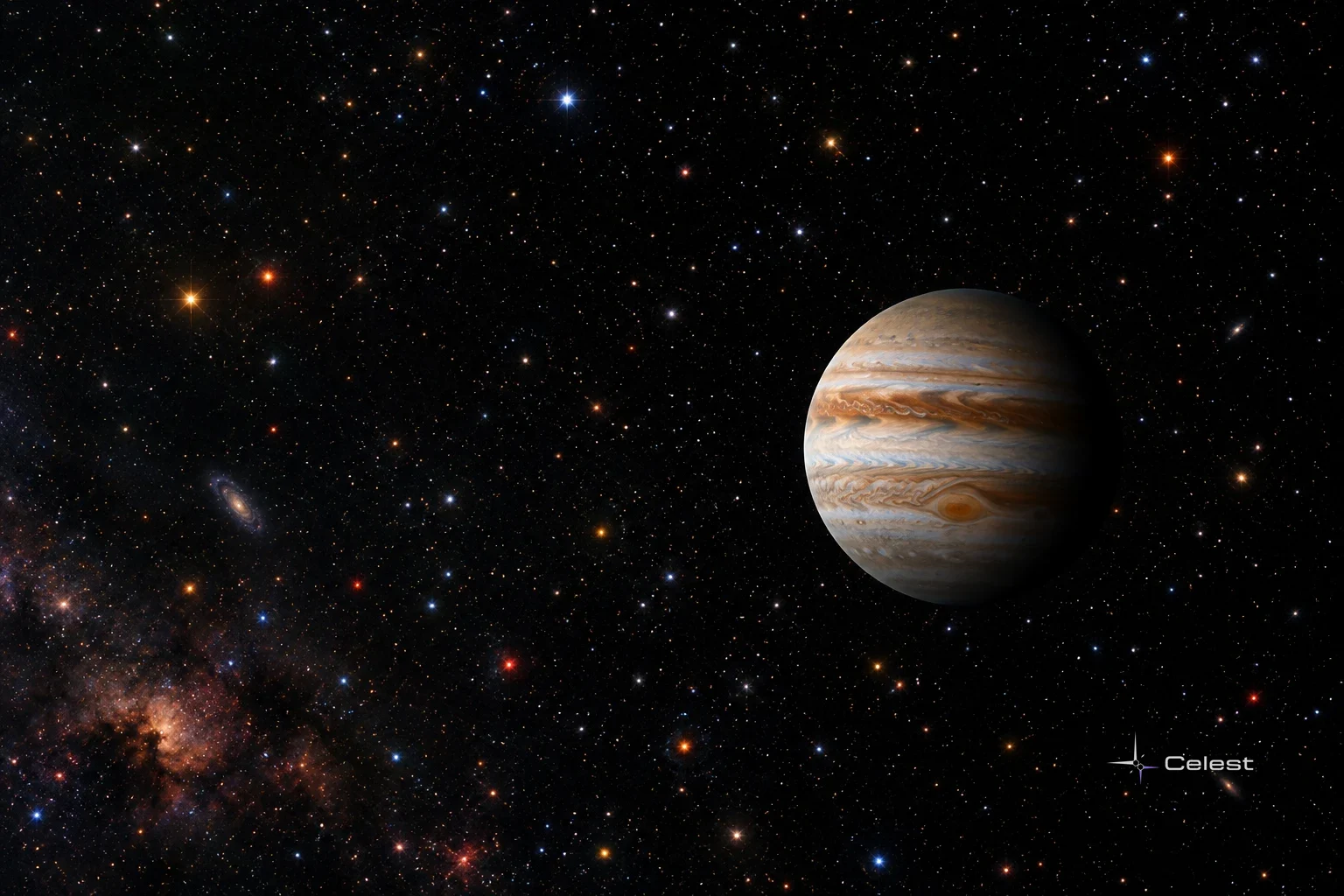
A gas giant is a giant planet built mainly from hydrogen and helium — the same two elements that make up most of the Sun. In the Solar System, that fits Jupiter and Saturn.
Uranus and Neptune look similar from a distance, but they're usually kept in a separate group, ice giants, because most of their mass comes from heavier compounds rather than hydrogen and helium. The label depends on what a planet is mostly made of, not just how big it looks.
How giant planets grow
Gas giants don't start big. They begin as small rocky-icy cores that snowball into monsters through a process called core accretion — a bottom-up scheme where small objects merge into bigger ones until one clears out enough gas from its surrounding disk to become a giant.
- A thin atmosphere begins — once a body grows to roughly the size of the Moon, it can hold a wispy first envelope of gas.
- The atmosphere thickens — as the body approaches the size of Mars, that envelope grows denser and hot enough to support a liquid ocean.
- The ocean boils away — beyond that mass, the ocean turns to steam, leaving a dense mix of steam, hydrogen and helium wrapped around the core.
- Runaway gas capture — once the core reaches a few times Earth's mass, its atmosphere grows faster than the solid planet beneath it, snowballing into a full gas giant.
That growth still has to happen fast. Gas disks around young stars usually disperse within one to ten million years, so a core has to reach the runaway stage before its raw material runs out.
Building a core the slow way, one planetesimal at a time, is estimated to take Earth at least 30 million years — too slow for a gas giant on its own.
One proposed fix has the growing planet sweep up icy pebbles roughly 30 centimeters across instead of full-size planetesimals.
Gas drag lets those pebbles spiral onto a young planet fast enough to build a giant's core in as little as a few thousand years, and tuned versions of that model tend to produce one to four gas giants a few astronomical units out — a reasonable match for the two gas giants and two ice giants actually found here.
For more on how planets take shape, Celest's astronomy guides cover the basics of planet formation.
According to a 2025 Ohio State University study led by Ji Wang, gas giants around other stars may form faster than once thought — closer to one to two million years rather than the three to five million years previously assumed, based on how much heavy material young giant planets managed to pack in before their birth clouds dispersed.
Why 'gas giant' is a bit of a misnomer
Science fiction writer James Blish coined the term "gas giant" in 1952, and it stuck even though it's not entirely accurate. Through nearly all of a giant planet's interior, pressure is so extreme that hydrogen and helium aren't gaseous at all — they're compressed past the point where liquid and gas even mean different things.
Planetary scientists still use "gas," "ice" and "rock" as shorthand, but the words describe categories of material, not the actual physical state matter is in. In that system, hydrogen and helium count as "gas"; water, methane and ammonia count as "ice"; silicates and metals count as "rock" — regardless of how squeezed they get.
Jupiter and Saturn are roughly 87 to 97 percent hydrogen and helium by mass, with heavier elements making up the remaining 3 to 13 percent. Below the visible clouds sits a deep atmosphere of molecular hydrogen, compressing into a layer of liquid metallic hydrogen that wraps a molten rocky core near 20,000 K (about 35,500 °F).
The outer clouds are mostly water and ammonia, and theorists sort giant-planet atmospheres into five classes by what condenses there. Jupiter and Saturn both fall into the coolest class, with ammonia clouds; scorching exoplanets called hot Jupiters land in the alkali-metal or silicate-cloud classes instead.
Gas giants vs ice giants
Uranus and Neptune aren't small versions of Jupiter and Saturn — they're built from different material. They hold onto some hydrogen and helium, but most of their mass comes from heavier volatiles such as water, methane and ammonia, compressed into forms planetary scientists still call "ice."
Starting in the 1970s and continuing through the 1980s, that difference earned them their own class: ice giants.
The composition split shows up in the weather, too. On Jupiter and Saturn, interior heat vents upward through towering storms that spin into long-lived systems such as Jupiter's Great Red Spot, an anticyclone whipping around at 430 to 680 kilometers per hour.
On Saturn, helium that won't mix with liquid metallic hydrogen falls as rain, a process thought to explain some of the extra heat the planet gives off.
Jupiter and Saturn's early growth and migration are thought to have shoved Mercury out of its original orbit and stunted Mars's growth, keeping it far smaller than Earth or Venus. Their final spacing, alongside the ice giants, is explained by what's called the grand tack hypothesis.
Where planets stop being planets
Gas giants beyond the Solar System come in a wide range of sizes. Cold gas giants heavier than Jupiter, up to about 500 Earth masses (1.6 Jupiter masses), barely grow bigger. Past that point gravity starts crushing the planet smaller rather than larger, so the biggest gas giants aren't much wider than Jupiter itself.
At the small end sit gas dwarfs: rocky cores wrapped in a modest hydrogen-helium envelope, with total radii between about 1.7 and 3.9 Earth radii. Kepler-138d, with roughly Earth's mass but 60 percent more volume, is thought to be one of the smallest planets that fits this category.
At the massive end, the line blurs into brown dwarfs, objects that can weigh as little as 13 Jupiter masses.
Exactly where a gas giant ends and a brown dwarf begins is still debated — one definition follows how the object formed, another looks only at its interior physics, and part of the argument turns on whether a brown dwarf must have undergone nuclear fusion at some point.
See it for yourself
This article doesn't carry a current schedule for when Jupiter and Saturn are best placed in the sky, since that shifts from month to month. Check Celest's night sky guide to see what's visible from a given location, or open the live sky map to get oriented and find both planets among the stars.
Sources
The facts in this article are based on the sources below. How we work: editorial policy.
- Gas giant - Wikipedia — wikipedia.org
- Steam Worlds: The Mystery of How Gas Giants Form | Carnegie Science — carnegiescience.edu
- Astronomer finds gas giant exoplanets formed earlier than previously thought — osu.edu
- Building the Gas Giants | Centauri Dreams — centauri-dreams.org
Leave a comment
Comments appear after moderation.