Is Nibiru Real? What the Ancient Name Actually Means
Ancient Babylon really did have a word for Nibiru — it just never meant a planet on a collision course with Earth.

- Published
- ◷
- 5 min read
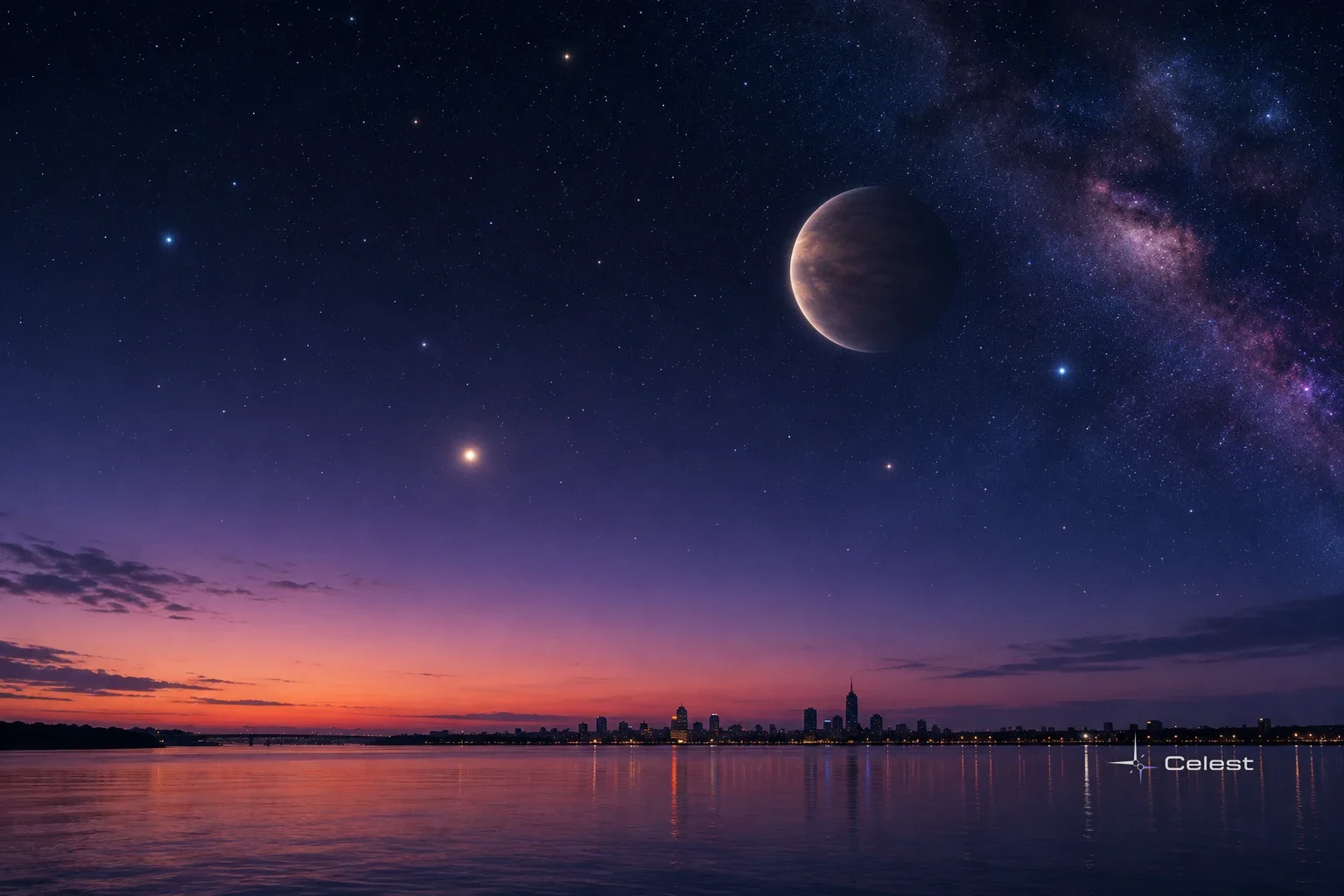
Nibiru is a real word from ancient Babylon, but the planet supposedly bearing down on Earth is a modern invention with no scientific evidence behind it. The ancient term described a point in the sky tied to a crossing or transition, not a rogue world on a collision course.
No credible evidence supports a hidden planet called Nibiru approaching Earth, and nothing visible in the night sky since 2012 has changed that.
How it works
Nibiru, also spelled Neberu or Nebiru, comes from Akkadian and translates roughly to "crossing" or "point of transition," especially the crossing of rivers. Scholars still argue over which astronomical crossing the ancient texts actually meant.
In Babylonian cosmology, Nibiru was the seat of a supreme god who shepherds the stars like sheep, a role tied to Marduk. The Enûma Eliš, an ancient creation poem, has Marduk fixing the positions of Nibiru, Enlil and Ea in the sky and calling Nibiru his own star.
A 2015 cuneiform study published in the Cuneiform Digital Library Bulletin concluded the name may have marked any visible object lining up with an equinox. Other researchers have linked Tablet 5's reference to Jupiter, or even to a fixed pole star like Thuban.
Nobody has settled which object the ancients actually meant, and that ambiguity is worth keeping rather than smoothing over.
The modern doomsday version has a shorter, better-documented history:
- 1976: Author Zecharia Sitchin publishes "The Twelfth Planet," claiming his own translation of Sumerian tablets reveals a planet Nibiru orbiting the Sun every 3,600 years.
- Soon after: Self-described psychic Nancy Lieder says aliens warned her this planet would strike Earth in 2003.
- 2003 to 2012: When 2003 passes without incident, the date shifts to 2012, tied to the end of the Mayan long-count calendar.
- 2011: Comet Elenin's appearance feeds the panic, with some claiming it's Nibiru in disguise.
- December 2012: Earth reaches the deadline with no impact, and the story loses its date.
Each stage borrowed just enough real astronomy — ancient names, comet sightings, calendar milestones — to sound credible without any of it pointing to an actual approaching planet.
Why the doomsday mechanism fails
A planet swinging past the Sun every 3,600 years on a wildly elongated orbit wouldn't survive quietly for 4.5 billion years. Every close pass would tug at the other planets, and their gravity would tug back, changing that orbit within just a few trips around the Sun.
Orbital mechanics backs this up. Kepler's third law ties a planet's orbital period to its distance from the Sun in a fixed, predictable ratio — the kind of clockwork regularity that doesn't survive a wrecking ball crashing through every few thousand years, as the Vatican Observatory has pointed out.
There's also a visibility problem. A planet due to hit Earth in 2012 should have been bright enough to see with the naked eye well before then. By April 2012, calculations showed it would have outshone the faintest stars visible from a city and nearly matched Mars at its dimmest.
Believers pointed to a 1984 paper describing unexplained infrared sources as proof something big was out there. The 1985 follow-up identified most of those sources as distant galaxies. None turned out to be planets.
A common misconception
The most persistent version of this myth assumes NASA is hiding a planet only the government can see. That doesn't match how astronomy actually works.
NASA issued a public statement rejecting the 2012 doomsday claim outright. Hundreds of thousands of amateur astronomers around the world own telescopes capable of finding a bright, nearby planet on their own, and most professional astronomers work at private universities rather than government agencies.
Astronomer David Morrison noted in 2012 that government agencies mostly get their information from these independent observers, not the other way around. A cover-up would require silencing an enormous, scattered community, not one agency.
Comet Elenin fed the confusion partly because people didn't distinguish comets from planets. A comet carries a coma, a temporary gas atmosphere, and often a tail; a planet has neither.
Elenin actually broke apart after passing too close to the Sun, and its fragments are still drifting toward the outer solar system on a journey expected to take roughly 12,000 years.
Nibiru vs. Planet Nine
A genuinely open question in astronomy today involves a different hypothetical world, sometimes still called Planet X. Researchers including Mike Brown, Konstantin Batygin, Scott Sheppard and Chad Trujillo noticed that small objects beyond Neptune cluster together in a way that's hard to explain by chance.
The best explanation so far, in their view, is an unseen "perturber" far from the Sun — nicknamed Planet Nine because it would effectively replace Pluto, demoted from planet status by the International Astronomical Union in 2006. Estimates suggest it could be about 10 times Earth's mass and orbit roughly 600 times farther from the Sun than Earth does, on average.
That's nothing like the Nibiru story. Planet Nine, if it exists, sits quietly and slowly far beyond Neptune. It isn't due to swing past Earth on any timeline, doomsday or otherwise. Check Celest's visible planets guide to see what's actually out there tonight.
See it for yourself
Nothing in the night sky argues for a hidden wrecking-ball planet. The opposite, really.
The stars, planets and constellations visible tonight are largely the same ones described roughly 2,300 years ago in the poem "The Phenomena" by Aratus. Next time Taurus the Bull climbs into view, look for the tight cluster of stars at its shoulder — the Pleiades, sitting right where Aratus placed it inside the Bull's outline.
That kind of long-term stability is exactly what orbital mechanics predicts, and exactly what a rogue planet crashing through the solar system every few millennia would ruin. Use Celest's constellation guide to find Taurus and the Pleiades for yourself.
Sources
The facts in this article are based on the sources below. How we work: editorial policy.
- Nibiru: The Nonexistent Planet — space.com
- Nibiru - Crystalinks — colorado.edu
- Nibiru (Babylonian astronomy) — wikipedia.org
- The Earth-Destroying Planet Nibiru! (and Johannes Kepler) — vaticanobservatory.org
Leave a comment
Comments appear after moderation.