How Far Is Mars From Earth, Really?
The gap between Earth and Mars keeps changing. Here's the orbital reason why, the real range of distances, and what a close approach actually means.

- Published
- ◷
- 4 min read
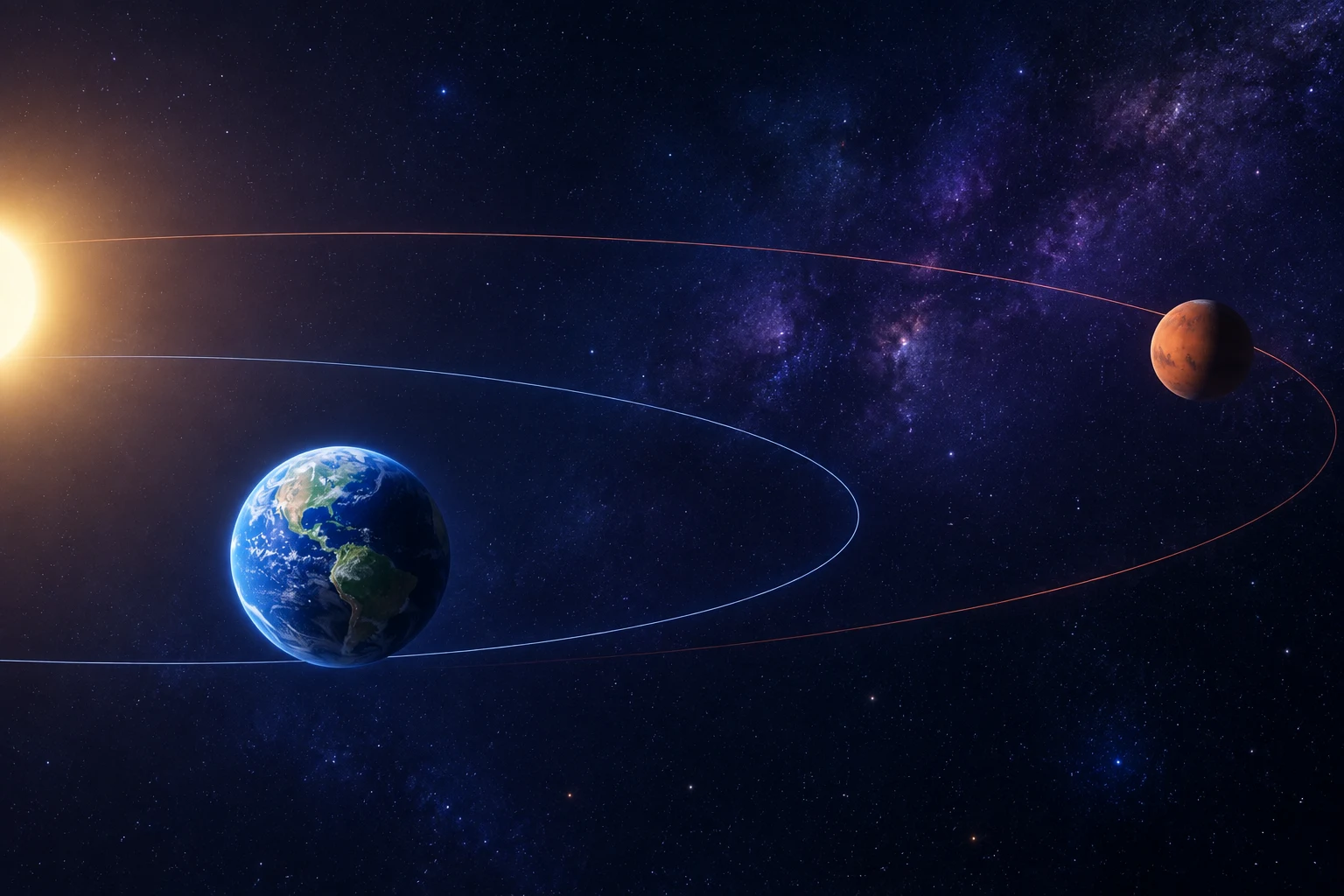
Mars is never a fixed distance from Earth. On average the two planets sit about 140 million miles (225 million km) apart, but the true distance swings between roughly 33.9 million miles (54.6 million km) at its closest theoretical point and 250 million miles (401 million km) at its farthest.
What you get on any given night depends on where each planet happens to be in its orbit — the night sky guide shows what's currently visible from your location.
That range exists because Earth and Mars don't move in lockstep. Earth is the third planet out from the Sun, and Mars orbits one step farther still. Checking the astronomy calendar is the only way to know where Mars actually stands relative to Earth on a given date.
How it works
The changing gap comes down to a simple chain of cause and effect, playing out over years rather than days.
- Both planets orbit the Sun, but on different paths — Earth's is the inner, tighter loop.
- Earth moves faster. It completes one orbit in 365.25 days, while Mars takes about 687 Earth days (686.98 days, or 668.60 Martian sols) to do the same.
- Their relative positions constantly shift because of that mismatched speed, so Earth keeps lapping Mars from the inside track.
- When Mars, Earth and the Sun line up, with both planets on the same side of the Sun, that's called opposition — the two worlds are about as close as they'll get for that cycle.
- When they're on opposite sides of the Sun, or near their farthest orbital points, the distance stretches out toward the maximum.
Add one more wrinkle: neither orbit is a perfect circle, and they're slightly tilted relative to each other. If both were circular and aligned, every close approach would measure the same. They don't, so no two approaches are quite identical.
The one-fixed-distance myth
It's tempting to treat 140 million miles as "the" distance to Mars, the way people say the Moon is 384,000 km away. But that number is only an average pulled from a constantly shifting range.
Even the close approaches, which happen roughly every 26 months when Earth overtakes Mars on the inside track, aren't all the same. A typical close approach puts the planets around 38.6 million miles (62.07 million km) apart.
The closest one ever recorded happened in August 2003, at 34.8 million miles — closer than the usual pattern, though not the absolute theoretical floor.
That floor, 33.9 million miles (54.6 million km), would require Mars at perihelion (its closest point to the Sun) while Earth sits at aphelion (its farthest point) at the exact same moment. It's never happened in recorded history.
Neither has the opposite extreme: both planets at aphelion on opposite sides of the Sun, which would push the separation out to 250 million miles (401 million km).
Closest and farthest: the numbers compared
Lining up the extremes side by side makes the pattern easier to hold onto:
- Typical close approach: about 38.6 million miles (62.07 million km), occurring roughly every 26 months.
- Closest ever recorded: 34.8 million miles, in August 2003.
- Theoretical minimum: 33.9 million miles (54.6 million km) — never actually reached.
- Theoretical maximum: 250 million miles (401 million km) — also never actually reached.
This is also why Mars missions don't have one standard flight time. Many spacecraft take around seven months to arrive, but the exact duration depends on how far apart the planets are when the mission launches.
The distance question isn't new, either. In September and October 1672, Mars and Earth were in opposition, and astronomer John Flamsteed predicted Mars would pass in front of a star in Aquarius that October.
Giovanni Cassini used that opposition to measure the gap: he sent Jean Richer to Cayenne in French Guiana, about 7,089 km from Paris, while he and Jean Picard observed from the Paris Observatory.
Comparing Mars's apparent position from both locations — a technique called parallax — let them estimate the Earth-Mars distance within roughly 7% of today's calculated value, and from there, using Kepler's Third Law, estimate the Earth-Sun distance itself.
That 17th-century measurement still holds up remarkably well against the modern figure, calculated from a parallax angle of 9.5 arcseconds versus today's precise 8.794143 arcseconds.
See it for yourself
During an opposition, Mars, Earth and the Sun form a straight line with both planets on the same side, and Mars sits closer and brighter than usual — one of the better windows for spotting it with the naked eye.
Check the visible planets page to see whether Mars is currently well placed from your location, and use the observing conditions page to check for clear skies before heading out.
Mars won't look like a disk without a telescope, but its reddish color stands out clearly once you know where to look — and that color is the same reason ancient observers linked it to war and fire long before anyone measured the distance to it at all.
Sources
The facts in this article are based on the sources below. How we work: editorial policy.
- Distance from Earth to Mars | Facts & Measurement — study.com
- The Geography of Mars — csulb.edu
Leave a comment
Comments appear after moderation.