Pollux: Gemini’s Orange Giant and Its Planet Signal
Gemini’s two bright heads look paired, but Pollux and Castor have different distances and histories. Pollux is an evolved giant whose changing light also carries evidence of an unseen planet.

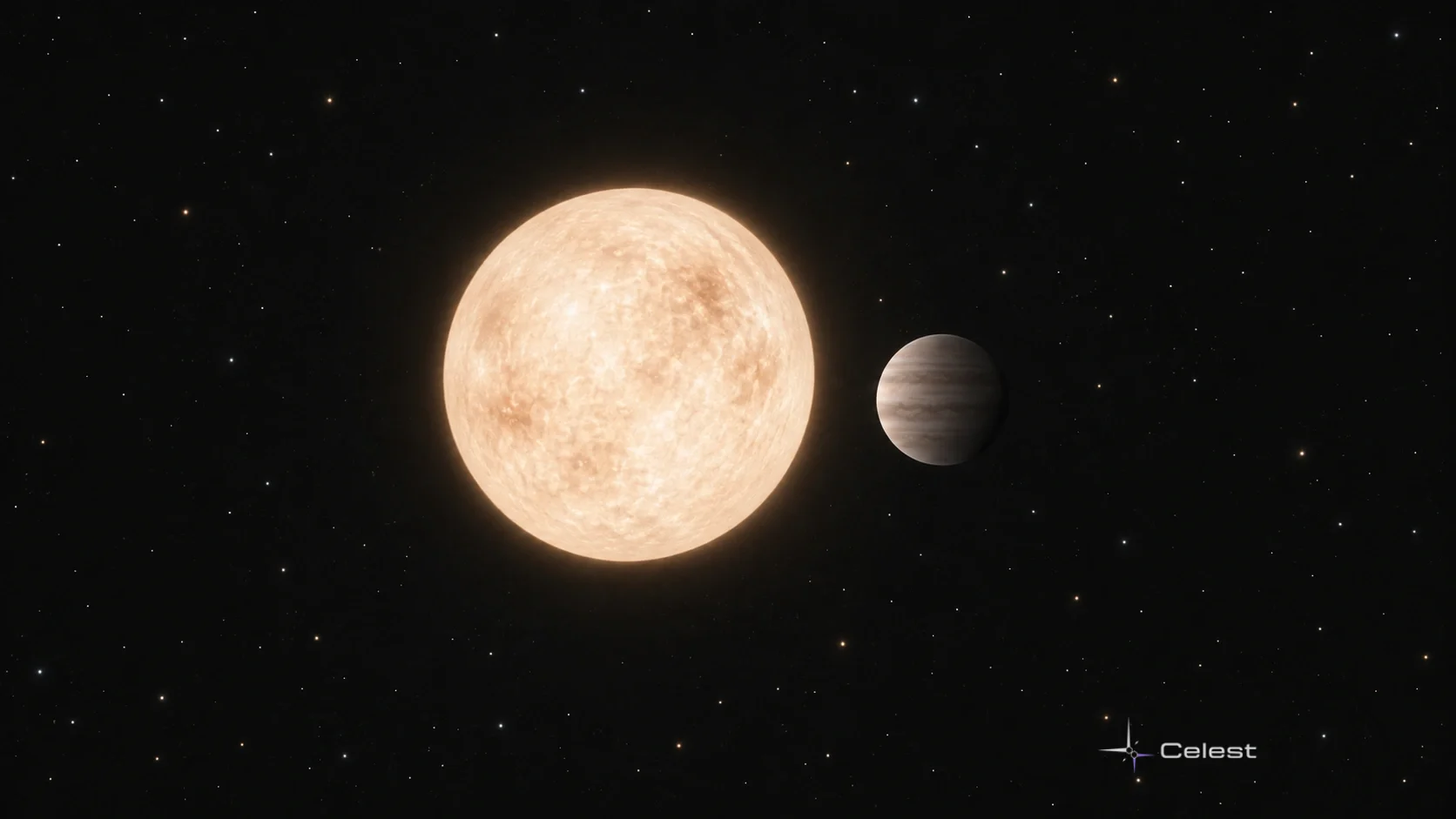
Pollux is the brighter of Gemini’s two prominent heads, with a warm orange colour beside bluer-white Castor. It is an evolved giant, about 34 light-years away. Compare the pair with neighbouring landmarks in the bright-star guide.
You can find the Twins by working outward from Orion. Use the live sky map to match the orientation for your evening, then identify both head stars. Their neat pairing helps you recognise Gemini, but the stars are not physically bound to each other.
Pollux at a Glance
The familiar orange point carries several different kinds of evidence.
- Other names: Beta Geminorum, or HD 62509.
- Constellation: Gemini, the Twins.
- Distance: roughly 34 light-years.
- Star type: an evolved K-type giant.
- Scale: roughly two solar masses and nine solar radii.
- Planet signal: a roughly 590-day orbit listed in the current NASA catalogue.
The Twins Do Not Share One Stellar History
Pollux and Castor mark the heads of the twin figures in the constellation. The relationship belongs to the sky drawing and its mythology. Castor lies roughly 51 light-years away, considerably farther than Pollux, and is a six-star system rather than a single orange giant.
The difference is visible before you learn the numbers. Compare their colours and brightness: Pollux is the brighter, warmer-coloured member. Looking similar in prominence or close in angle does not make stars similar in physical structure.
An Expanded Star, Rather Than a Larger Sun
A giant has moved beyond the long stage of hydrogen fusion in its core and expanded as its internal structure changed. Pollux is therefore useful for seeing what stellar evolution means: a star’s current appearance reflects an earlier history, not just the amount of material it started with.
Its approximate mass is twice the Sun’s, while its radius is about nine times greater. Mass and radius measure different things. You should not read “twice as massive” as a statement that the visible star is only twice as wide.
The K-type giant classification also differs from the red-supergiant category of Betelgeuse. Both descriptions concern evolved stars, but they do not imply the same dimensions or future. There is no need to imagine Pollux’s modest orange point as an imminent stellar explosion.
A Planet Revealed Through the Star’s Motion
Pollux b, also catalogued as HD 62509 b, is listed as a confirmed gas-giant planet in the current NASA Exoplanet Archive. Its discovery was announced in 2006. The adopted solution gives an orbit of about 590 days, or roughly 1.6 years.
The detection comes from radial velocity: the motion of the star toward or away from us. That motion shifts the positions of lines in its spectrum. A planet’s gravitational pull can make those shifts repeat, allowing astronomers to infer an unseen companion.
This method is not a photograph of the planet. The discovery analysis combined more than 25 years of stellar measurements and tested other possible causes of the repeating signal. It found no corresponding significant changes in the activity, line-shape and brightness diagnostics used in that study.
Its often-quoted mass of about 2.3 Jupiters is a minimum estimate. The orbit’s unknown viewing angle affects how much motion we measure, and the calculation also depends on the adopted stellar properties. It is a lower bound on mass, not a directly measured diameter.
Why the Magnetic Field Still Matters
Pollux has a weak magnetic field, detected through precise measurements of polarised light. Stellar surface activity can influence spectral lines, so measuring that field is relevant to interpreting a planet signal, even when the star looks steady to your eyes.
A 2021 follow-up estimated a rotation period near 660 days, compared with the roughly 590-day velocity cycle. The authors retained two possibilities: separate periods supporting the planet interpretation, or matching periods that might allow stellar activity to explain the signal.
The current catalogue still lists the planet as confirmed. The scientific caveat concerns how confidently the measured motion can be separated from the star’s own activity. It does not turn the ordinary orange point into something you can diagnose by watching for a visible wobble.
Compare the Two Heads of Gemini
Find Orion first, then follow the approximate route from Rigel toward Betelgeuse and onward to Gemini on your chart. Pollux and Castor stand out together above the Twins’ longer figures. The evening pattern is most prominent in northern winter and southern summer.
Try comparing them without equipment, then use binoculars to explore the wider constellation. M35 near the foot of the Castor figure offers a different kind of object: a real star cluster. Check observing conditions if you want to extend the session to those fainter stars.
An Ordinary Landmark Can Carry a Complex Signal
You can recognise Pollux with your eyes while its measurements test much subtler questions. Its expanded structure, magnetic field and possible influence from a planet are recorded in the same light. Separating those effects is part of learning what surrounds an evolved star.
The two heads of Gemini make a useful first comparison precisely because their appearance is simple. One sky drawing can lead you to a giant with a catalogued planet and a farther six-star system, rather than two matching stellar twins.
Leave a comment
Comments appear after moderation.