Saturn: A Giant Planet With Rings of Ice and Rock
The sixth planet is far more than a ringed globe. Its moving ice particles, unusual moons and thick atmosphere form a system that changes how you look at a familiar planetary image.

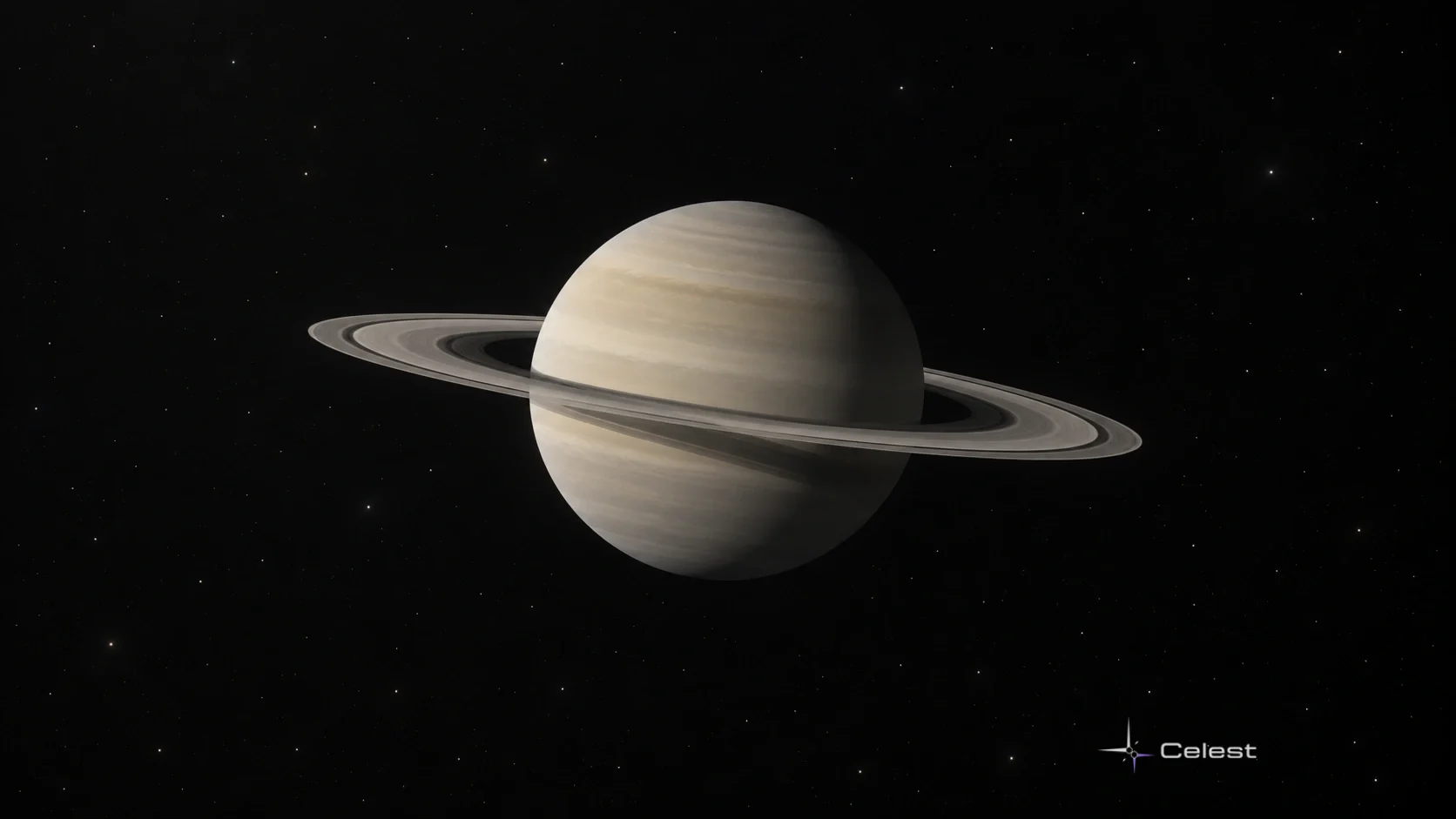
Saturn is a giant of hydrogen and helium, surrounded by broad rings of mostly icy particles. Moving outward from the Sun, it is the sixth planet; only Jupiter is larger. The rings that give Saturn its familiar outline are separate pieces moving around the planet, not a solid plate.
You can find Saturn with unaided eyes when it is favourably placed, but a telescope reveals the feature that makes it so recognisable. Before choosing a session, check the visible planets guide for your location.
Then check the evening’s observing conditions.
Saturn at a Glance
- Place in the solar system: sixth from the Sun.
- Type: a hydrogen-and-helium gas giant.
- Equatorial diameter: about 120,500 kilometres.
- Average solar distance: roughly 1.4 billion kilometres, or 9.5 AU.
- Rotation and year: about 10.7 hours and 29.4 Earth years, respectively.
- Rings: countless separate pieces, mainly water ice, with rock and dust.
A Large Planet With a Short Day
Saturn is much wider than Earth, yet it turns rapidly. An approximate rotation takes 10.7 hours, while a complete trip around the Sun takes about 29.4 Earth years. A short day and a long year describe two different motions.
Its average distance from the Sun is about 9.5 astronomical units. One AU is the average Earth–Sun distance. This is not the distance between Saturn and your observing site tonight, which changes as both planets move. Sunlight takes roughly 80 minutes to reach Saturn.
The striped globe in a spacecraft image is the visible atmosphere. It is not a painted rocky landscape. Hydrogen and helium dominate the planet, whose interior and atmosphere behave differently from a solid world such as Earth.
Wide Rings Made of Separate Pieces
The rings look continuous from far away because many particles contribute to the view. Up close, the material has a broad range of sizes, from small grains to large chunks. Water ice makes up most of it, while rock and dust also contribute.
The main rings are remarkably thin compared with their enormous width. Their typical vertical thickness is around 10 metres. That is an approximate description of the main ring layer, not a uniform measurement for every location. Cassini also observed structures rising much higher above the ring plane.
Moons can shape structures through gravity and exchange particles with the rings. A ring is therefore a moving environment with interactions, rather than a permanent solid decoration attached to Saturn. The planet’s tilted axis also changes which side of the rings receives sunlight over its long seasons.
From Earth, the viewing angle changes too. Rings seen nearly edge-on can be difficult to distinguish, even though the particles are still present. A very different appearance in two photographs can reflect geometry rather than the disappearance of the ring system.
Two Moons That Add Different Stories
Titan, Saturn’s largest moon, has a substantial atmosphere. Its surface includes rivers, lakes and seas made of liquid hydrocarbons such as methane and ethane. The resemblance to a watery landscape is striking, but the liquids are different from those in lakes on Earth.
Enceladus is a smaller icy world with an ocean beneath its shell. Jets carry water vapour and ice particles into space. Some of that material supplies Saturn’s diffuse E ring, outside the bright main rings. Enceladus does not make every ring you see in a classic Saturn picture.
The ocean and its chemistry make Enceladus scientifically interesting as a possible habitable environment. They do not establish that life has been found. For a beginner, the key connection is simpler: a moon can contribute material to the larger planetary system around it.
What Spacecraft Added to the View
Four robotic spacecraft have visited Saturn: Pioneer 11, the two Voyagers and Cassini. Flybys provided close looks, while Cassini remained in orbit from 2004 to 2017, repeatedly studying the planet, rings and moons.
Cassini carried the European Space Agency’s Huygens probe, which landed on Titan in 2005. That descent offered a very different kind of evidence from a distant telescope view. Orbital images, measurements through ring material and a landing all help build the portrait of one planetary system.
Keep the observing scale in mind when comparing images. A spacecraft close-up reveals structures that are not visible in a first backyard telescope session. Your own smaller view can still connect directly with the same planet and rings.
How to Find and Observe Saturn
Set the live sky map to your location and observing date. Saturn moves against the background stars, so a remembered direction from another month is not enough. Confirm the surrounding sky before pointing an instrument.
In a telescope, start with a steady, manageable view. The ring opening, atmospheric steadiness and your optics affect the detail. Excessive magnification can make a shaky or blurred image larger without making it more informative.
The separate guide to seeing Saturn’s rings goes further into that observing task. This profile gives the context behind the view: the pale bands around the globe are light from a large population of moving particles.
More Than a Famous Outline
Recognising Saturn is only the start. Its rings show how small pieces behave together under gravity, while its moons reveal very different environments within one system. Some of those worlds even help supply material to a ring.
When you next see Saturn, notice the opening of the rings and compare it with an observation from another season. A familiar shape becomes more interesting when you know that the apparent disk is thin, particulate and continually interacting with the worlds around it.
Leave a comment
Comments appear after moderation.