Sirius: The Brightest Star Has a Hidden Companion
The brilliant star below Orion is easy to notice. Separating its faint companion is much harder, and that contrast tells two very different stellar stories.

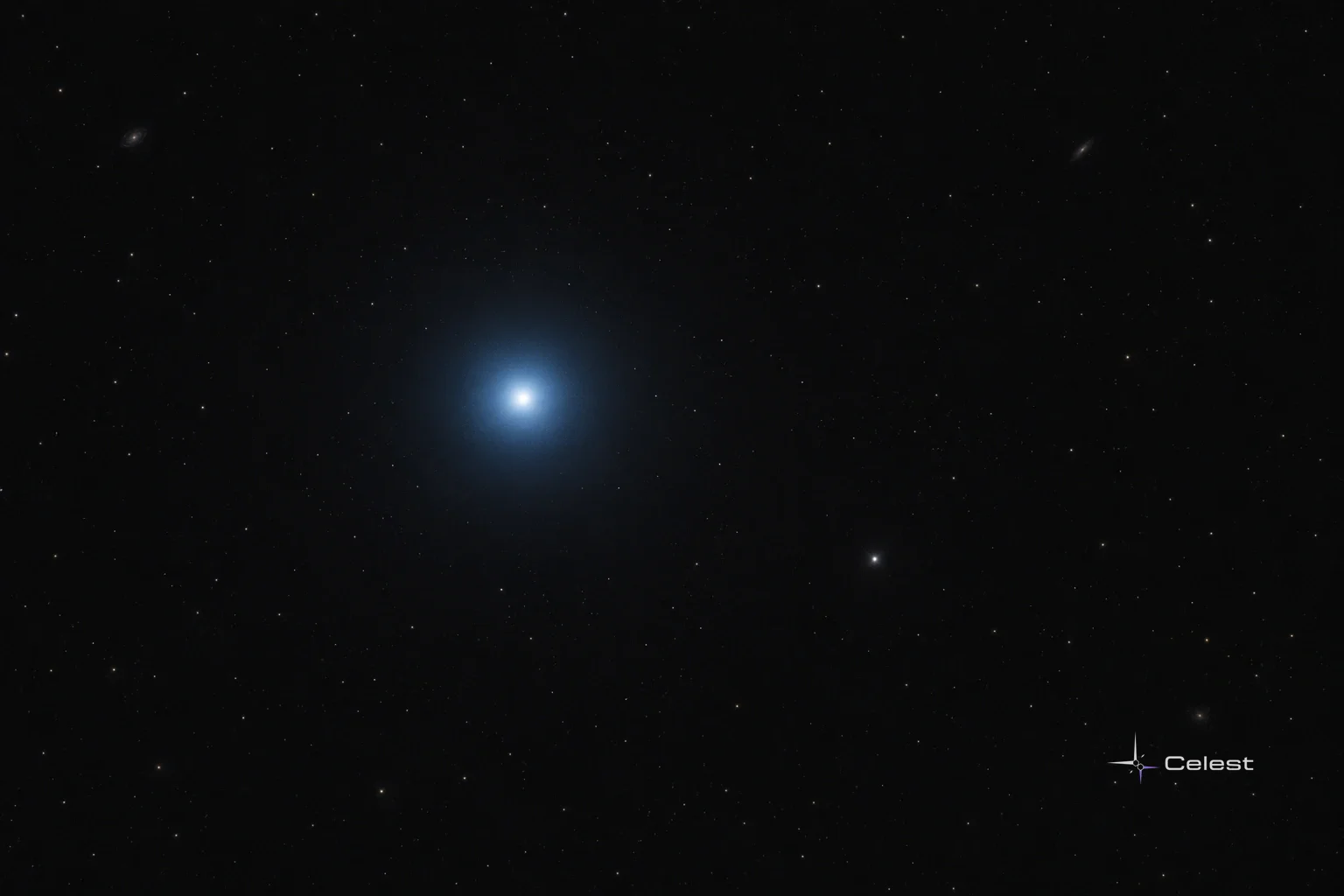
Sirius is the brightest star in Earth's night sky, a blue-white point in the constellation Canis Major. It is about 8.6 light-years away, close enough for its brilliance to dominate the surrounding stars. What looks like one star is actually a pair, with a faint companion hidden in the glare.
For observers in the Northern Hemisphere it is a familiar winter sight below Orion. Check the bright-star guide to identify it, then compare its position with the live sky map for your location. You can recognise Sirius without a telescope; its companion is a much harder observation.
Sirius at a glance
These facts separate the bright star you notice from the system behind it:
- Constellation: Canis Major, the Great Dog.
- Distance: about 8.6 light-years, a measure of distance rather than age.
- Appearance: a brilliant blue-white star that can flash colours near the horizon.
- System: Sirius A and the faint white dwarf Sirius B.
- Orbit: the pair takes about 50 years to circle one another.
Bright in our sky, not brightest everywhere
Two things help Sirius stand out: how much light it produces and how close it is. A star that emits more light can still look faint if it is far enough away. The ranking you see outdoors describes apparent brightness, the light reaching Earth, rather than a universal ranking of stellar power.
If Sirius A and the Sun were placed at the same distance, Sirius A would be about 25 times brighter in NASA's comparison. That makes it a powerful star, but not the most luminous star in the Universe. Its relatively nearby position is part of the explanation for its prominence.
Keep the Sun out of the nighttime ranking. Sirius is the brightest star in the night sky, not brighter than the Sun as seen from Earth. Planets are a separate category too; the claim does not mean Sirius always outshines every other point of light you might notice.
The companion that is easy to miss
Sirius B is a white dwarf, the compact remnant left after a star exhausts its nuclear fuel. Roughly Earth-sized, it contains a mass close to the Sun's. Small size and low apparent brightness therefore do not mean it contains little matter.
Its light is overwhelmed by Sirius A. Even with a large telescope, separating the companion is a demanding observation. Do not take failure to see two stars as a problem with your binoculars or your identification.
The companion was discovered in 1862. That date belongs to Sirius B, rather than the first recognition of Sirius, which people have watched since antiquity. Modern measurements of the pair's orbit help astronomers determine their masses.
Why Sirius flashes different colours
Moving air in Earth's atmosphere bends the incoming starlight along changing paths. Sirius is bright enough for the resulting twinkling to be especially noticeable. Close to the horizon, you look through more atmosphere and may see rapid red, blue or other coloured flashes.
The star is not switching its own colour back and forth on that timescale. Try comparing the view when it is higher in the sky, with help from the night sky guide. This changes the path through the atmosphere while leaving the distant star the same.
How to see it
Find Orion's three Belt stars first. Extend their line toward the southeast to reach Sirius. In the usual upright, south-facing winter view from northern latitudes, that is roughly down and left. Rotate your chart to match the sky before relying on those page directions.
Start with your eyes, not an expectation of a magnified stellar globe. The main star is conspicuous; Sirius B is a separate advanced challenge. A photograph of the pair also needs careful reading: the bright spikes and rings around stars in the Hubble image come from the telescope's imaging system.
A different kind of colour change
Light leaving Sirius B loses energy as it climbs out of the white dwarf's strong gravitational field. Its wavelengths stretch toward the red, an effect called gravitational redshift. Hubble's measurements of this shift have helped investigate the compact star's mass.
That effect belongs to gravity at the star, unlike the coloured flicker produced in the air above you. The easy-to-spot winter landmark therefore points to something harder to see: a dense stellar remnant whose light tests how gravity behaves.
Leave a comment
Comments appear after moderation.