The Sun: A Changing Star at the Centre of Our Solar System
Our nearest star is a moving, magnetic ball of plasma. Its familiar light comes from a world whose surface, atmosphere and activity keep changing.

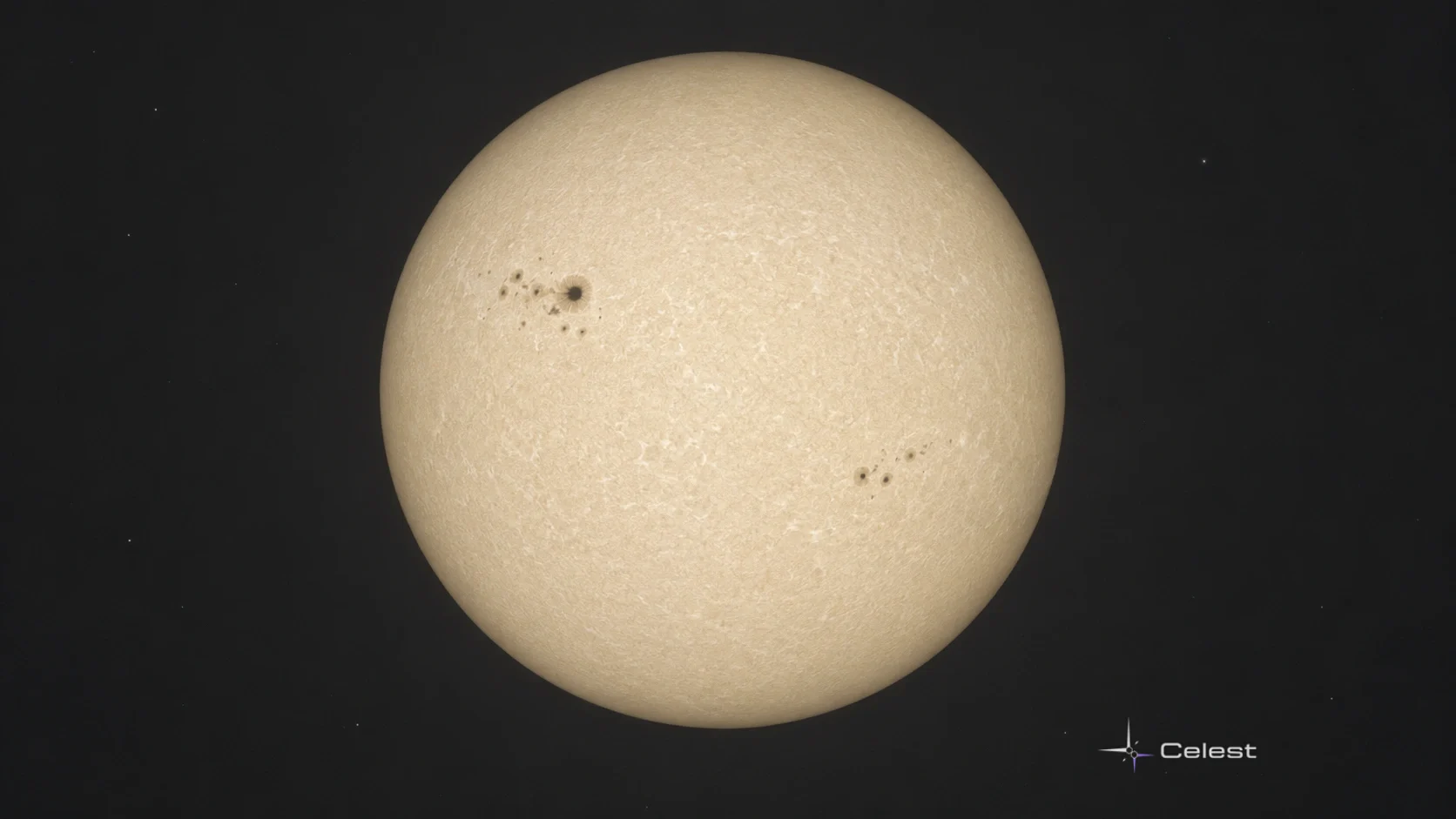
The Sun is the star at the centre of our solar system. Its gravity keeps the planets in orbit, and energy produced deep inside it supplies the light and warmth that make life on Earth possible.
It may look like a steady bright disk from day to day, but it is made of moving plasma, with changing magnetic fields and an active atmosphere.
That makes it more than a familiar background to the sky. The Sun gives us a nearby example of how a star works, and its eruptions can affect the space environment around Earth. You can explore those changes through observatory images without looking directly at the Sun.
The Sun at a Glance
- Type: our solar system’s only star, made mainly of hydrogen and helium.
- Age: roughly 4.6 billion years.
- Diameter: about 1.4 million kilometres.
- Distance from Earth: around 150 million kilometres, varying during the year.
- Power source: nuclear fusion in the core.
- Activity: sunspots and eruptions vary over a cycle of roughly 11 years.
A Star Powered From the Inside
The Sun formed when a cloud of gas and dust collapsed under gravity. Most of the material gathered at the centre; other material helped form the planets and smaller bodies. Today the Sun contains about 99.8 percent of the solar system’s mass. A bright disk that looks small in our sky is therefore the system’s dominant object.
Inside its core, temperatures reach around 15 million degrees Celsius. Hydrogen nuclei combine to form helium, releasing energy through nuclear fusion. This is different from a flame consuming fuel in air. The Sun does not need atmospheric oxygen to keep shining.
Energy travels outward through the star before escaping into space. The part we normally call its surface is the photosphere, the layer from which most visible sunlight emerges. It is around 5,500 degrees Celsius, far cooler than the core, though still extremely hot.
A Globe That Does Not Turn as One Solid Piece
Solar material is plasma: gas hot enough for many atoms to lose electrons. Unlike a rocky planet, the Sun has no solid surface that forces every latitude to rotate together. Near the equator, a rotation takes roughly 25 Earth days. Near the poles, it takes around 36.
Those numbers describe different parts of the star, rather than conflicting measurements of one fixed day. They also help explain why the Sun’s magnetism becomes complicated. Material moving at different speeds can twist magnetic fields; when the fields rearrange and reconnect, stored energy can be released.
The atmosphere above the photosphere has several layers. Its outermost extensive layer, the corona, can reach around 2 million degrees Celsius. The temperature rises again outside the visible layer, one of the important puzzles in solar physics. That thin, hot atmosphere is not the solid surface seen in a dramatic close-up illustration.
What Sunspots and Solar Storms Tell You
Sunspots look dark because they are cooler than the surrounding photosphere. They mark regions of concentrated magnetic activity, rather than empty holes in the star. Their numbers rise and fall over a roughly 11-year activity cycle. The magnetic field’s reversal and return spans roughly 22 years.
An active region can produce a solar flare, a burst of radiation, or a coronal mass ejection, a large release of solar material and magnetic field. These events can occur together, but the names do not describe the same thing. A bright flash in one image does not automatically mean that a cloud of material is travelling toward Earth.
When solar activity affects our planet, it can disturb the magnetic environment, influence communications and satellites, and help produce auroras. The direction and character of an event matter. Following solar activity means checking observations and forecasts, rather than assuming that every eruption will produce a visible aurora where you live.
How to Follow the Sun Safely
Start with current spacecraft images. NASA’s sunspot activities point to Solar Dynamics Observatory views, including images designed to show the visible photosphere. Compare several dates and look for changes in sunspot groups instead of treating one picture as the Sun’s permanent appearance.
Pay attention to the type of light recorded. The Sun’s visible emission spans many colours and appears white, while ultraviolet images often use assigned colours to distinguish measurements. A green or vivid orange solar image can be scientifically useful without being the colour your eyes would see.
Direct observation needs proper solar protection. Ordinary sunglasses are unsafe. A camera, binoculars or a telescope needs a special-purpose solar filter securely fitted over the front of the optics. Never look through those instruments while relying on eclipse glasses: magnified sunlight can damage the glasses and injure your eyes.
If you are unfamiliar with solar equipment, use observatory images or seek help from an experienced astronomy club.
The Nearby Star That Helps Explain Distant Ones
Studying the Sun connects everyday sunlight with processes operating throughout the universe. Its plasma, layers and magnetic changes can be examined in much more detail than those of a distant star. The same object that lights your afternoon also gives astronomers a way to test how stars behave.
For your next look, choose a recent observatory image and identify what it measures. A sunspot view and an ultraviolet atmosphere view answer different questions. Understanding that difference turns a colourful picture into evidence about a changing star.
Leave a comment
Comments appear after moderation.