Conjunctions: Why Worlds Appear to Meet in the Sky
Two planets can share a tiny part of the sky while remaining enormously far apart. Learn what their apparent meeting means and why the observer’s viewpoint matters.

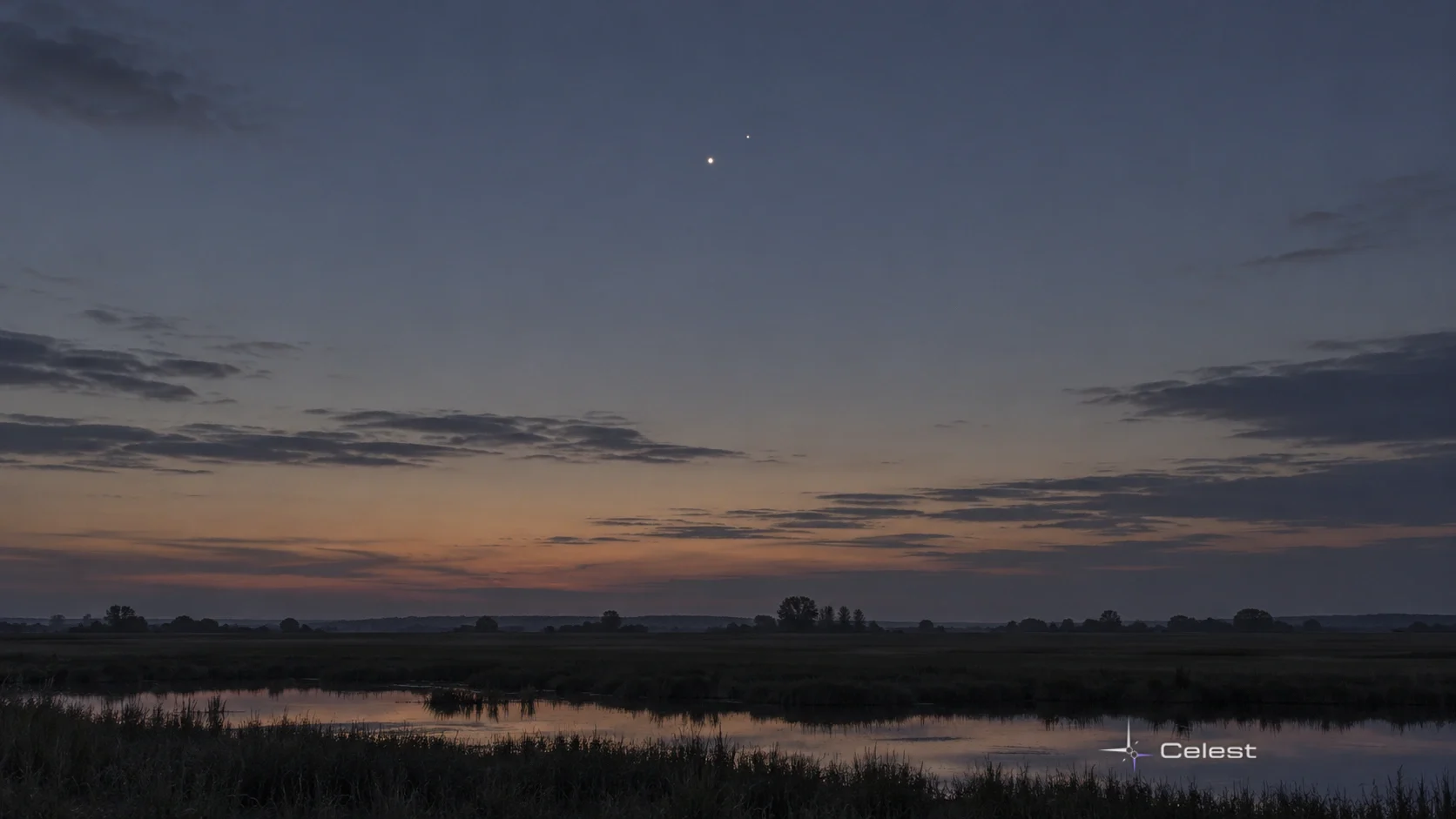
A conjunction is an apparent meeting in the sky: two planets, or a planet with the Moon or a star, appear near one another. The objects can remain very far apart in space. Their paths happen to bring them into similar directions as seen from your viewpoint.
You are watching a changing arrangement, not a new pair of physically joined worlds.
The astronomy calendar can identify an event worth checking, but its date is a starting point. Darkness, direction and the height of the objects still determine the view you can have from your observing area.
Why Do Planets Pass Near Each Other?
The planets orbit the Sun in approximately the same plane. From Earth, inside that relatively flat system, their routes appear along a broad arc. They generally stay near the ecliptic, the Sun’s apparent yearly path through the sky, although their orbits are not perfectly identical planes.
As the planets and Earth move, one planet can appear to catch up with another.
A star can also supply a background point beside which a planet passes. The close appearance concerns direction; the objects do not need to become neighbours in physical space.
Use the sky map to compare the named points rather than assuming every bright pair is the announced event. Changing the date also lets you follow how the arrangement develops against the stars.
Does the Published Time Mean the Closest View?
Not necessarily. A formal conjunction occurs when two objects share one specified sky coordinate. Astronomers use different coordinate systems, rather as different grids can describe the same place. Two points can share one coordinate while still being separated in the other.
The exact moment of minimum apparent separation is a related event called an appulse.
For objects moving near the ecliptic, the two times can be close, but they describe different conditions. A useful observing plan therefore checks the event’s definition as well as the local sky. A timestamp does not tell you whether that moment falls in darkness for you.
What Happened With Jupiter and Saturn in 2020?
On December 21, 2020 Jupiter and Saturn appeared about a tenth of a degree apart. That small angle produced a striking view of two bright planets sharing a tiny part of the sky. They nevertheless remained nearly a billion kilometres apart—hundreds of millions of miles—in physical space.
Their closeness was in the view, not in the gap between their worlds.
Jupiter and Saturn produce conjunctions roughly every 20 years, but the separation and observing conditions differ.
The interval describes a recurring configuration, not an equally close repetition of that particular evening. No current date or direction should be copied from a 2020 viewing guide.
Are All Conjunctions Visible at Night?
No. The term also covers alignments involving the Sun. A planet can be close to the Sun’s apparent position and hidden in the glare. Mercury and Venus can pass between Earth and the Sun or around the far side, producing different kinds of solar conjunction.
For a visible nighttime pairing, compare the date with darkness, local direction and an open view. The planet guide helps identify which worlds you are comparing. A low grouping in twilight may be harder to distinguish than the same objects higher in a darker sky.
Bright planets usually look like bright points without optical aid.
A telescope can add detail, but its field is limited. Whether both objects fit in one view depends on the particular separation and instrument; the word conjunction does not settle that question.
What Changes If One Object Covers Another?
When one body truly passes in front of another, it is an occultation: the closer object hides the farther one. A close pairing can be attractive without producing that effect. For an occultation, the alignment must be precise from the observer’s location.
Observers in different places can see different outcomes.
In an ESA account of a predicted 2022 occultation involving Jupiter’s moon Europa and a star, the useful viewing area followed a narrow track across Earth. The purpose was more than a striking picture: timing the disappearance from several places could improve knowledge of Europa’s position and orbit.
What Can You Notice on Another Evening?
Try comparing the same bright points against the surrounding stars on a later suitable night. You may notice a changed gap or a different relative arrangement as the Moon or planets move. A single attractive scene becomes part of a sequence you can follow.
The sky gives you directions much more readily than depth. A conjunction makes that limitation visible: worlds separated by an enormous distance can briefly share a small part of your view. Learning the geometry turns an apparent meeting into a way to understand the moving Solar System.
Leave a comment
Comments appear after moderation.