Light Pollution: Why Faint Stars Disappear
A brighter sky can reveal fewer stars. Follow scattered light from a streetlamp to the background sky, then learn why maps and observations tell different parts of the story.

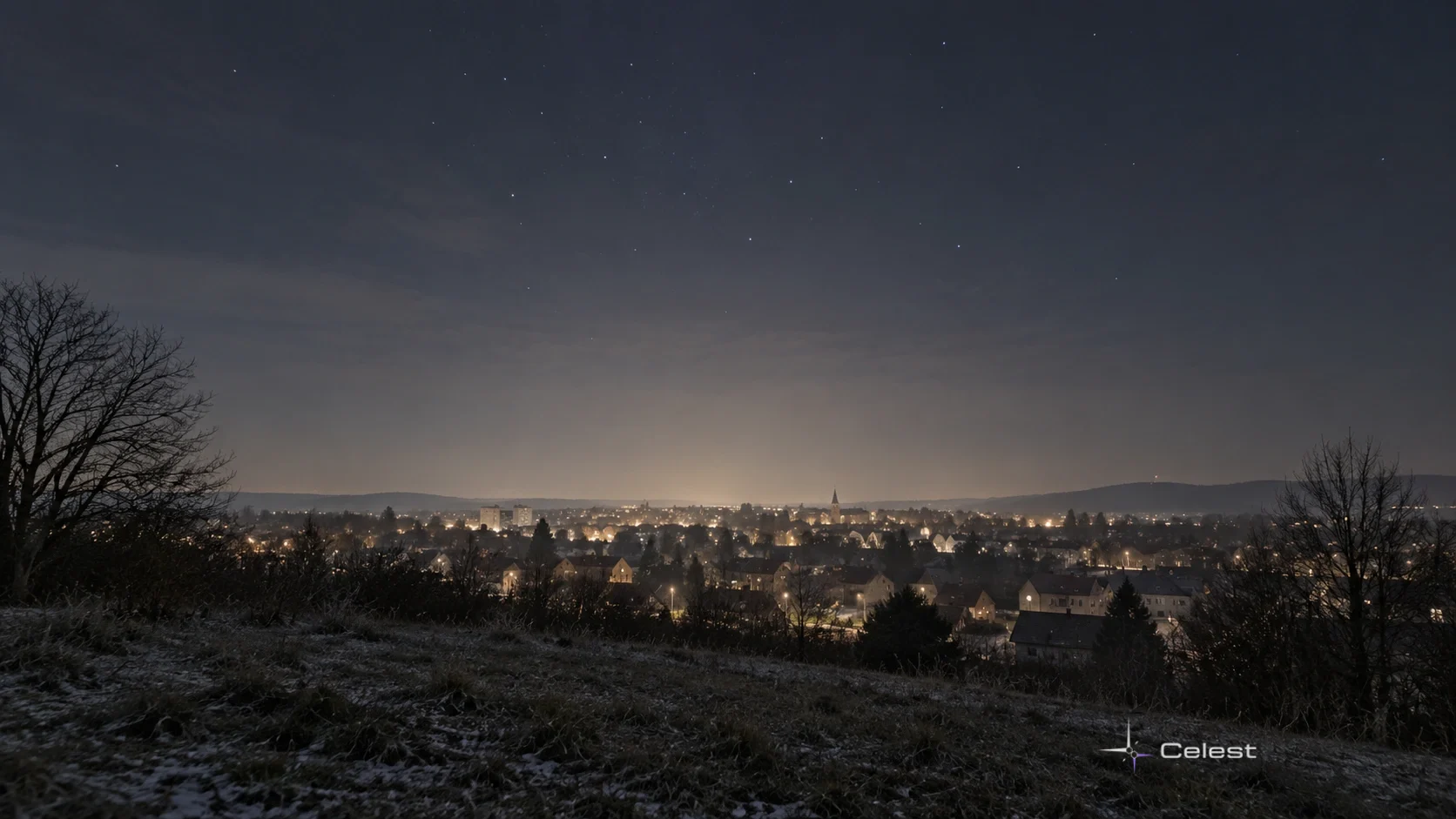
Light pollution is artificial light that changes the natural darkness outdoors. For astronomy, one important result is a brighter sky background: faint stars become harder to distinguish, even though their own light has not changed. Light scattered through the atmosphere can affect a view far beyond the lamp that produced it.
The missing stars are often a contrast problem.
Use a light pollution map to compare the broad surroundings, then look at the actual sky. The map and your eyes answer related questions, but a regional colour cannot show every nearby lamp or describe every direction equally well.
Why Faint Stars Disappear First
Skyglow is the diffuse brightening produced when artificial light scatters in the atmosphere. Light sent upward or sideways can contribute, and some light aimed at the ground is reflected back upward. A distant illuminated town can therefore brighten part of your sky.
The star’s light must stand out against that background. As the background gets brighter, weaker points become harder to recognise. Think of a faint pale mark that is easy to see on dark paper but difficult to pick out against a pale sheet.
The comparison shows how a weak signal becomes harder to distinguish from its background.
Aerosols, including haze and dust, can scatter additional light. Clouds above an illuminated urban area can also send more light back downward. That is why the same observing area can look different on two nights without every streetlight having changed.
Check the observing conditions before attributing the whole difference to a lighting change. The atmosphere is part of the route that both artificial light and starlight take to your eyes.
Is a Nearby Lamp the Same as Skyglow?
Glare is direct, uncomfortable brightness that interferes with your vision. A lamp shining into your eyes can also limit their adjustment to darkness. Moving behind a building that blocks that lamp may help, even when the wider sky remains bright.
It solves a local problem rather than erasing the city’s glow.
Light trespass is spill into a place where the light is not wanted or needed. The same fixture can cause trespass, glare and skyglow, but the terms describe different effects. Separating them helps you decide whether to change where you stand or how the light is directed.
What a Map Can and Cannot Tell You
Some maps show light travelling upward from the surface. Others estimate the skyglow that this lighting produces by applying a model. These are different quantities: a bright road viewed from space is not a direct measurement of the background behind a star.
Use the layer description to understand which quantity you are seeing.
At ground level, look around as well as upward. A horizon facing a distant city can remain bright when the sky overhead is much darker. A site can work well for one direction and poorly for another, so compare it with the object’s position on the sky map.
Try a Fair Comparison of Two Views
Choose a small recognisable star pattern and compare it with an appropriate reference chart. Note which weaker stars you can distinguish, rather than judging the sky only by the brightest point. Globe at Night uses this basic idea to collect observations without telescopes.
Keep the comparison useful by recording where and when you observed, which patch of sky you used, and whether Moonlight or cloud affected the view. If you move behind a lamp shield, allow your vision to settle before judging the result.
A single change is a clue, not a measurement of an entire region’s trend.
Can Better Lighting Preserve the View?
Yes. A shielded fixture that directs light where it is needed reduces upward spill and direct glare. Lowering an unnecessarily bright lamp reduces another contribution. Some light still reflects from the ground, so direction and intensity both matter.
The five principles developed by DarkSky and the Illuminating Engineering Society combine purpose, direction, level, timing and colour. Use useful light, aim it carefully, keep it no brighter than necessary, control when it operates and limit short blue-violet wavelengths where possible.
Changing colour while leaving an excessive light shining in every direction misses several parts of that approach.
Why Observers Still Add Something Satellites Miss
A study announced in 2023 analysed more than 50,000 Globe at Night observations from 2011 to 2022. It excluded entries affected by factors such as cloud and Moonlight and focused on the better-sampled Europe and North America. The visual trend showed faster brightening than the compared satellite trend.
The instruments were not measuring exactly the same view.
The satellite measurements considered in that report missed some short visible wavelengths and poorly captured light sent sideways. Both can matter to skyglow seen from the ground. The result does not turn its historical average into a prediction for your next observing night.
Your view of the stars records the consequence that matters to a skywatcher: which faint points still stand out. A satellite map supplies valuable context, while a careful observation shows what that lighting and atmosphere have actually left visible from the ground.
Leave a comment
Comments appear after moderation.