Altair: The Nearby Star Spun Out of Shape
One familiar point in the Summer Triangle hides a flattened stellar surface. Combining light from separated telescopes lets astronomers measure a shape your eyes cannot resolve.

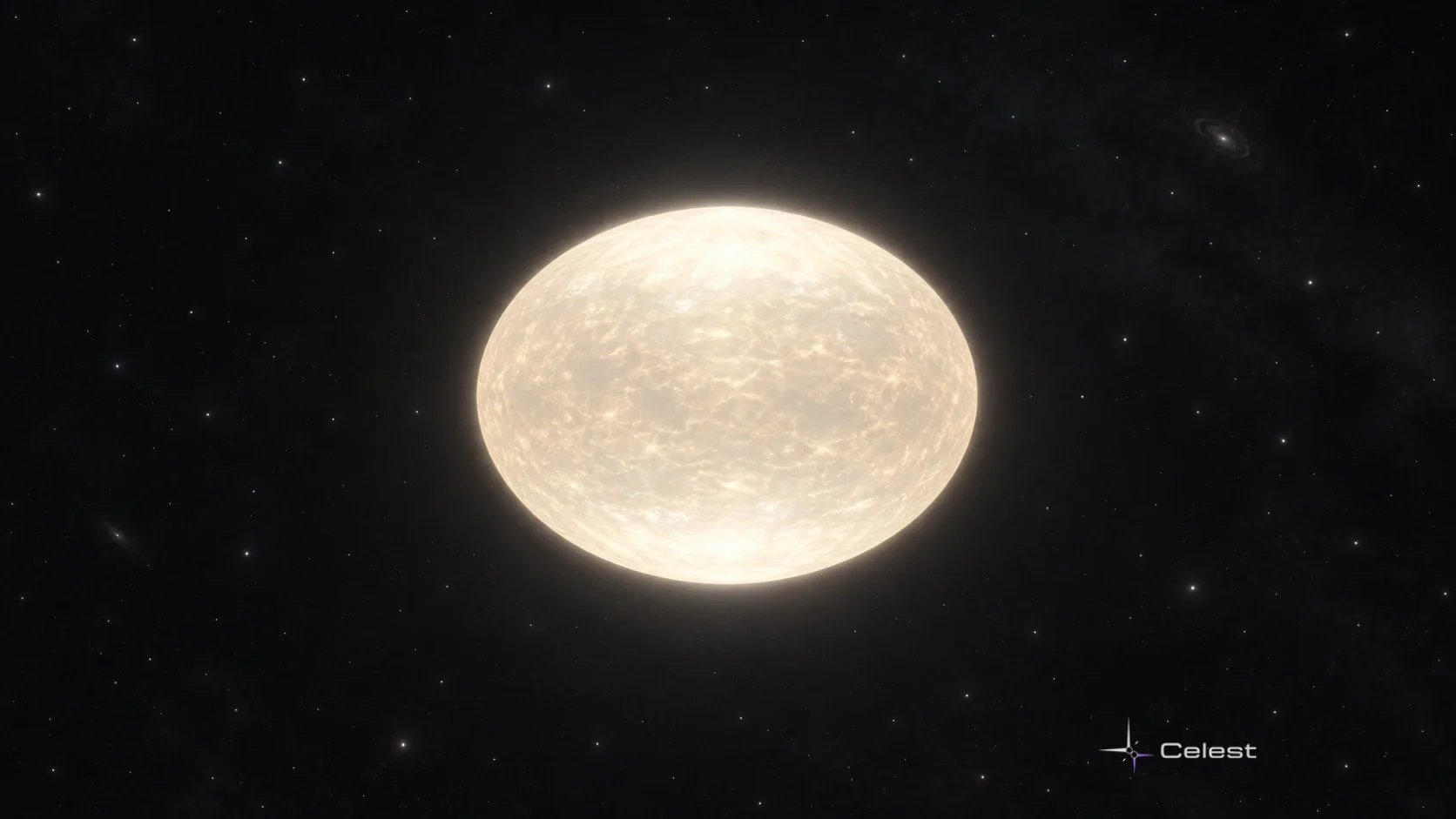
Altair is Aquila’s brightest star, about 16.7 light-years away, and its rapid rotation has stretched it into a flattened shape. You can find its point of light among the bright landmarks in the star guide, although its unusual outline requires professional observations to resolve.
Altair shares the Summer Triangle with Vega and Deneb. Set the live sky map to your date and observing position before matching those three corners; a familiar seasonal name does not fix where the triangle appears every evening.
Altair at a Glance
Keep the star’s physical properties separate from the pattern that helps you locate it.
- Home constellation: Aquila, the Eagle.
- Distance: approximately 16.7 light-years.
- Stellar stage: main sequence, with hydrogen fusion supplying energy in the core.
- Distinctive shape: a widened equator and flattened poles.
- Modelled rotation: 7 hours 46 minutes in a study published in 2020.
- Sky landmark: one corner of the Summer Triangle, recognisable without a telescope.
A Star With a Wider Waist
Altair contains hot gas rather than a rigid surface. Rapid spinning changes how that material is distributed, pushing its equatorial region farther outward. The resulting star is broader across its equator than along the direction between its poles.
The distortion changes its light as well as its outline.
Its poles are hotter and brighter than its equator. Astronomers call this gravity darkening: the surface brightness varies with the conditions created by rotation. The cooler equator looks dimmer by comparison, but it remains intensely luminous. It is not a dark ring blocking light from the star.
That distinction matters when you see an illustration. A dramatic black stripe can suggest an eclipse or surrounding dust, whereas Altair’s contrast comes from its own surface. A reconstructed image measures a brightness distribution; an artist chooses how to display it.
What an Eight-Hour Spin Means
A two-dimensional analysis published in 2020 estimated a rotation lasting 7 hours 46 minutes. Its equatorial radius was about twice the Sun’s radius, with the detailed result of 2.008 ± 0.006 solar radii. Material near that equator was moving at roughly 314 kilometres per second, or 195 miles per second.
These are results of a particular model fitted to observations, rather than exact numbers every study must reproduce.
The same analysis gave a mass of 1.86 ± 0.03 times the Sun’s, conditional on interpreting the star’s oscillations correctly. Its interior and composition assumptions suggested an age near 100 million years. That estimate is not an observed birthday, and earlier mass determinations used different stellar models.
Altair still belongs to the main sequence. This is the long stellar phase powered by hydrogen nuclei joining to make helium in the core. Released energy supports the hot star against gravity. Its flattened outline changes the way that star must be modelled; it does not mean the energy source has failed.
How Astronomers Resolved the Surface
In 2007, researchers produced a near-infrared reconstruction that revealed Altair’s distorted shape and uneven brightness. They combined starlight from four telescopes separated by about 300 metres, or 984 feet, in California.
The technique is interferometry, in which separately collected light is combined to recover exceptionally fine detail. The separation between telescopes helps distinguish angles too small for a conventional view. It does not create one solid mirror spanning the entire distance.
The 2007 report also found that a simple, uniformly rotating stellar model could not explain all its measurements. Rotation varying within the star, a different description of gravity darkening, or both were possible explanations. An image can therefore test a theory as well as show a shape.
Altair’s ordinary visible spectrum supplies another kind of evidence. Hydrogen in its atmosphere absorbs particular wavelengths, leaving dark lines across a spectrum and dips in a brightness graph. Those absorption lines describe how light passes through the atmosphere, rather than drawing the star’s equatorial band.
Find Its Corner of the Summer Triangle
For northern observers, summer evenings are a useful season for recognising the Summer Triangle. Its three bright stars can remain recognisable in urban skies. The triangle is an asterism, a familiar drawing made from stars, rather than an extra official constellation.
Use the constellation guide to distinguish Aquila, which contains Altair, from Lyra around Vega and Cygnus around Deneb. Confirm the triangle first, then match Altair’s corner with your correctly oriented chart. If the pattern seems turned around, compare the whole arrangement instead of relying on a remembered up-or-down direction.
Seeing Altair and seeing its surface are very different achievements. Your eyes identify its place in the pattern. A professional interferometer measures the shape and brightness hidden inside that tiny point.
Rotation Changes the Stellar Portrait
The 2020 model left some combinations of mass and composition difficult to distinguish. Better measurements of the spectrum can help separate those possibilities and improve the interpretation of Altair’s interior.
A single temperature and a perfectly round outline are therefore an incomplete description of this nearby star. The same dot you locate in the Summer Triangle is a test of how accurately astronomers can describe a spinning, unevenly bright star.
Leave a comment
Comments appear after moderation.