Andromeda Constellation: The Pattern That Names a Galaxy
Andromeda is a region of sky with recognisable stellar landmarks, not another name for one enormous object. Its stars help you navigate toward both a nearby stellar remnant and a separate galaxy.

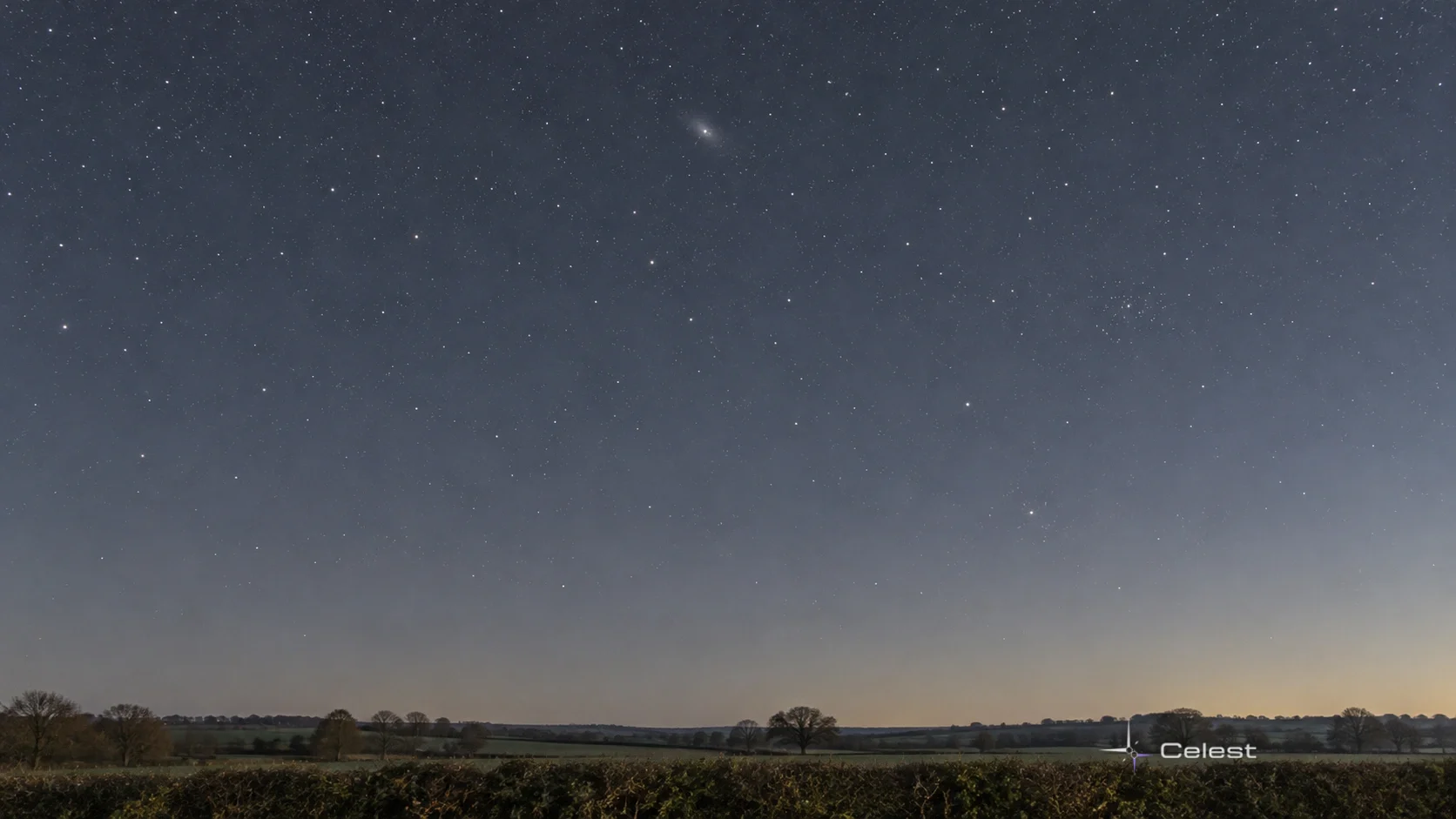
The Andromeda constellation is a northern autumn sky region whose stars lead away from the Great Square of Pegasus. It contains the direction of the famous Andromeda Galaxy, but the constellation and galaxy are different things. Compare its borders and neighbouring patterns in the constellation guide.
Start with its bright stellar landmarks rather than searching immediately for a faint galaxy. Use the live sky map for your location and time, then identify the Square and the line of stars attached to one of its corners.
Andromeda at a Glance
Keep the region, its landmarks and its separate physical objects distinct.
- Official identity: one of the 88 IAU constellations, abbreviated And.
- Traditional figure: the Chained Maiden.
- Starting landmark: Alpheratz, at a corner of the Great Square of Pegasus.
- Other named stars: Mirach and Almach.
- Famous galaxy: M31, about 2.5 million light-years away; this is not the constellation’s distance.
- Northern observing season: autumn, with the current placement checked on a map.
One Corner of Pegasus Belongs to Andromeda
Alpheratz forms a corner of the Great Square, but its stellar designation is Alpha Andromedae. It belongs to Andromeda. The other corners are Markab, Scheat and Algenib, illustrating why a familiar pattern’s name does not define every star’s official constellation.
The Square is an asterism, a recognised drawing made from stars. Constellations now have defined boundaries covering the sky. A useful observing shape can therefore connect stars across those boundaries without creating a new official region.
From the Alpheratz corner, follow the attached line of bright stars into Andromeda. Mirach and Almach are additional names to recognise on the chart. Learning these landmarks gives you a route through the region rather than a list of isolated catalogue entries.
The drawing also carries an older story. In the myth retold by NASA/JPL, Perseus rescues Andromeda after finding her chained beside the sea; her parents are Cepheus and Cassiopeia. The names connect figures in a traditional tale, not stars joined by a shared physical history.
The Galaxy Is Beyond the Foreground Stars
M31 is a spiral galaxy outside the Milky Way, roughly 2.5 million light-years away. A light-year is the distance light travels in one year. That figure describes the galaxy; the individual stars marking Andromeda’s pattern occupy different distances.
Under a dark sky, M31 can look like a faint diffuse patch rather than a stellar point. Binoculars give its brighter centre more definition, with some of the surrounding disk. The spiral structure in a detailed photograph is a much more demanding view than simply finding that patch.
More magnification does not automatically show more of the whole galaxy. A telescope can reveal additional detail but may frame only part of the extended object. Finding M31 and fitting it into an instrument’s field are separate observing decisions.
Its name can hide that change in scale. Saying a galaxy is in Andromeda means its direction falls within the constellation’s boundaries. It does not mean the galaxy sits among the bright stars forming the drawing.
A Compact Cloud Is Not a Small Planet
NGC 7662, also catalogued as Caldwell 22, is the planetary nebula nicknamed the Blue Snowball Nebula. A planetary nebula is an expanding shell cast off by an aging Sun-like star. The term comes from the rounded appearance of such objects, not from the presence of a planet.
The compact remnant at the centre is a white dwarf, the stellar core left after its outer layers are lost. NASA’s Caldwell entry places the nebula about 2,500 light-years away, far inside the distance scale of M31.
Through a telescope at low magnification, the nebula can resemble a star. Greater magnification may distinguish its extended shape. Its listed apparent magnitude is 8.3: magnitude measures brightness as seen from Earth, and larger numbers describe fainter objects. The central remnant is not an easy beginner detail.
How to Find the Constellation
Northern autumn gives you a useful season to learn the region. Begin with the Great Square of Pegasus, confirm Alpheratz at the corner leading into Andromeda, and trace the attached bright stars. Match the chart’s orientation to the sky before following a smaller route.
If M31 is your next stop, use the detailed chart to turn from the brighter stellar line toward the galaxy’s diffuse patch. Cassiopeia offers a wider reference nearby. The constellation can be recognised even when a bright sky hides the fainter galaxy.
Check the observing conditions before deciding whether the session is for star-pattern recognition or a fainter object. For M31, begin with a binocular view of the bright centre. For NGC 7662, a telescope and its appropriate detailed finder chart serve a different task.
An illustration can explain the idea of a star field, but it cannot establish that you have found the right stars. Use the current chart for identification and compare the actual field around the object, rather than matching a generated picture’s exact dots.
One Direction Opens Two Very Different Depths
NGC 7662 and M31 both appear in Andromeda’s region. Their rounded distances differ by about a factor of a thousand: roughly 2,500 light-years for the stellar shell, compared with 2.5 million for the galaxy.
That contrast gives the familiar stars a second purpose. They help you navigate not just across a drawing, but between a remnant of one star inside the Milky Way and the collected light of an entirely separate galaxy.
Leave a comment
Comments appear after moderation.