Andromeda Galaxy (M31): Beyond Its Visible Stars
The faint patch in Andromeda contains a spiral galaxy, but its familiar stellar light shows only part of the system. An enormous gas envelope is studied through the light of even more distant objects.

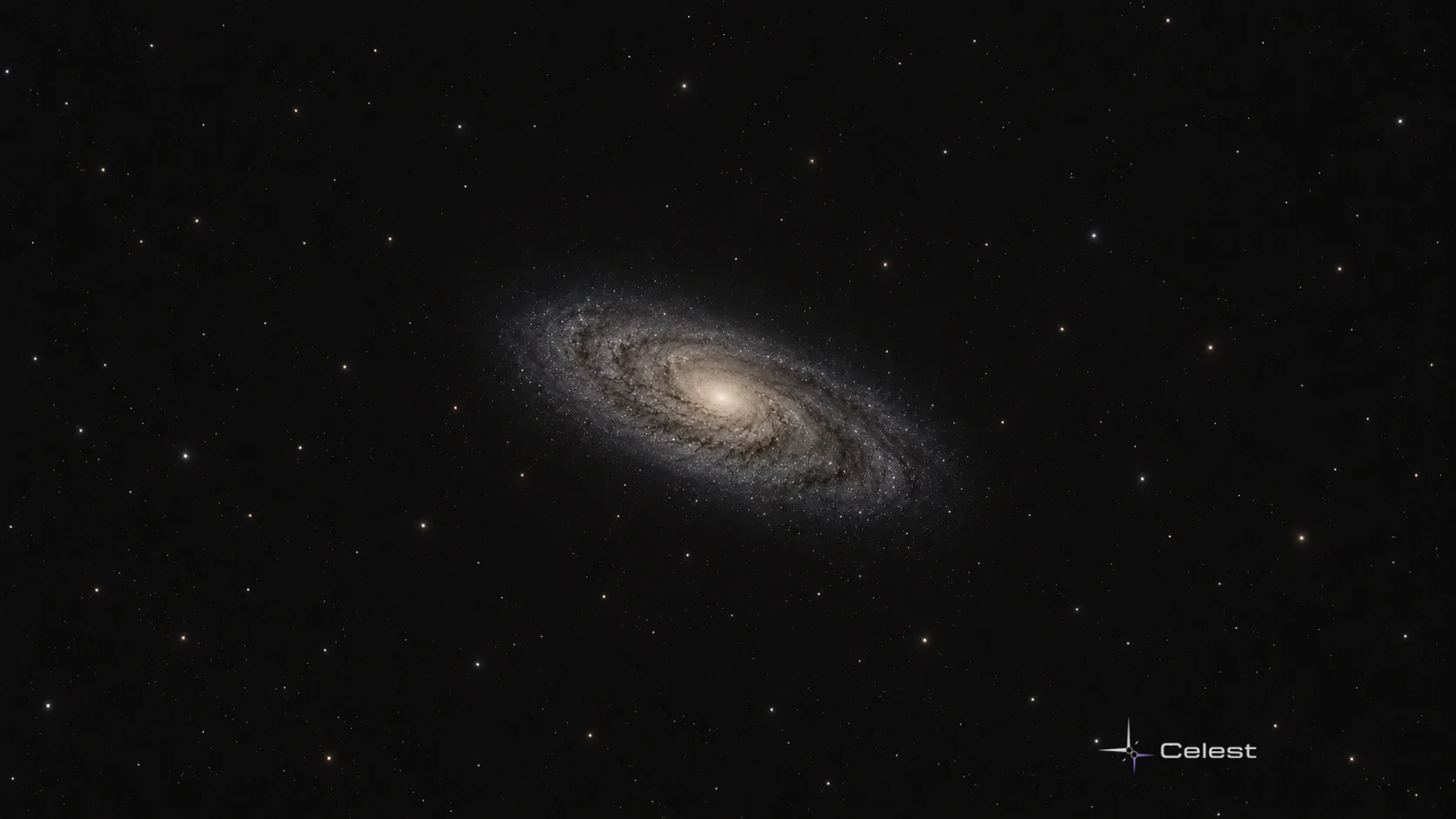
The Andromeda galaxy, also called M31, is the nearest large galaxy to our Milky Way. Its distance is about 2.5 million light-years. Under a dark sky, the brighter part appears as a faint elongated patch in the constellation of the same name. Use the constellation guide to place that direction among familiar stars.
The patch is only the readily visible part of a much larger physical system. Beyond the stellar disk lies an enormous envelope of sparse gas. Astronomers study that material by examining what it removes from the light of objects much farther away.
Andromeda at a Glance
- Catalogue: Messier 31, or M31.
- Type: a spiral galaxy beyond our own.
- Distance: approximately 2.5 million light-years.
- Stellar population: estimated around a trillion, rather than completely counted.
- First visual impression: a faint patch, not a detailed spiral photograph.
- An outer component: an extensive gaseous halo.
Check the live sky for your date and location. Northern autumn evenings are a useful general starting point. The galaxy’s place within the constellation becomes easier to recognise once you know the surrounding patterns, without needing to identify its individual stars.
A Galaxy Seen From Outside
We observe Andromeda’s disk from outside, giving a perspective we cannot obtain for the whole Milky Way from our position inside it. Its view includes an older central population, younger stars in the disk and dark dust structures. Those features help researchers compare the histories of two large neighbours.
The disk is tilted strongly to our line of sight, so its appearance is elongated. An attractive photograph shows much more than the brightest glow you first detect. The reach of a faint outer structure and the size of an image’s field are also different things, so photographic comparisons need their observing context.
Millions of Stars in One Mosaic
The Hubble panorama released in 2025 combines observations spanning more than a decade. Roughly 600 overlapping fields were assembled into a detailed view. It resolves an estimated 200 million stars, still only a fraction of the population. The two survey programmes expanded an earlier northern-disk portrait with observations of the southern part.
The stars provide information about ages, chemical abundances and masses. Researchers use those measurements to test histories involving previous encounters and mergers. Andromeda’s unusual stellar structures are clues to an eventful past; reconstructing it requires more than finding one attractive spiral outline.
A Gas Envelope Far Beyond the Bright Disk
In 2020, Project AMIGA mapped Andromeda’s gaseous halo using Hubble observations. The inferred envelope reaches approximately 1.3 million light-years outward from the galaxy, with greater extents in some directions. That measurement describes a reach from Andromeda, rather than the diameter of its familiar bright disk.
The gas is extremely thin and difficult to detect directly. Researchers found two broad layers with different characteristics, including a more complex inner region and a smoother hotter outer one. Its structure helps explain why a galaxy’s surroundings matter alongside its visible stars.
How Can Light Reveal Such Faint Gas?
The team used 43 quasars behind Andromeda as background sources. Quasars are bright central regions of distant active galaxies. Their light crosses the halo before reaching us, giving several different paths through its material.
Hubble’s spectrograph examined ultraviolet light along those paths. Particular gas absorbs particular parts of the light, leaving features researchers can analyse. The experiment therefore used the background sources to investigate material that would be difficult to capture in a direct glowing-cloud picture.
The halo also contains elements produced within stars and released into their surroundings. It includes material expelled by energetic events as well as a reservoir relevant to future star formation. The gas can preserve information about earlier stellar activity while participating in the galaxy’s later evolution.
A Star Helped Establish the Distance
Andromeda’s status was once disputed. In 1923, Edwin Hubble identified a Cepheid variable there: a star with a recurring brightening and fading pattern, useful as a distance marker. Its behaviour helped show that the object lay beyond the Milky Way.
That discovery was about understanding the scale of an already known patch, rather than first noticing it. Measuring a suitable star changed the interpretation of the whole object. Modern surveys now resolve millions of stars in the same galaxy and use them to reconstruct more of its history.
Will Andromeda Collide With the Milky Way?
A 2025 study using Hubble and Gaia data reported approximately equal chances of a collision or no collision within the following 10 billion years. The simulations included observational uncertainties and the influence of other galaxies. That differs from older descriptions of an inevitable direct encounter on a fixed timetable.
This remains a model-based forecast. Better measurements of motion and mass can change the outcomes researchers consider likely. Approaching our general neighbourhood does not by itself determine the complete future path of a system influenced by several massive neighbours.
The Visible Patch Is a Starting Point
For a first observation, choose an interval with less bright moonlight and look for the faint elongated glow. A modest visual view can still connect you with a large external galaxy. Its outer gas envelope becomes part of the picture through a different kind of observation.
The most useful ending to the story lies in that method. Light from galaxies behind Andromeda carries evidence about material surrounding it. The patch you recognise can lead from visible stars to otherwise elusive gas, and from an attractive object to a record of stellar activity and galactic change.
Leave a comment
Comments appear after moderation.