Aquarius Constellation: Clouds Left Behind by Sun-Like Stars
Aquarius contains dense groups of stars and clouds expelled by stars nearing the end of their lives. The Helix and Saturn nebulae turn this sky region into a place to explore a possible distant future for our Sun.

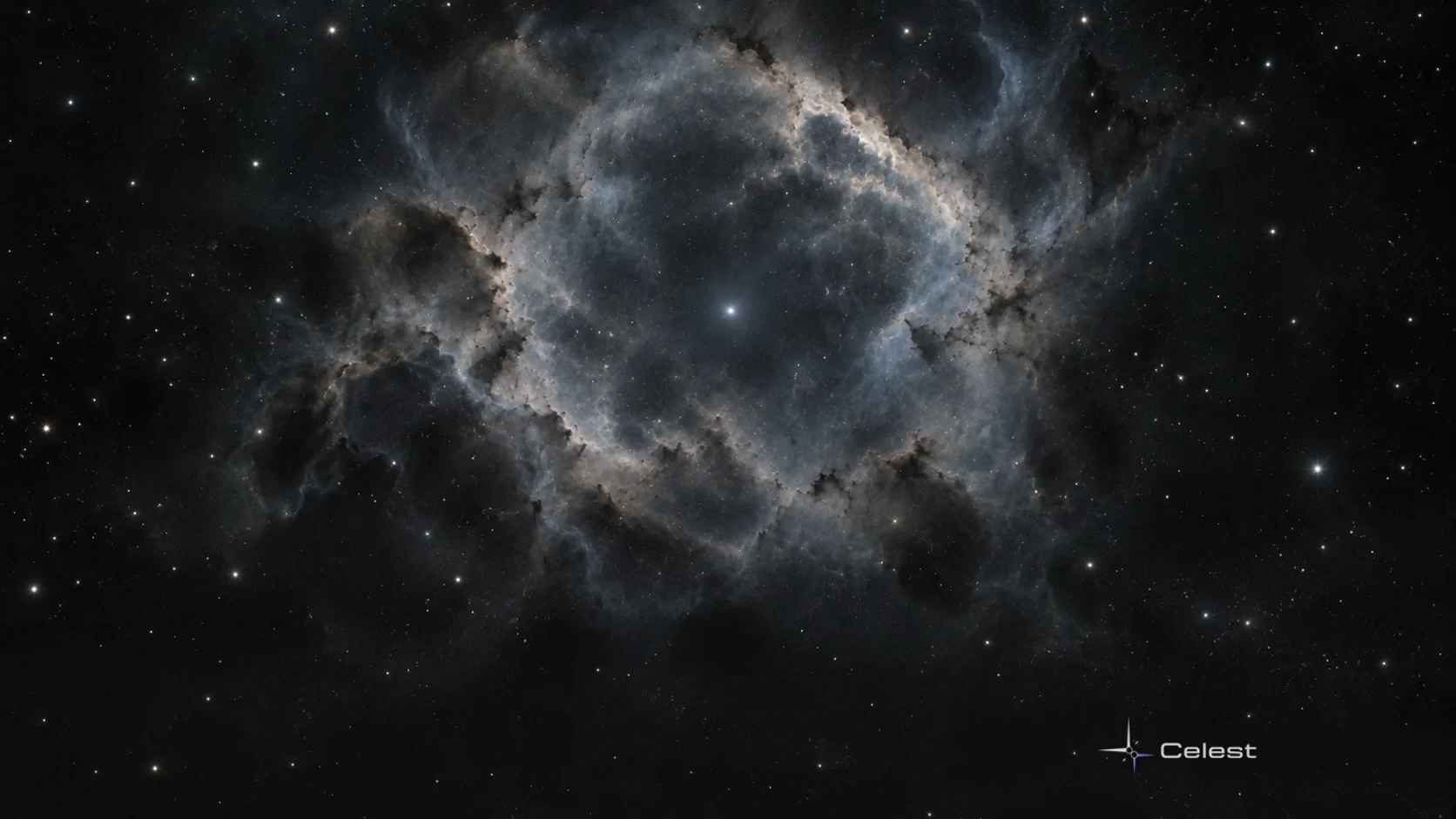
The Aquarius constellation, the Water Bearer, contains M2, a dense star cluster, and two famous clouds expelled by dying stars: the Saturn and Helix nebulae. Compare its region with neighbouring Pegasus and Capricornus in the constellation guide.
Northern autumn and southern spring evenings are useful seasons for exploring it. Set the live sky map to your latitude and time before searching. The objects share directions within one constellation, rather than belonging to one physical system.
Aquarius at a Glance
The region offers a route from stellar groups to the remains of individual stars.
- Traditional figure: the Water Bearer.
- Official abbreviation: Aqr.
- Sky position: across the celestial equator and along the ecliptic.
- Dense stellar group: M2, a globular cluster.
- Compact gas cloud: NGC 7009, the Saturn Nebula.
- Extended stellar remnant: NGC 7293, the Helix Nebula.
Find the Region Before the Fainter Objects
Aquarius lies among Pegasus, Capricornus, Pisces and other constellations. Matching those neighbours on an oriented map helps establish the correct field. The Water Bearer interpretation is a memory aid, while modern constellation boundaries define the region astronomers use.
The celestial equator projects Earth’s equator into the sky. The ecliptic is the Sun’s apparent annual path. Aquarius crosses both, which explains why Solar System objects can sometimes appear in this direction. Their current positions still need a dated chart, rather than a remembered planetary arrangement.
Complete visibility varies at far northern and southern latitudes. An overview establishes the constellation field; a detailed finder chart serves the smaller object.
M2 Collects the Light of Many Stars
M2 is a globular cluster, a broadly spherical group held together by its stars’ mutual gravitational attraction. NASA’s catalogue places it roughly 37,000 light-years away. Its appearance becomes denser toward the centre, unlike the wider constellation drawing that connects unrelated directions.
A telescope search begins with recognising that concentration of light. Resolving individual stars in the crowded field is a more demanding goal. The catalogue describes unaided-eye visibility under ideal conditions, but that should not become the standard you require of a first observing session.
The group contains old stars. Hubble’s visible and infrared observations and GALEX’s assigned ultraviolet colours reveal different information about the population, rather than one literal colour template for your direct view.
The Saturn Nebula Is Expelled Stellar Gas
NGC 7009, also catalogued as Caldwell 55, is called the Saturn Nebula because extended features can recall the ringed planet’s outline. It is a planetary nebula: outer gas shed by a star late in its evolution. The name concerns appearance, rather than an actual planet inside the cloud.
A Sun-like star can expand and lose its outer layers, leaving a small, hot central core. Ultraviolet radiation from that core energises the surrounding material. The cloud therefore remains luminous even though the original star no longer has the ordinary structure it had earlier in life.
Small telescopes may show a nearly stellar point; larger instruments reveal more of the extended shape. Confirm its field and focus before expecting side features.
The Helix Spreads Its Light Over a Wide Cloud
The Helix Nebula, NGC 7293 or Caldwell 63, is another planetary nebula in Aquarius. NASA’s catalogue places it about 650 light-years away, making it one of the nearby examples of this stellar phase. Gas surrounds the small hot remnant of a star once similar to our Sun.
Its broad ring-like appearance is more complicated in three dimensions than one photograph suggests. Detailed observations reveal structures sometimes called cometary knots. These are clumps of gas and dust; the descriptive name does not identify each one as an orbiting comet.
Under dark conditions, binoculars or a small telescope can reveal the Helix as a faint extended patch. A suitable nebula filter can improve contrast. The recognisable ring and fine filaments of a processed image are separate goals, rather than features every observer must see.
The observing guide places northern autumn observations low in the sky and recommends early spring for southern observers. Your actual altitude depends on latitude and time. Use the current map to judge that setting instead of adopting a fixed universal observing hour.
Aquarius Also Names Meteor Directions
The Eta Aquariids in May arise from particles shed by comet Halley. The Southern Delta Aquariids peak generally near late July, with comet 96P/Machholz as their suspected parent. Their radiant directions lie in Aquarius, but its distant stars do not produce the meteor particles.
Choose One Deep-Sky Goal First
Begin with the constellation field, then use a detailed finder chart for M2 or a nebula. Check the observing conditions before selecting the task. A concentrated cluster, a compact planetary nebula and a broad faint cloud need different expectations, even when their photographs appear equally bright.
Losing Outer Layers Is Not the End of the Story
The Helix and Saturn nebulae show that a star’s later evolution can separate its hot core from much of its former gas. The core continues to supply energy while the expelled material expands and eventually disperses. Some of that matter may contribute to later stars and planets.
Our Sun is expected to follow the same broad kind of late evolution, though these clouds do not predict its exact shape or brightness. Aquarius lets us examine an outcome rather than only an intact shining star: the remaining core and the material it has returned to space.
Leave a comment
Comments appear after moderation.