Aquila Constellation: The Eagle and a Star That Isn't Round
Altair gives the Eagle an easy starting point, but its fainter outline takes a more careful look. The same direction contains dust clouds that block background starlight and hold material for new stars.

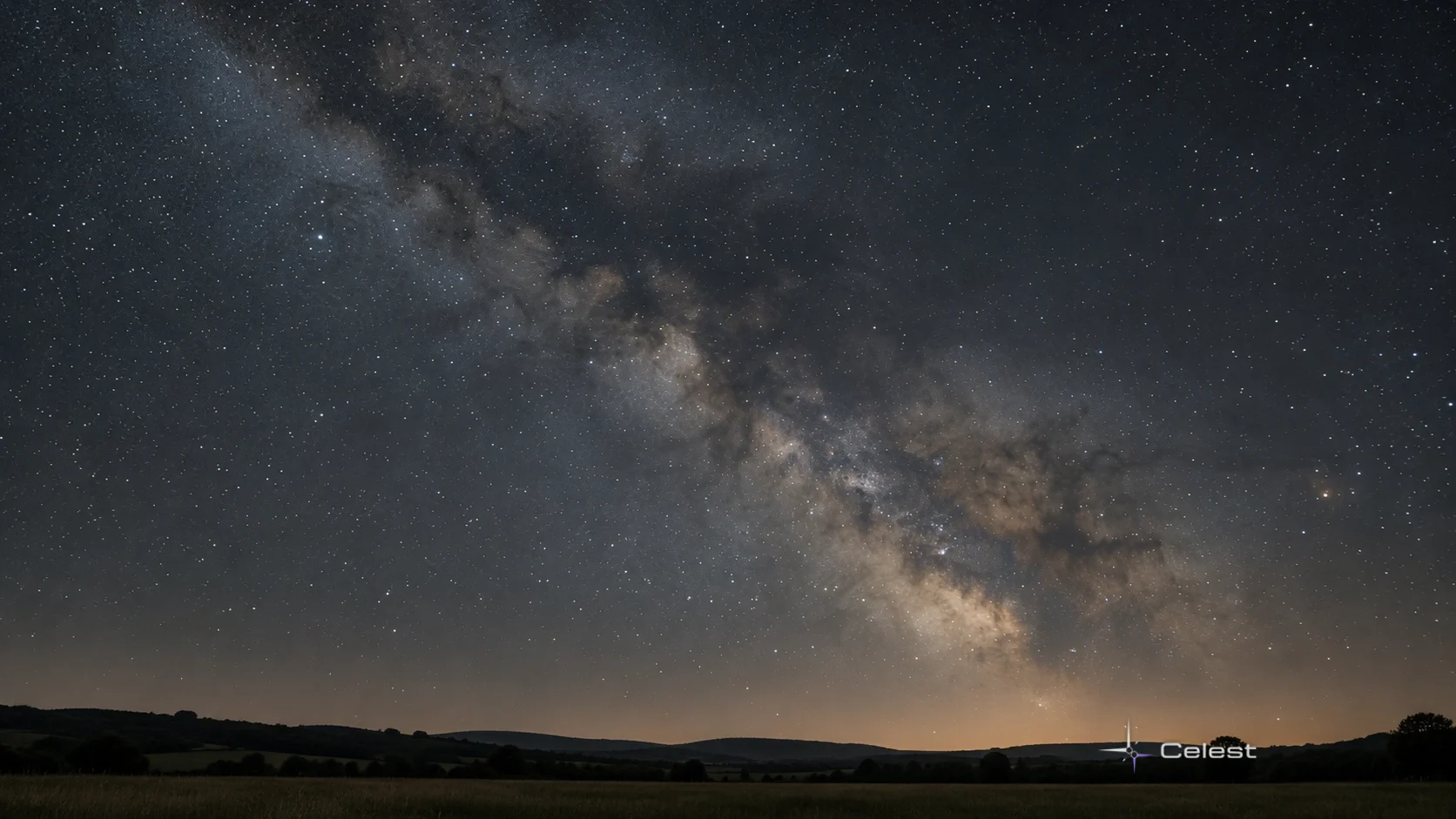
The Aquila constellation, the Eagle, contains Altair, one of the Summer Triangle’s three bright stars. Its easiest landmark is also a rapidly spinning star whose middle bulges outward. Compare the Eagle’s outline with neighbouring Lyra and Cygnus in the constellation guide.
Finding Altair is easier than completing the whole fainter figure. Set the live sky map to your time and location, then use the surrounding stars to trace the wings rather than expecting the Eagle to stay upright in one familiar drawing.
Aquila at a Glance
The bright star, the apparent pattern and the surrounding clouds have different physical meanings.
- Traditional figure: the Eagle, called Aquila in Latin.
- Official abbreviation: Aql.
- Brightest landmark: Altair, at the southern corner of the Summer Triangle.
- Altair’s distance: roughly 17 light-years, not the distance of the entire constellation.
- Fainter feature: the dark-cloud pair B142 and B143, nicknamed the E Nebula.
- Northern observing season: summer into early autumn, with placement checked for the actual date.
A Bright Corner Does Not Show the Whole Eagle
Altair joins Vega in Lyra and Deneb in Cygnus to make the Summer Triangle. This larger asterism, a recognisable shape made from stars, spans three official constellations. It gives you a broad frame before you look for Aquila’s smaller outline.
Most other stars in the Eagle’s figure are fainter than Altair. Under urban skyglow, the brilliant point may stand out while much of the wing pattern remains difficult. Knowing its orientation lets you match the landmarks you can see before searching for the weaker ones.
The traditional Eagle interpretation is a human reading of that pattern. Greek mythology linked it with Zeus, while other cultures gave the stars their own meanings. The official boundary now identifies a region of sky, not a physically connected animal-shaped stellar system.
Altair Spins Into a Different Shape
Altair is in the main sequence, the long stage when a star produces energy by fusing hydrogen in its core. At approximately 17 light-years away, its light takes about 17 years to reach Earth. This nearby landmark still appears as a point in an ordinary visual observation.
Specialised measurements tell a different story about its shape. An interferometer combines light collected by separated instruments to investigate small angular details. Palomar observations compared Altair’s apparent radius along different directions and found that it was not perfectly round.
Rapid rotation expands the equatorial region, leaving the star wider through the middle than between its poles. Later interferometric views confirmed the flattened form. The result describes stellar structure; it is not an oval you should expect to see through a beginner telescope.
The equator is also cooler and dimmer than the poles, an effect called gravity darkening. The comparison is relative: the equatorial region is still intensely bright. A darker band in a scientific model does not mean the star has a black, unlit strip around it.
A Dark Patch Can Contain More Than It Reveals
Toward Aquila, B142 and B143 form the dark features nicknamed the E Nebula. They are absorption nebulae, clouds that block visible light arriving from behind them. The nickname describes an apparent outline rather than a letter physically written in space.
Their cold gas can contain stable molecules, giving such regions the name molecular clouds. Dust mixed through the cloud obscures the background stellar field. That darkness is caused by material in the line of sight, not by every star disappearing from the region.
Do not confuse it with the effect of artificial light. Skyglow adds brightness to the background and makes faint stellar contrast harder to see. A dark nebula instead removes background light along particular sightlines. Both change the view, but through different mechanisms.
How to Explore the Eagle
For northern summer observation, identify the Summer Triangle and its Altair corner first. Use the oriented map to follow Aquila’s fainter outline, comparing more than one star. A correct bright landmark is a useful start even if the entire figure is not yet visible.
Binoculars let you explore the surrounding stellar field and, under suitable conditions, the E-Nebula region. Use a detailed chart for the dark feature rather than choosing any gap between stars and assuming it is the cloud.
Check the observing conditions before seeking those subtler fields. A quieter, darker sky helps preserve the contrast between the star-rich background and obscuring dust. Finding Altair, tracing the Eagle and identifying a dark cloud are three progressively different tasks.
Hidden Material Can Become the Next Stars
Cold clouds can develop dense gas concentrations that may collapse into stars. The broader Aquila Rift spans both Aquila and Serpens, and infrared studies reveal a complex containing young stellar regions rather than a simple empty divide in the Milky Way.
Herschel’s far-infrared measurements record dust emission that visible-light observations handle differently. Magnetic-field lines overlaid on a combined Herschel and Planck image represent inferred orientations, not luminous threads an observer sees through binoculars.
The dark view and the infrared view therefore answer different questions. A cloud can hide background stars while containing material for new ones. Learning Aquila lets you connect one conspicuous stellar point with places where the absence of visible light can itself point to substantial matter.
Leave a comment
Comments appear after moderation.