Aries Constellation: A Giant Star and a Distorted Spiral
Aries holds a bright stellar landmark and a distant spiral with an uneven shape. Hamal reveals an orbiting planet through small changes in its light; NGC 772 shows how a neighbouring galaxy can alter an entire spiral arm.

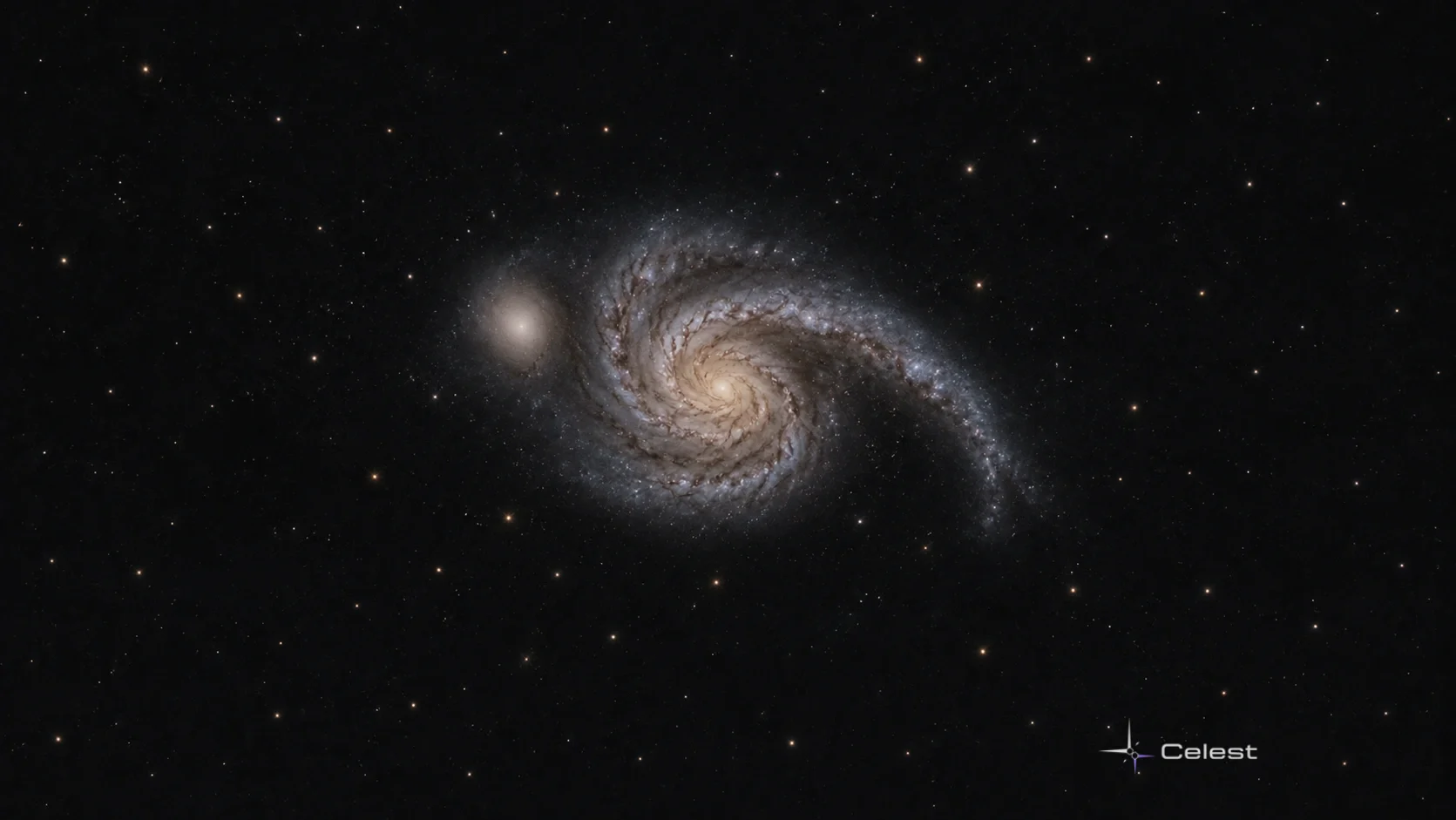
The Aries constellation, the Ram, contains Hamal, a giant star with a detected planet, and NGC 772, a distant spiral galaxy with an unusually long arm. Locate its region beside Taurus and Triangulum in the constellation guide.
Aries is useful to explore on northern winter or southern summer evenings. Set the live sky map to your latitude and date to see where its stars are now. These objects occupy the same patch of sky from Earth, while telling very different stories about gravity.
Aries at a Glance
Begin with its stellar landmarks before exploring the much fainter background.
- Traditional figure: the Ram.
- Official abbreviation: Ari.
- Sky position: north of the celestial equator, along the ecliptic.
- Bright landmark: Hamal, also called Alpha Arietis.
- Planetary clue: Alpha Arietis b, with a year of about 381 days.
- Distant galaxy: NGC 772, also catalogued as Arp 78.
The celestial equator projects Earth's equator onto the sky. The ecliptic is the Sun's apparent annual path, which crosses Aries. These are useful map references rather than lines visible among the stars, and they explain why Solar System planets can appear in this region at different times.
Start With Hamal and Its Neighbours
Hamal is a practical starting landmark. On charts it carries the Greek letter alpha; Sheratan carries beta. Learning both labels helps when you switch between a named-star guide and a chart that uses Greek letters. Identify the brighter landmarks first, then compare their spacing with the fainter surrounding points.
Use Taurus and Triangulum to establish the neighbouring regions before narrowing your view to Aries. Turn the chart to match the sky instead of expecting its printed page to remain upright. A view configured for the actual time gives a more useful direction than a fixed instruction to look left or right.
You can recognise the main stars without a telescope. Save the galaxy search for a more detailed chart and suitable equipment. Check observing conditions when planning that session: a darker background matters much more for an extended faint object than for identifying a bright stellar point.
Aries also lies in the Sun's direction during part of the year. The IAU education guide places its solar passage approximately between mid-April and mid-May. That astronomical position is separate from astrological sign dates; it is the actual sky region that a star map tracks.
A Planet Found Through a Star's Movement
Hamal is a K-type giant star, a different kind of host from our Sun. NASA's catalogue identifies its companion, Alpha Arietis b, as a gas giant. The listed orbital period is 380.8 days: a planetary year slightly longer than Earth's, without suggesting a similar surface or climate.
Astronomers detected the companion through radial velocity. This measures how quickly the star moves towards or away from us. Gravity from an orbiting planet changes that movement slightly, leaving a repeating signal in the star's spectrum, the light separated into its component wavelengths.
The signal is a subtle shift in spectral features, rather than a star visibly changing between red and blue to your eyes. Measuring it repeatedly allows astronomers to fit an orbit even when the planet itself is not resolved in an image.
A study published in 2011 analysed observations spanning November 2003 to February 2010. The researchers also examined signs of stellar activity and changes in spectral line shapes, because a giant star's own behaviour can complicate a planet search. The current archive lists the companion as confirmed.
The estimated minimum mass is about 1.8 times Jupiter's. Minimum matters: this method measures the part of the movement directed along our line of sight. Without fully determining the orbit's tilt, that result should not be presented as the planet's exact true mass.
A Spiral Arm Stretched Out of Shape
Far behind those stellar landmarks lies NGC 772. NASA gives its distance as roughly 100 million light-years. Professional images reveal a central concentration of light, dusty spiral structure and a particularly extended outer arm. It belongs to another galaxy, rather than to Hamal's planetary system.
NGC 772 is described as an unbarred spiral. It lacks the central bar of stars and gas found in barred spirals, including the Milky Way. Its uneven outer structure adds another distinction: a spiral galaxy can retain its general form while one arm becomes noticeably asymmetric.
The likely explanation involves gravitational interaction with the smaller companion NGC 770. A neighbouring galaxy's pull can affect an extended structure unevenly, producing gravitational tides that distort it. The visible shape records that influence without supplying a complete timetable of every past encounter.
Deep photographs also show dark dust lanes and young blue stellar groups along the prominent arm. Those details belong to demanding observations and processed images. A beginner should approach the galaxy as a faint extended object; identifying it and seeing the full photographed structure are different achievements.
Aries connects two ways of detecting gravity's influence. Around Hamal, precise measurements reveal a companion through stellar movement. In NGC 772, an altered arm points to interaction across galactic scales. What looks quiet from Earth can preserve evidence of unseen companions and continuing change.
Leave a comment
Comments appear after moderation.