Auriga Constellation: Capella, Clusters and a Runaway Star
Capella makes Auriga easy to start, while binoculars open a richer field of star clusters. The same sky region holds a star thought to have escaped from Orion and illuminated the cloud it now crosses.

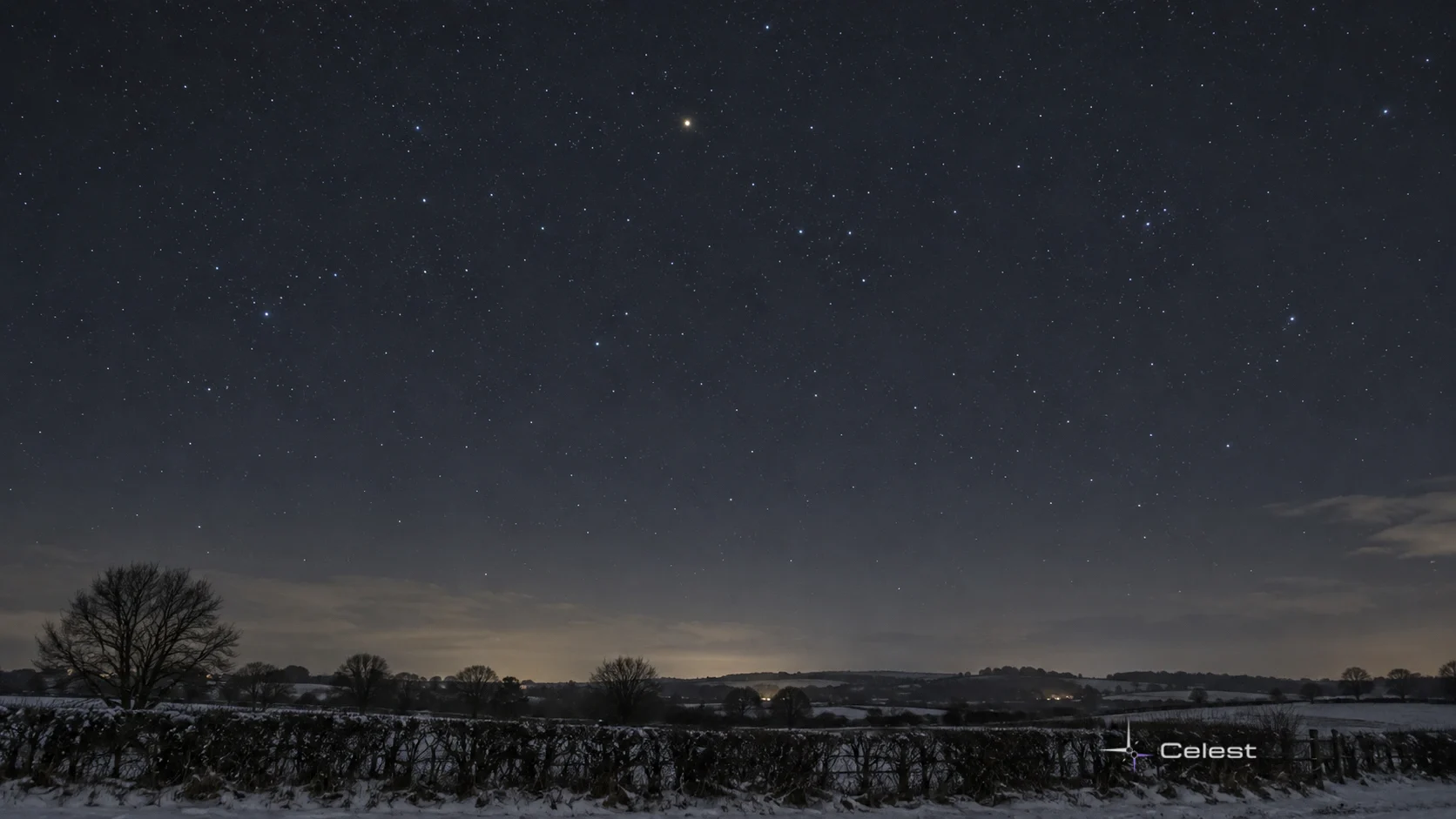
The Auriga constellation, the Charioteer, is a northern-winter landmark led by bright Capella. Its apparent outline also borrows a useful point from neighbouring Taurus: Elnath. Compare the two regions in the constellation guide, where boundaries and familiar star patterns serve different purposes.
Auriga rewards a second look beyond that outline. Three open clusters offer binocular destinations, while a less conspicuous star lights the Flaming Star Nebula. Start with the live sky map set to your location and time, rather than expecting every photographic feature to appear when you look up.
Auriga at a Glance
Its bright landmarks make an entry point into a much richer stellar field.
- Traditional figure: a chariot driver, called Auriga in Latin.
- Official abbreviation: Aur.
- Brightest landmark: Capella, approximately 42 light-years away.
- Useful neighbour: Elnath, officially in Taurus despite helping the outline.
- Binocular destinations: the open clusters M36, M37 and M38.
- Another story: runaway star AE Aurigae illuminates the Flaming Star Nebula.
Capella Leads a Pattern With a Borrowed Corner
Capella gives the figure a strong starting point. Its name means a female goat in Latin, and three smaller nearby stars carry the traditional nickname the Kids. That playful grouping belongs to the way people read a pattern; it does not describe a mother star and her physical offspring.
Elnath lies opposite Capella in the roughly rounded outline used in NASA’s winter guide. It helps you complete the apparent figure, yet the official boundary assigns it to Taurus. A drawing can therefore use a neighbouring landmark without moving that star into another constellation.
Modern constellations are defined regions of sky rather than one compulsory set of connecting lines. Auriga does not form a single stellar object at one distance. Even the roughly 42-light-year distance attached to Capella tells you about that system, not the entire picture surrounding it.
The bright light called Capella is itself more complicated than one dot suggests. Its close luminous pair consists of two giant stars orbiting each other in about 104 days. Giant describes an expanded stage of stellar development, not a large disk that ordinary eyes resolve in the night sky.
Measurements of motion and position reveal that close binary, a pair held in mutual orbit. A beginner should not expect to split those two bright giants simply by magnifying the dot. You can recognise the landmark first, while leaving its tightly packed structure to specialised observations.
Three Clusters Beyond the Outline
The Milky Way’s plane crosses Auriga, placing a rich stellar background behind its familiar figure. M36, M37 and M38 are open clusters in this direction. An open cluster is a relatively loose physical grouping of stars, unlike the whole constellation’s collection of unrelated sightlines.
Binocular observers can explore this trio with a sufficiently detailed chart. The catalogue numbers identify separate destinations, not three names for the same glow. Work on one cluster at a time and compare its location with the surrounding stellar field before moving to the next.
M38 offers an example of the variety inside such a group. Its population includes bright blue stars and a yellow giant. Their colours reflect differences in the stars rather than coloured markers on a diagram, though a photograph can make those differences more conspicuous than the visual view.
These clusters also change over time. They are loosely held by gravity, and some member stars gradually escape as the groups orbit within the galaxy. The compact patch you identify is a present stage in a developing stellar population, not a permanently sealed arrangement.
The Flaming Star Is Not Literally on Fire
AE Aurigae illuminates the cloud known as the Flaming Star Nebula, or IC 405. It is described as a runaway star: one travelling away from its birthplace after being ejected. Its likely origin lies in Orion’s Trapezium cluster, where a stellar encounter is thought to have sent it outward.
That origin is a reconstruction from evidence, not an explosion astronomers watched happen. The constellation name describes the star’s direction now. It does not require AE Aurigae to have formed beside every object that currently appears around it.
Surrounding gas emits light, while dust reflects visible starlight and glows at infrared wavelengths when heated. WISE observations assign colours to infrared bands that our eyes cannot see. The resulting fiery appearance explains the nickname without describing ordinary chemical flames floating in space.
How to Find and Explore Auriga
On a northern winter evening, locate Orion first, then use your oriented chart to move northward toward Capella. Identify Elnath on the opposite part of the outline and match the intervening stars. The figure’s tilt and compass placement change with the hour, date and observing latitude.
Use the observing conditions before attempting the subtler cluster fields. Then take a detailed map to the binoculars and search separately for M36, M37 and M38. Finding Capella, distinguishing a cluster and identifying nebular emission are different levels of the same exploration.
A Familiar Pattern Can Orient a Spacecraft
In late 2022, NASA’s LunaH-Map used images containing Auriga stars to test autonomous optical navigation. Its software recognised stellar positions and estimated the camera’s orientation. This was an instrument measurement, rather than a claim that the spacecraft saw the entire traditional figure.
The connection gives Auriga another practical meaning. You match its landmarks to a chart to decide where you are looking; a spacecraft can compare stellar points with a catalogue to establish its viewing direction. A pattern invented to organise the sky can still lead to useful measurements beyond Earth.
Leave a comment
Comments appear after moderation.