Beehive Cluster (M44): Its Stars and Hidden Planets
The Beehive’s broad patch resolves into individual stars through binoculars. Precise measurements add another layer: planets revealed by the motion of their host stars.

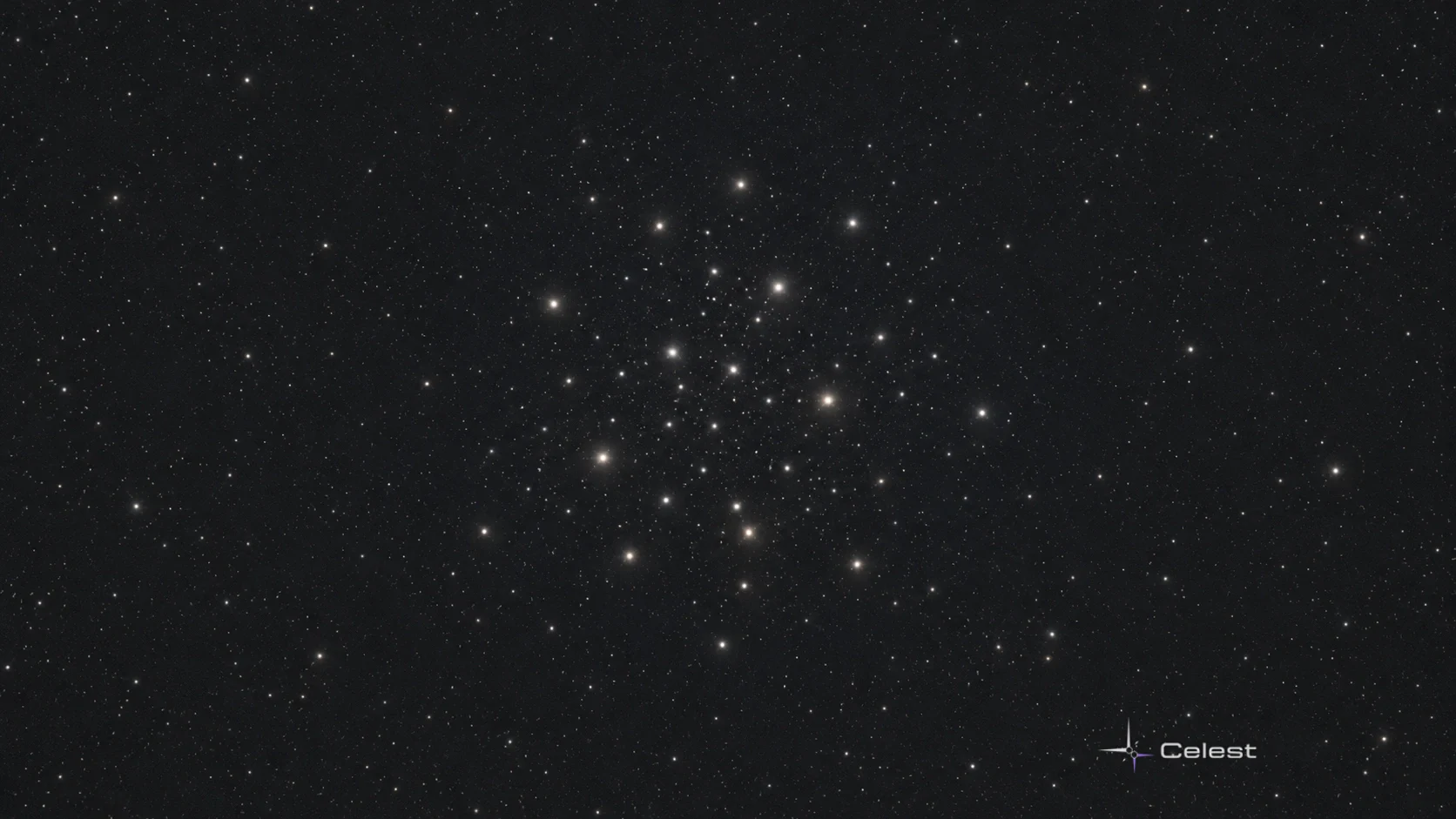
Messier 44, the Beehive Cluster, is a wide group of stars in Cancer. Under a good dark sky it can look like a faint cloud, while binoculars turn part of that cloud into individual points. Its other familiar name, Praesepe, refers to the same cluster.
What you can see is only the beginning of its story. Some M44 stars have planets whose presence was established through precise measurements of stellar motion. You do not need to see a planet separately to learn that it is there: its gravity leaves a detectable effect on the star it orbits.
Messier 44 at a Glance
- Object type: an open cluster, with stars loosely held together by gravity.
- Constellation: Cancer.
- Approximate distance: 600 light-years in NASA’s Hubble catalogue.
- Estimated population: around 1,000 stars in the same description.
- Approximate age: 600–700 million years.
- Apparent magnitude: about 3.7 for the combined light.
- Apparent width: around 1.5 degrees, or three full-Moon widths.
Apparent magnitude is a measure of brightness seen from Earth. For M44 it describes the group’s accumulated light, rather than the visibility of every member. Its wide spread is one reason to begin with a broad observing field instead of immediately selecting high magnification.
Where Can You Look for the Beehive?
Cancer lies between the brighter constellations Gemini and Leo. The constellation guide helps you place those neighbours, then work toward Cancer’s less conspicuous pattern. M44 lies near the middle of the constellation and is particularly useful during northern spring evenings.
Try looking with your eyes first, then bringing binoculars to the same area. If the unaided view is too faint, use the brighter surrounding stars to guide the search. The sky map for your chosen evening shows their arrangement without requiring you to memorise the whole constellation in advance.
What Changes When You Use Binoculars?
More of the broad haze separates into individual stars. You can follow small groups of points, compare their brightness and see gaps within the larger patch. Galileo made a related change in understanding when he resolved around forty stars through a telescope, according to NASA’s catalogue.
A telescope can reveal additional members, but keep enough sky in view to appreciate the whole group. Hubble’s detailed images cover selected outskirts and even include galaxies beyond M44. Sharing an image does not make those distant galaxies part of the cluster; the view contains objects at different depths.
Which Planets Were Discovered in 2012?
The reported planets, Pr0201 b and Pr0211 b, orbit two different Sun-like stars. They are exoplanets, meaning worlds outside our Solar System. Both were classified as hot Jupiters: large gas planets that orbit close to their stars and receive intense heating.
The 2012 analysis gave their orbital periods as about 4.4 days and 2.15 days respectively. A period is the time needed to complete one circuit of the star. These short years are very different from Jupiter’s broad orbit in our own planetary system.
Those two discoveries were a historical first for Sun-like stars in an open cluster. They are not a statement that M44 has only two planets today. The discovery matters because it established particular worlds through measured signals, then opened those systems to further study.
How Can an Unseen Planet Move a Star?
Gravity acts between both objects. The planet goes around the star, while the star also makes a smaller motion. Astronomers measure the part of that movement directed toward or away from Earth, known as radial velocity.
The star’s light supplies the evidence. Its wavelengths shift slightly as it approaches and recedes, and repeated measurements can trace a recurring pattern. The 2012 team used this method rather than direct pictures of the planetary disks. The planet guide offers a starting point for comparing these systems with our familiar neighbours.
How Do Researchers Check the Signal?
They test whether another effect could account for the measurements. Stars have activity of their own, so changes cannot automatically be attributed to a planet. The 2012 authors compared indicators of stellar activity and the shapes of spectral features with the proposed orbital pattern.
A later study of Pr0211, published in 2016, combined measurements of its motion with observations of changing brightness. The team modelled the star’s activity alongside its planets. This made it possible to interpret what remained after the already known short-period motion was accounted for.
What Did the Longer Observations Reveal?
The 2016 analysis reported a long-term signal attributed to a second, massive planet farther from Pr0211. Its inferred orbital period was longer than 3,500 days, and its orbit was much more elongated than the inner planet’s nearly circular path.
The outer planet’s quoted mass depended on the angle of the system relative to us, so the paper reported a projected minimum mass. These qualifications are part of the result. A short recurring signal and a slower trend can describe different companions, but their exact properties require a suitable model and sufficient observations.
Why Is the Beehive Useful Beyond Its Appearance?
Its stars share a broadly common birth environment, giving researchers a helpful background for studying how stellar and planetary systems evolve. The 2016 authors discussed possible earlier gravitational interactions, while leaving the history inferred rather than directly witnessed.
When you next look at M44, let the visible points connect those two kinds of discovery. Binoculars separate stars from a faint patch. Patient measurements separate planetary effects from the light and motion of a star. The same familiar group can be both a beautiful observing stop and a place where unseen worlds become measurable.
Leave a comment
Comments appear after moderation.