Canis Major Constellation: Sirius and the Great Dog
Sirius makes the Great Dog easy to begin recognising. The surrounding region connects a nearby stellar pair, groups born together and a much less conspicuous star shedding enormous amounts of material.

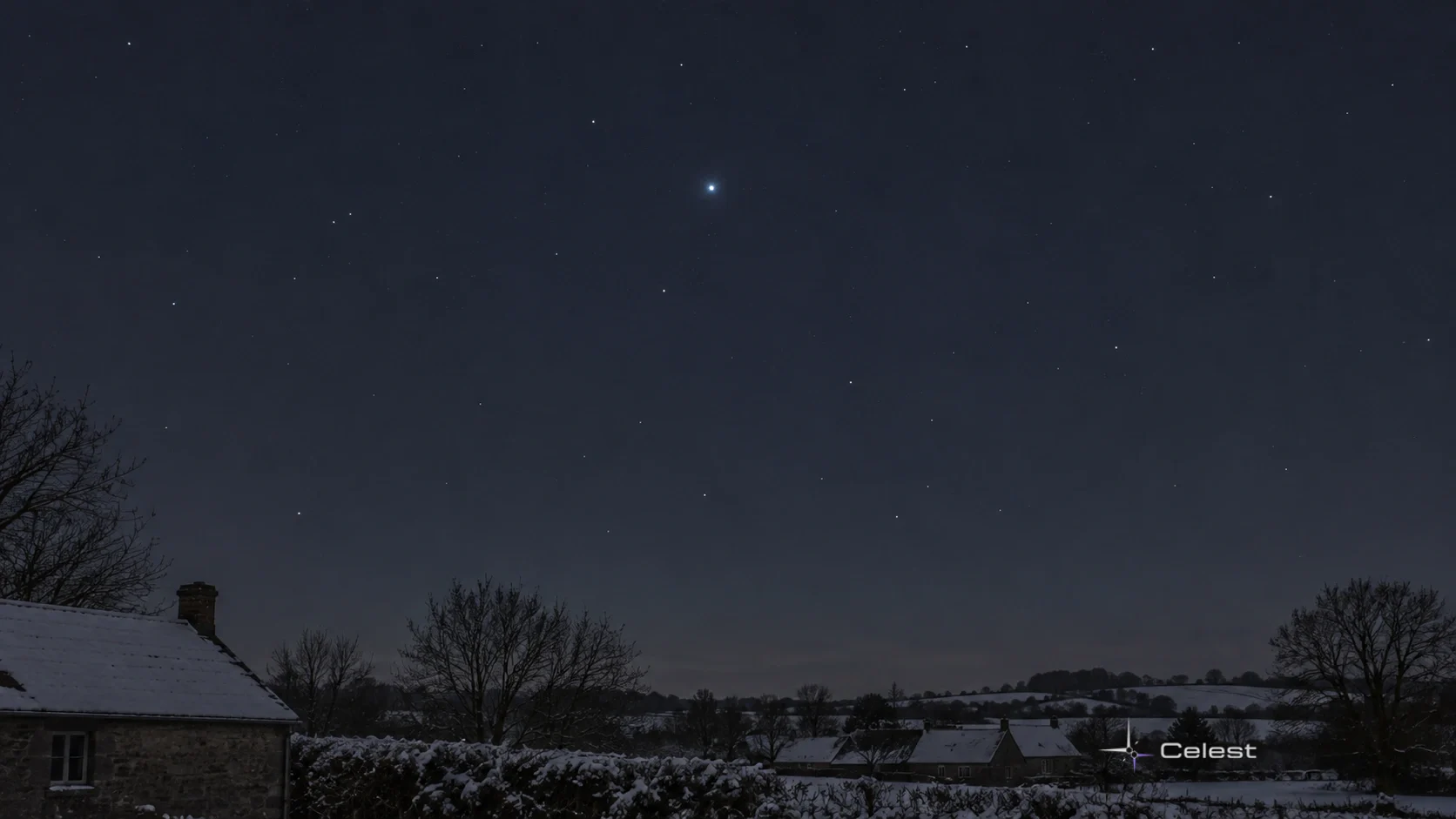
The Canis Major constellation, the Great Dog, contains Sirius, the brightest star in the night sky. Its most obvious landmark belongs to a nearby stellar pair, while the surrounding region includes star clusters and a red hypergiant. Locate the region beside Orion in the constellation guide.
The three stars of Orion's belt give you a useful first route toward Sirius. Check their orientation in the live sky map, set to where and when you observe, before trying to recognise the rest of the dog.
Canis Major at a Glance
The bright landmark and the broader constellation have different roles.
- Traditional name: the Great Dog.
- Official abbreviation: CMa.
- Sky position: south of the celestial equator, the sky's extension of Earth's equator.
- Main landmark: Sirius, also called the Dog Star.
- Sirius's distance: about 8.6 light-years, the distance its light crosses in that many years.
- Useful season: late-winter evenings for northern observers; late-summer evenings in the south.
A Nearby Star Makes a Strong Landmark
Sirius wins the night sky's stellar brightness contest as seen from Earth. That ranking concerns apparent brightness, rather than how much energy each star produces. The Sun belongs to the daytime sky, and a bright planet is a different kind of object.
Distance helps explain the result. Sirius is relatively close to the solar system, so its light has a much shorter journey than light from many stars visible in the same direction. A light-year measures that journey's distance, rather than the age of a star.
The bright point also conceals a second star. Sirius A is accompanied by Sirius B, a white dwarf: the compact remnant left after a star's giant phase. You can recognise the system with your eyes without separating its two components.
Seeing the companion through a telescope is a different task. Its faint light sits close to the brilliance of Sirius A. Start by learning the surrounding star pattern; recognising the Dog Star does not require resolving the pair.
A Dog Drawn Across Separate Distances
Canis Major is one of the 88 officially defined sky regions. A constellation's boundary sorts directions, while the connecting lines on a chart help you remember a shape. Neither set of lines appears overhead, and neither turns its stars into one physical group.
The difference matters when you compare Sirius with nearby-looking objects. They can lie inside the same outline while having different distances, sizes and histories. The pattern tells you where to look; it does not tell you that its members formed together.
The name also carries several traditions. One Greek and Roman account places Orion's larger hunting dog here and the smaller dog in Canis Minor. Another connects the region with Laelaps, a legendary hound. Those stories explain the remembered figure, rather than why the stars occupy these directions.
Groups That Really Belong Together
The open clusters M41, NGC 2360 and NGC 2362 lie within the constellation's boundaries. An open cluster is a group of stars associated with one another, making it different from the broad sky drawing around it.
M41 contains conspicuous blue stars and orange-looking red giants among less conspicuous members. These appearances reflect different stellar temperatures and stages of development. A star field can therefore carry physical information even when its brightest members first catch your attention as simple points.
Be careful when comparing your view with a processed photograph. In NASA's 2025 image of M41, diffuse hydrogen emission was selected with a filter and enhanced. Those red filaments are a feature of that photographic presentation, not a promised binocular view.
How to Begin With Orion
Northern late-winter evenings offer a useful starting season. For southern observers, the comparable evening season is late summer. Use the map for the date you choose, since the same pattern's position changes through the night and across the year.
Find Orion's three belt stars, then extend their line toward Sirius. In the familiar northern view this goes downward; the southern view reverses that orientation. Confirm the bright point before tracing fainter stars around it.
Compare the chart's symbol sizes with the stars you see: larger symbols usually indicate brighter points. You can then examine the surrounding fields through binoculars. Check observing conditions when planning a darker outing, particularly if the weaker parts of the pattern disappear in city light.
The Brightest Point Hides Part of the Story
The constellation also contains VY Canis Majoris, an enormous red hypergiant. A 2021 Hubble study connected expelled material with episodes when the star faded. Dust obstructing some of its light was the suggested explanation; the star was described as too faint for unaided viewing despite its great intrinsic luminosity.
That contrast changes what a familiar star pattern means. Sirius can dominate your view without representing the region's most extreme physical object. Meanwhile, clusters such as M41 can slowly disperse as their members follow different paths. The Great Dog's outline stays a useful guide across very different stellar lives.
Leave a comment
Comments appear after moderation.