Canis Minor Constellation: Procyon and a Star With a Disc
Procyon makes the Little Dog easy to begin with. Nearby on the sky, Gomeisa offers a different stellar story: rapid rotation, material outside the star and delicate measurements of its light.

Canis Minor, the Little Dog, is a compact constellation with relatively few bright stars. Procyon provides the obvious starting point, while Gomeisa offers a quieter second landmark. The constellation guide places the region beside Gemini, Monoceros, Hydra and Cancer.
The two landmarks lead to different observing questions. Procyon helps you trace the wider winter sky; Gomeisa is studied for a thin disc of gas outside the star. Begin with the live sky map to identify their positions before connecting the visible pattern with those physical stories.
Canis Minor at a Glance
- Traditional name: the Little Dog.
- Brightest landmark: Procyon, Alpha Canis Minoris.
- Other useful landmark: Gomeisa, Beta Canis Minoris.
- Wider pattern: the Winter Triangle.
- Sky position: the constellation spans the celestial equator.
- Research target: Gomeisa’s surrounding gaseous disc.
A Small Region Helps Join the Winter Sky
Canis Minor’s prominent stars give you a manageable starting area. A chart contains fainter stars and an official boundary as well, so recognising the bright landmarks is different from identifying every object within the region. Start with Procyon, then compare its position with Gomeisa.
The constellation spans the celestial equator. At least part becomes visible during the year from throughout Earth, while only the most polar regions miss some of the whole constellation. Its evening role in the Winter Triangle is especially useful during northern winter, or southern summer.
The Winter Triangle uses Procyon, Sirius and Betelgeuse. Those stars belong to Canis Minor, Canis Major and Orion respectively. It is an asterism, an apparent pattern crossing constellation boundaries, rather than a separate officially bounded constellation.
Procyon also belongs to the larger Winter Circle. NASA’s 2024 guide traces that pattern through Rigel, Aldebaran, Capella, Pollux, Procyon and Sirius. Learning the smaller triangle first gives you fewer points to recognise before adding that wider route across the sky.
A Landmark Is an Apparent Position
Procyon is a nearby bright star; the cited NASA solar-neighbourhood overview gives a rounded distance of 11.4 light-years. Its usefulness as a landmark comes from its apparent brightness and position. The star’s physical distance is a separate piece of information.
Stars forming an apparent pattern need not share a physical location or similar properties. Their light reaches us from different distances, while a chart projects directions onto a flat surface.
A constellation gives you directions on the sky, while physical relationships require other measurements.
The Little Dog therefore links objects that can be studied for very different reasons. Once you have identified the visible points, the next step is to ask what each star’s light reveals. Gomeisa supplies a particularly clear example of material surrounding a star.
Gomeisa Has Gas Outside the Star
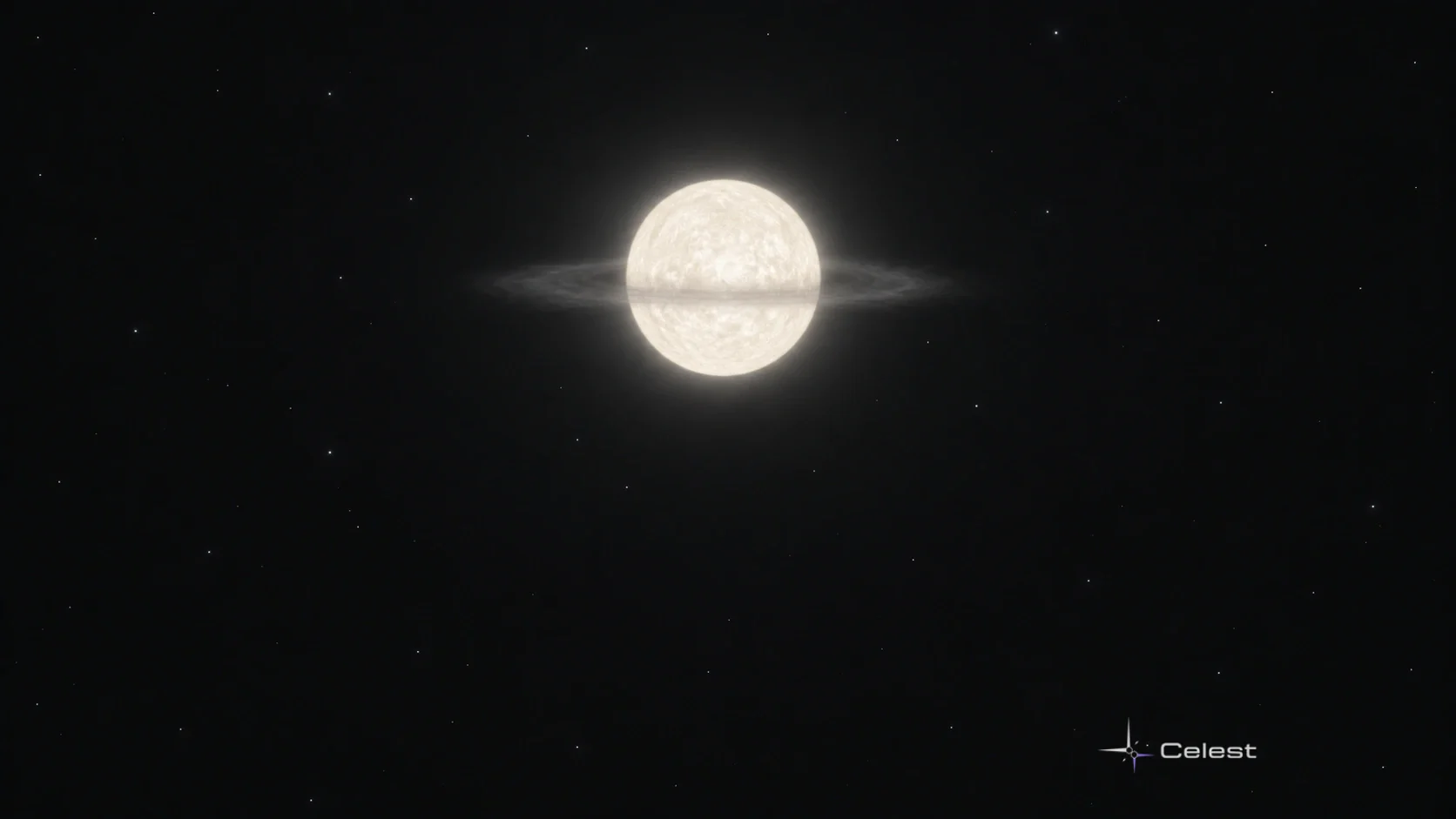
Gomeisa, also called Beta Canis Minoris, is a hot Be star. The designation refers to a B-type star whose spectrum includes emission lines. In this case, a thin gaseous disc around the star contributes distinctive light to the spectrum.
Classical Be discs consist of material ejected from a rapidly rotating star. The gas orbits around it, and models describe transport outward through the disc. The detailed way material is first supplied remains a research question; fast rotation alone is not a complete explanation of every step.
A 2015 analysis combined spectra, brightness measurements, polarization and interferometry. Its modelling inferred very rapid stellar rotation. A 2017 recalculation corrected a software issue affecting the disc’s density model, while retaining the broad conclusion of very rapid rotation.
These studies compare several kinds of observations with physical models. The disc’s apparent size, brightness and gas emission probe different parts of the same structure. Combining them helps test whether one proposed disc model explains the evidence consistently.
Light From the Disc Reveals Motion
Intense starlight removes electrons from atoms in the gas, a process called ionisation. When hydrogen regains electrons, it emits characteristic light. Gas moving toward or away from us shifts that emission slightly in wavelength. Those spectral changes reveal motion outside the star.
In 2025, a team used a specialised instrument at the Subaru Telescope to recover spatial information from Gomeisa’s hydrogen-emitting disc. The technique combines careful handling of the incoming light with measurements at different wavelengths, rather than relying only on an ordinary intensity image.
The reported demonstration measured an asymmetry between the disc’s nearer and farther sides during about ten minutes of observation. That is a particular research measurement with specialised equipment. It shows how much information a carefully measured point of light can contain.
Try the Bright Route Before the Fainter Field
Use Orion and Sirius to establish the wider winter pattern, then identify Procyon as the third Winter Triangle point. Compare the current chart with the sky before tracing Gomeisa. The relative layout becomes easier to remember when you have several bright landmarks around it.
Binoculars can help you explore the fainter field once the main points are familiar. Check observing conditions before comparing those smaller stars. Your observing task is to recognise Gomeisa; the thin disc is investigated through specialised measurements rather than appearing as a separate ring in the eyepiece.
A Simple Outline Leads to Different Physics
Canis Minor combines an easy landmark with a less obvious gas-disc system. One constellation can serve as a practical map region while holding objects whose light requires very different interpretations.
That connection gives the simple pattern a deeper purpose. You can begin by recognising a few points, then understand how spectra and precise instruments turn one of those points into evidence about a star and the moving material around it.
Leave a comment
Comments appear after moderation.