Capricornus Constellation: Faint Stars and a Hidden Angle
Capricornus combines faint evening stars with a nearby-looking but distant cluster. A separate system in its direction shows why measuring motion and understanding its geometry are different steps.

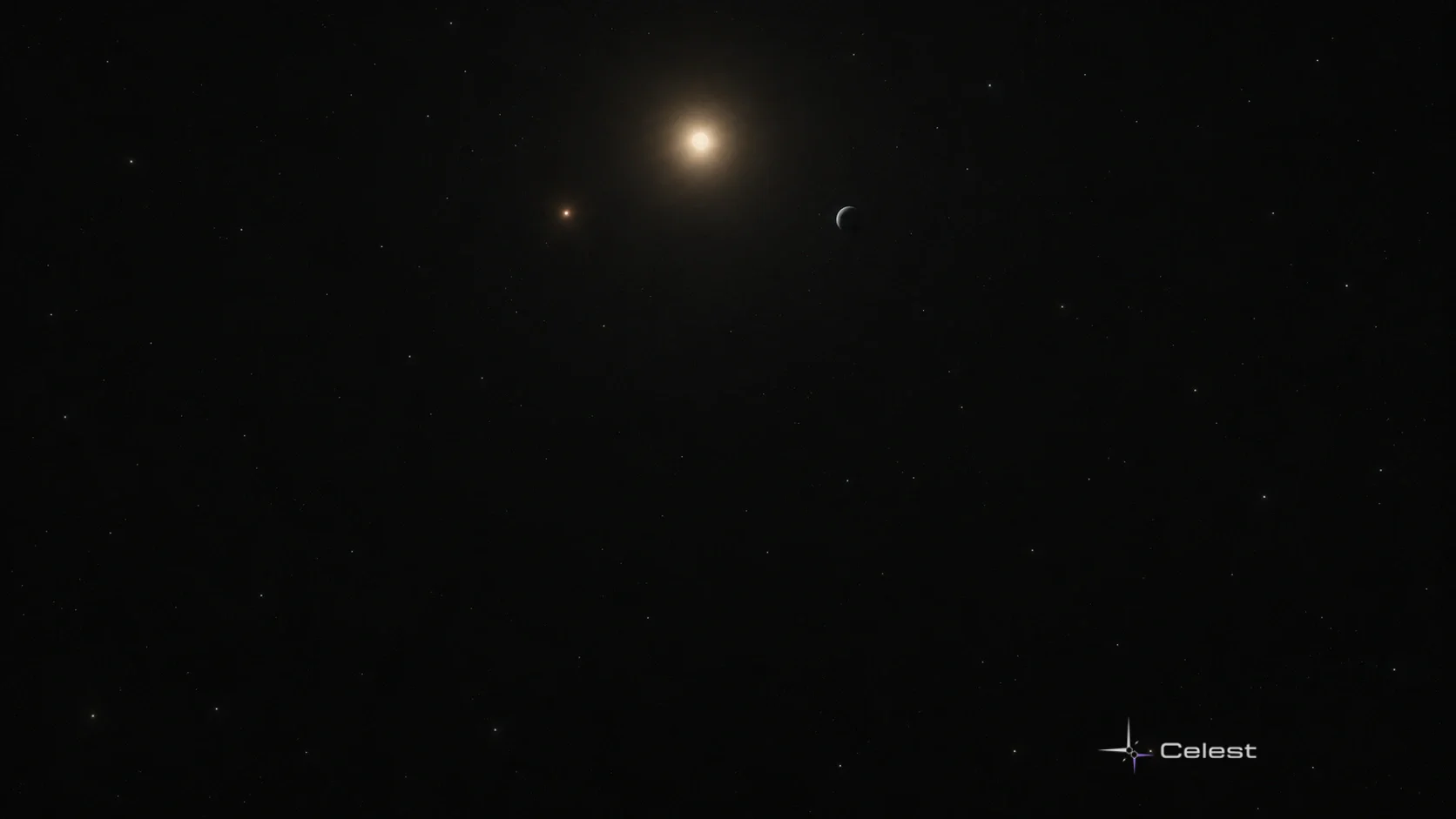
Capricornus is a southern constellation on the ecliptic, the Sun’s apparent yearly route across the sky. Its stars are relatively faint, so learning its position beside brighter, familiar regions is often more useful than expecting a striking figure at first glance.
Start with the constellation guide, then compare Capricornus with Aquarius, Aquila and Sagittarius. Within this mapped region, a globular cluster offers a binocular subject, while the system HD 202206 shows how a hidden orbital angle can change the masses astronomers infer.
Capricornus at a Glance
- Romanian name: Capricornul.
- Sky position: just south of the celestial equator.
- Evening season: northern autumn or southern spring.
- Sun’s passage: roughly January to February.
- Cluster: M30, around 28,000 light-years away.
- Research example: HD 202206 and its debated orbital geometry.
Where Should You Look for Capricornus?
Use its neighbours to locate the region. Aquarius, Aquila, Sagittarius, Microscopium and Piscis Austrinus surround it. The constellation lies south of the celestial equator, which extends Earth’s equator onto the sky.
For an evening attempt, northern autumn or southern spring provides the seasonal reference. Open the live sky map for your own location and chosen hour, then work from a nearby pattern you recognise.
Trace a few stars at a time.
The IAU educational chart places the Sun in Capricornus from about mid-January to mid-February. That passage describes the Sun’s direction against the constellation; the useful evening season is a different piece of information.
What Do the Lines on a Chart Mean?
They organise the sky. Joining lines suggest a recognisable figure, while boundaries determine which constellation contains an object’s direction. Larger plotted dots generally represent stars that look brighter from Earth.
The apparent grouping does not make every star a physical neighbour. Capricornus gives you a region to explore, containing objects with different distances and histories.
What Can You Observe in M30?
A distant concentration of stars. M30 is a globular cluster: a roughly rounded stellar swarm held together by gravity. NASA places it around 28,000 light-years away and gives it apparent magnitude 7.7.
Magnitude measures brightness as it appears from Earth.
The catalogue lists M30 as visible through binoculars, with October a favourable observing month. Try recognising its compact glow first, then compare that impression with photographs that separate many individual stars. The cluster belongs to the constellation’s direction, rather than sitting beside every star in its outline.
Why Is HD 202206 an Interesting System?
Its companions’ inferred identities depend strongly on orbital geometry. Primary catalogue coordinates place the star within Capricornus, and research has combined its changing light with extremely precise measurements of its position.
Radial velocity measures motion towards and away from us through shifts in starlight. Astrometry follows changes in the star’s position across the sky. Both can reveal gravitational effects from companions, but they constrain different parts of the motion.
A small measured signal can therefore have more than one explanation until the geometry is constrained.
How Can the Viewing Angle Affect Mass?
A radial-velocity measurement captures the motion along our line of sight. The inclination describes how the orbit is tilted relative to our view. Changing the assumed inclination changes the companion mass needed to explain the recorded movement.
This is why a minimum mass and a mass inferred with an orbital angle are different results. Astronomers combine complementary measurements to learn which three-dimensional arrangement fits.
The orbit does not physically tilt just because a newer paper describes it differently. The revised quantity is our estimate of its orientation.
What Did the 2017 Model Propose?
A nearly face-on system. Benedict and Harrison combined Hubble Fine Guidance Sensor astrometry with previously published radial velocities. Their model described an inner companion of stellar mass and an outer brown dwarf.
A brown dwarf lacks the mass needed to sustain hydrogen fusion like an ordinary star. It occupies a different physical category from a hydrogen-burning stellar companion, so the geometry changed more than a decimal place in a table.
The published interpretation belongs to that analysis and its data.
What Changed in the 2026 Analysis?
Cao and colleagues challenged the nearly face-on geometry. They used Hipparcos–Gaia motion information, Gaia catalogue constraints and a new dynamical fit to radial velocities from CORALIE and HARPS.
Their best-fit model, assuming both companions share an orbital plane inclined by about 51 degrees, gave an inner brown dwarf of about 21.56 Jupiter masses and an outer giant planet of about 3.12 Jupiter masses.
Those numbers describe that specific model, not a direct weighing or a photograph of either companion. The two studies should be compared with their dates and assumptions intact.
What Does the Roughly 5:1 Rhythm Tell Us?
The inner companion completes about five circuits in the time the outer one makes one. Their gravitational interactions create a dynamical problem, not simply two independent clocks.
The 2026 analysis examined the resonance and found its model stable in its simulations. This tests whether a proposed arrangement can persist, adding a useful constraint beyond reproducing a short stretch of observed motion.
Check the observing conditions before choosing an evening for the constellation. You can explore its faint stars and M30 while appreciating a different kind of discovery: sometimes understanding what circles a star requires finding the angle from which we happen to see it.
Leave a comment
Comments appear after moderation.