Cepheus Constellation: A House of Stars and a Distance Clue
Many observers recognise Cepheus as a simple house near the North Star. Its famous variable, Delta Cephei, connects a change you can follow across several nights with the measurement of much larger distances.

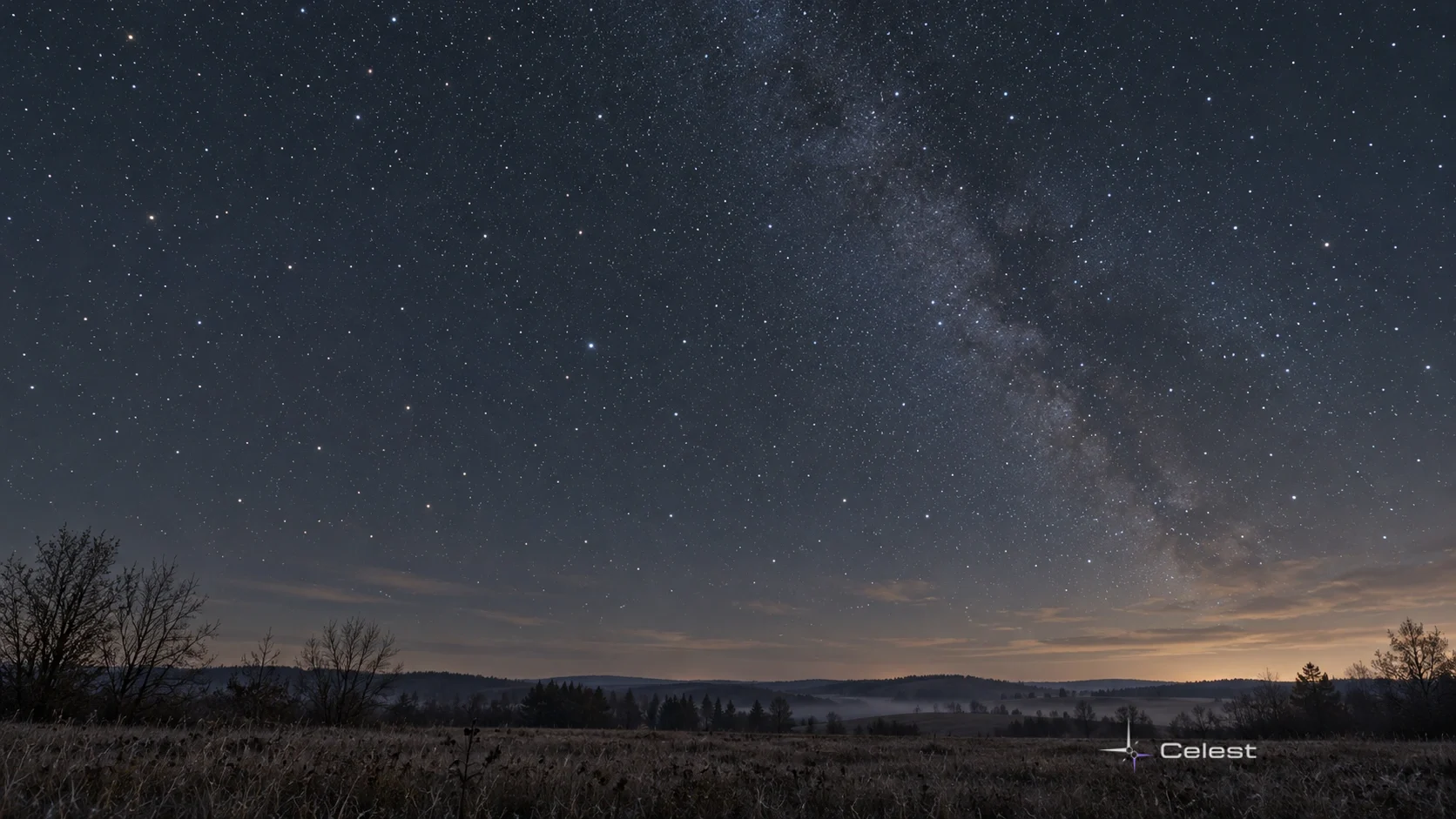
The Cepheus constellation, the King, is often easier to recognise as a simple house with a peaked roof. Inside it, Delta Cephei brightens and dims on a roughly five-day rhythm. Compare the house with neighbouring Cassiopeia and Ursa Minor in the constellation guide.
This northern figure sits close to the north celestial pole, so many mid-northern observers can return to it throughout the year. Set the live sky map to your location and time before choosing a field: its orientation changes, and visibility depends on latitude.
Cepheus at a Glance
The familiar outline connects several different stellar stories rather than one physical group.
- Traditional figure: the King, with a commonly recognised house-shaped outline.
- Official abbreviation: Cep.
- Northern evening season: especially late autumn.
- Famous variable: Delta Cephei, the prototype of Cepheid variables.
- Its brightness cycle: approximately 5.4 days, rounded from an AAVSO reference period.
- Colour landmark: Mu Cephei, the red Garnet Star.
A Northern House That Does Not Stay Upright
The King interpretation comes from mythology, while the house is a practical way many observers remember the outline. Neither reading changes the official sky region. The stars can share an apparent roof-like pattern without belonging to one nearby physical system.
Cepheus is circumpolar for many observers at middle and higher northern latitudes: it stays above the horizon rather than setting. Its apparent position turns around the north celestial pole, near Polaris. The house on a chart therefore does not keep one upright orientation through the night.
Use Cassiopeia and the North Star as broad landmarks, then match Cepheus to your actual map. For a more southerly observer, only part of the northern constellation may be accessible. Being familiar with one drawing is less useful than matching its tilt and surrounding stars correctly.
Delta Cephei Adds Time to the Observation
A variable star changes its brightness. Delta Cephei gives its name to a class whose changes follow a recognisable cycle. An AAVSO reference lists its period as 5.366 days, or about 5.4 days when rounded, allowing repeated observations across several nights to sample different parts of the cycle.
Cepheids pulsate: they expand and contract while their light output changes. The cycle means one repetition of brightening and fading. It is not the time needed for a companion to circle the star, nor the rapid sparkling caused by looking through Earth’s atmosphere.
AAVSO describes Delta’s variation as accessible to unaided eyes under suitable conditions. Use a current comparison chart to identify the field and estimate brightness against its selected reference stars. Keep dates and times with the estimates, instead of treating an uncertain memory of yesterday’s appearance as a measurement.
You do not need to see an expanding stellar disk to follow the change. The useful observation is how bright the point looks relative to the comparison field. Several visits give information that one magnified snapshot cannot show.
The Garnet Star Has a Different Rhythm
Mu Cephei is a very large evolved red star, traditionally known as Herschel’s Garnet Star. Its cooler surface contributes to its redness, while dust between it and us further reddens the light. The nickname refers to its deep colour.
It also varies, but it is not simply another example of Delta’s reliable Cepheid pattern. Different variable-star types change for different reasons and on different timescales. Recognising variability is therefore the beginning of classification, rather than proof that every changing star works as the same distance reference.
Dust Hides Young Stars in IC 1396
Toward the larger nebula IC 1396, the elongated dark cloud called the Elephant’s Trunk contains dense gas and dust. It blocks visible light from embedded objects. Spitzer’s infrared observations revealed young stars and protostars, stars still forming within the obscuring material.
The published colours represent selected infrared wavelengths. They do not describe the view through ordinary binoculars. This field provides another reason to distinguish a scientific image from an observation you can make directly.
How to Build a Useful Cepheus Session
Start by recognising the house in an oriented map, then locate Delta with a detailed finder chart. Check the observing conditions before making repeated brightness estimates. Binoculars can help with the field, while a carefully chosen comparison chart keeps the same reference across different nights.
Try returning over several nights and recording which comparison stars look brighter or fainter than Delta. Do not force an exact estimate when the difference is uncertain. Mu Cephei’s colour offers a separate observation; subtle nebular detail is another task requiring different expectations.
A Changing Star Can Become a Distance Tool
For a calibrated Cepheid class, the pulsation period relates to intrinsic luminosity, the amount of light the star actually emits. Longer-period members are intrinsically brighter. Comparing that inferred output with the light received on Earth lets astronomers estimate distance, extending the method to Cepheids in other galaxies.
The relationship still needs careful calibration. Material lost around Delta Cephei can alter its apparent brightness, and crowded neighbouring stars can contaminate a distant measurement. Observations at different wavelengths and with better resolution help investigate those effects.
The lesson goes beyond finding one northern pattern. A star’s changing light can provide a reference that a single bright point lacks. By following a repeated rhythm, astronomers turn time into information about distance, while checking the conditions that make the comparison trustworthy.
Leave a comment
Comments appear after moderation.