Cetus Constellation: A Changing Star With a Long Tail
Cetus contains Mira, a star whose brightness changes over months, and the active spiral galaxy M77. Ultraviolet observations revealed a long trail of material behind Mira, showing how a familiar stellar point can hold a much larger story.

The Cetus constellation, often called the Whale, contains Mira, a star that changes brightness over months, and M77, a spiral galaxy with a highly active centre. Locate its broad region beside Pisces and Aries in the constellation guide.
Northern late-autumn and southern late-spring evenings provide useful seasonal starting points. Set the live sky map to your latitude and time before searching. Cetus crosses the celestial equator, so its familiar drawing can extend over a substantial part of your view.
Cetus at a Glance
Its stars and background galaxy offer different kinds of observing projects.
- Traditional figure: the Whale or Sea Monster.
- Official abbreviation: Cet.
- Main stellar landmarks: Diphda and Menkar.
- Changing star: Mira, also called Omicron Ceti.
- Reference variability cycle: about 332 days for Mira.
- Active galaxy: M77, also catalogued as NGC 1068.
The stars used to trace Cetus are landmarks in one region of the sky. Mira and M77 share that region when viewed from Earth, while belonging to very different physical settings. The constellation name helps you find them before examining what their light reveals.
Build the Outline Before Searching for Mira
Identify Diphda and Menkar on the chart first. Some guides use their Greek-letter names, Beta Ceti and Alpha Ceti, so recognising both forms avoids confusion. Establish the surrounding Pisces and Aries regions, then compare the intervening stars with the map at a scale that includes the wider constellation.
Mira is a rewarding addition once you have that context. Its brightness changes enough that the naked-eye pattern may look different between visits. A faint Mira does not necessarily mean you have chosen the wrong region; use the neighbouring stars to confirm its position.
Check observing conditions when planning a return. For a useful comparison, choose an appropriate observing chart and nearby stars of known brightness. Note the date and your estimate. A sequence of such observations can reveal a change that a single glance cannot establish reliably.
A Red Giant With a Changing Appearance
Mira is a cool red giant, an evolved star with an expanded outer atmosphere. It is the prototype of a class of long-period variable stars bearing its name. Pulsation in these stars' outer layers contributes to brightness changes over periods of several hundred days.
The AAVSO reference gives Mira a cycle of 332 days, roughly eleven months. This is a guide to its behaviour, rather than a fixed appointment with an identical peak. Individual cycles can reach different maxima and minima, so current observations matter when deciding what is visible now.
You can follow the variation by comparing Mira with suitable reference stars on an observing chart. Plotting those estimates against time produces a light curve: a record of brightness rather than an image of the star's shape. The surrounding points become a measuring tool, not just a decorative pattern.
This project rewards returning over weeks and months. The change you are following is the amount of light reaching you, measured consistently against a reference.
The Long Wake Found in Ultraviolet Light
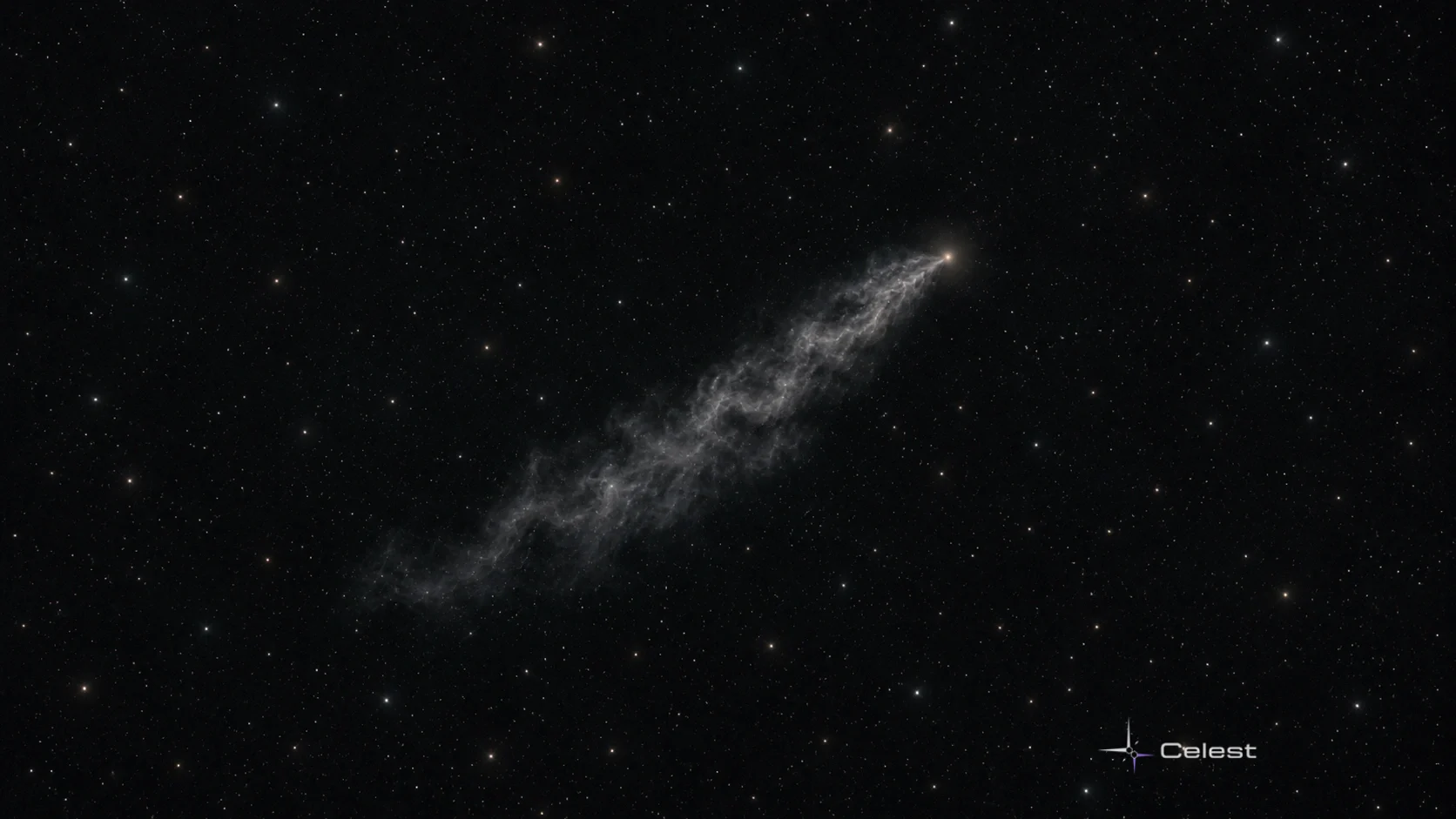
Mira has another remarkable feature beyond its varying light. In 2007, NASA's Galaxy Evolution Explorer, GALEX, revealed a material trail estimated at about 13 light-years long. That measures the wake's physical extent, rather than the star's distance from Earth.
The star moves through interstellar gas while releasing outer material. Ahead of it, the interaction can build up heated gas called a bow shock. The moving stellar wind and surrounding gas form a wake behind it, providing a record of material released as the star travels.
The long structure was apparent in ultraviolet observations and absent from a visible-light comparison. Ultraviolet is outside the wavelength range our eyes detect. Mira could therefore be a familiar stellar point for centuries while an extended feature around it remained unnoticed by observers using ordinary visible light.
The colours assigned to the ultraviolet image help make that emission readable. They do not describe a bright blue trail you should expect beside Mira in binoculars. The scientific finding concerns light detected by the instrument, and a wide survey exposed a feature that a small visible field had missed.
Mira's released material includes carbon, oxygen and other elements that can contribute to later stars and planets. Its wake connects the evolution of one star with the wider supply of material between stars, without requiring new worlds to be forming in the photographed trail today.
M77 Has a Powerful Galactic Centre
Much farther away, M77 lies roughly 45 million light-years from Earth. A telescope can reveal the galaxy as a faint extended object. Professional observations examine its spiral structure and a compact active nucleus: a central region producing intense radiation as gas moves around a supermassive black hole.
The strong glow comes from that hot surrounding material. Near-infrared observations also reveal a central bar of stars and gas more clearly than ordinary visible images. A 2026 Webb image displays sharp diffraction spikes from its bright core, an effect of the telescope's optics rather than the shape of the galaxy itself.
Time exposes Mira's changing brightness; ultraviolet reveals its wake; infrared adds structure within M77. Together they show why recognising an object is only a beginning. Following its light in different ways can uncover both its present activity and traces of the history that produced it.
Leave a comment
Comments appear after moderation.