Cygnus Constellation: The Swan Across the Milky Way
A cross-shaped pattern gives you an entrance to a crowded part of the Milky Way. Following the Swan introduces a colourful stellar pair, clouds where stars form and the remains of a stellar explosion.

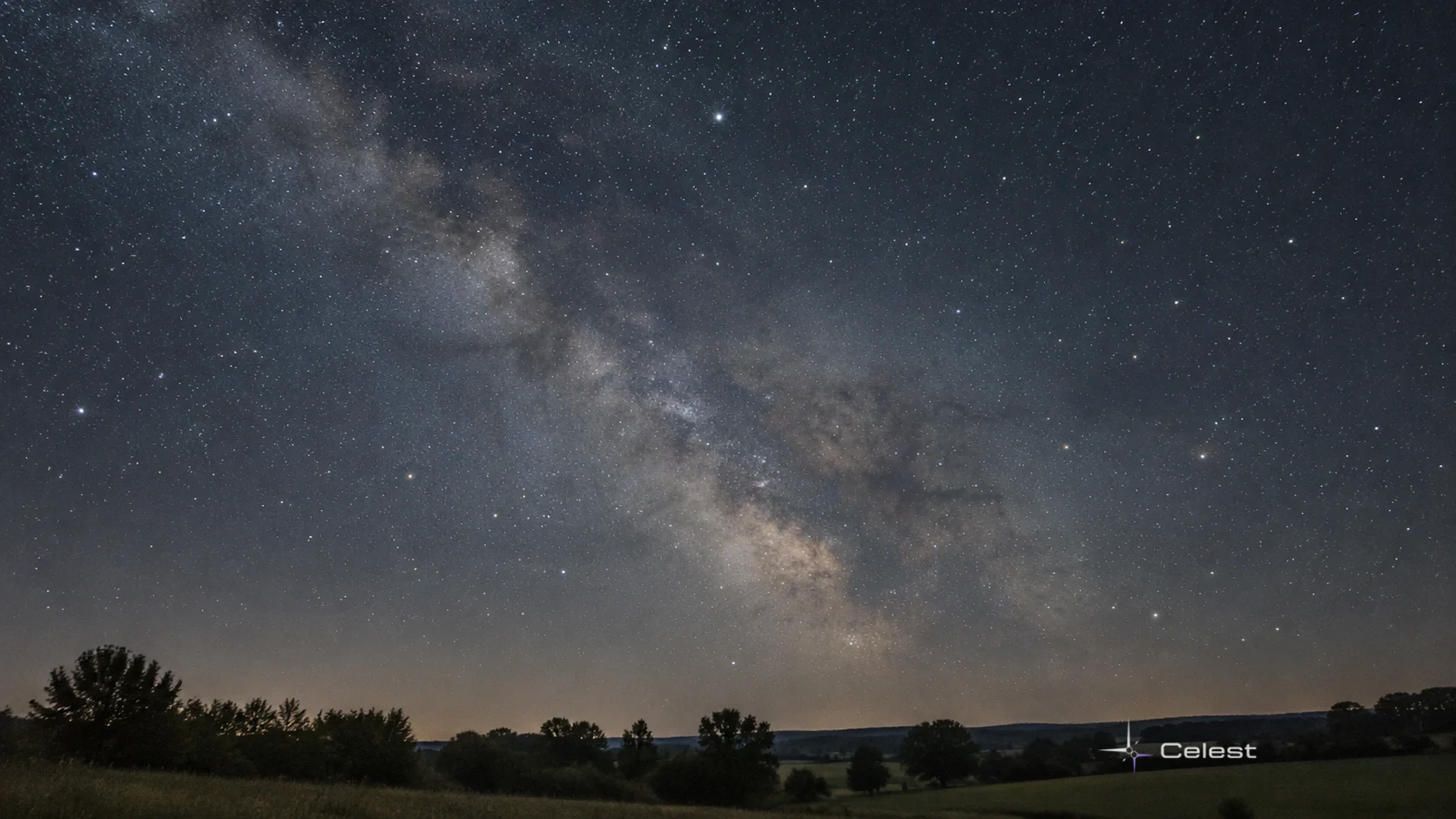
The Cygnus constellation, the Swan, crosses a rich stretch of the Milky Way and contains the familiar Northern Cross pattern. Its brightest star, Deneb, gives you a starting point among the surrounding stars. Compare the region with its neighbours in the constellation guide.
You can begin with the bright pattern before attempting its fainter clusters and nebulae. Set the live sky map to your location and observing time, because the Swan’s orientation changes rather than staying fixed in a textbook pose.
Cygnus at a Glance
The bright drawing is a useful landmark within a larger official region.
- Traditional figure: the Swan, named Cygnus in Latin.
- Official abbreviation: Cyg.
- Recognisable pattern: the Northern Cross, an asterism within Cygnus.
- Brightest star: Deneb, one corner of the Summer Triangle.
- Optical highlight: Albireo’s contrasting gold and blue pair.
- Northern observing season: summer into early autumn, with placement checked for the actual time.
A Cross Drawn Across the Galaxy
Deneb represents the Swan’s tail. Follow the long line inward toward the Summer Triangle and you reach Albireo, conventionally its beak. The shorter line across the body supplies the crossbar, which also suggests the outstretched wings.
These are two ways of reading the same bright pattern. The Northern Cross is an asterism, a recognisable shape made from stars. Cygnus is the officially bounded region containing that shape and many other objects.
The Summer Triangle provides a larger frame. Deneb belongs to Cygnus, Vega to Lyra and Altair to Aquila. Their triangle spans three constellations, rather than defining another official constellation or a system of three stars orbiting together.
Cygnus follows the Milky Way’s band. Under a darker sky, a much richer field emerges around the bright cross, interrupted by dark dust clouds. A city view may leave the main landmarks without revealing the same surrounding texture.
The visible region is not one nearby cloud of stars. Constellation boundaries organise directions, and their stars sit at different distances. A shape that appears flat on a map can point through many layers of the galaxy.
Albireo Turns One Point Into Two Colours
Albireo can look like one ordinary stellar point before you magnify it. A small telescope separates the familiar visual pair into gold or yellow and blue points. Their colour contrast makes identification rewarding even without a detailed stellar measurement.
Keep the observation distinct from an orbital conclusion. Two stars can appear close together because they share a physical system, or because separate stars lie along nearby sightlines. A visual double simply describes what the observer can distinguish.
Binoculars offer another kind of detail nearby. The open clusters M29 and M39 sit in the Cygnus direction and are suitable places to compare a concentrated stellar grouping with the surrounding field. An open cluster is a real group of stars, unlike the constellation’s perspective drawing.
Gas Records Both Stellar Beginnings and Endings
NGC 7000 is an emission nebula, a gas cloud that glows after receiving energy from a nearby star. Its outline gives it the nickname North America Nebula. Sensitive cameras record its reddish hydrogen emission, but a visual view can be a much subtler brightening against the Milky Way.
The nebula includes young stars studied with Hubble. Surrounding disks of gas and dust occur around many young stars of the T Tauri class and could become planetary systems. The detailed Hubble image shows only part of the much larger cloud.
The Veil Nebula preserves a different stage. It is part of the Cygnus Loop, the expanding remains of a massive star that exploded thousands of years ago. Moving debris and shockwaves have shaped the delicate gas filaments.
Hubble’s 2021 image combines several filters, assigning visible colours to emissions from different elements. Its fine red and blue threads are a processed close-up, not the appearance to expect when looking through a beginner telescope. Stellar birth and destruction share a direction on the sky without belonging to one event.
How to Explore the Swan
For northern observers, summer and early autumn are useful seasons to begin. Find the Summer Triangle on the map, identify Deneb, then trace toward Albireo and look for the crossbar. Check the actual orientation instead of assuming the cross stands upright.
Use your first look to confirm the brighter stars. If several fainter ones are missing, keep the landmarks you can see and compare them with the map. The familiar pattern can still guide you toward a darker place with more surrounding detail.
Choose that place with the observing conditions tools, then give each instrument a separate job. Binoculars suit a broad sweep through stellar fields and clusters. A telescope gives Albireo enough magnification for its visual pair, while faint gas clouds require more careful expectations and sky conditions.
A Shape Connects Different Stellar Histories
Learning the Northern Cross gives you more than another name on a map. You can return to the same region for a star pair, young stars with surrounding material, or the scattered remains of an exploded star.
Those sights belong to separate objects at different depths. The constellation’s value is that one recognisable pattern helps you navigate between physical systems that reveal very different stages of stellar life.
Leave a comment
Comments appear after moderation.