What Are Famous Nebulae, and How Do They Form?
A plain look at what a nebula actually is, why the famous ones look so different from each other, and what to expect the first time you find one in the sky.

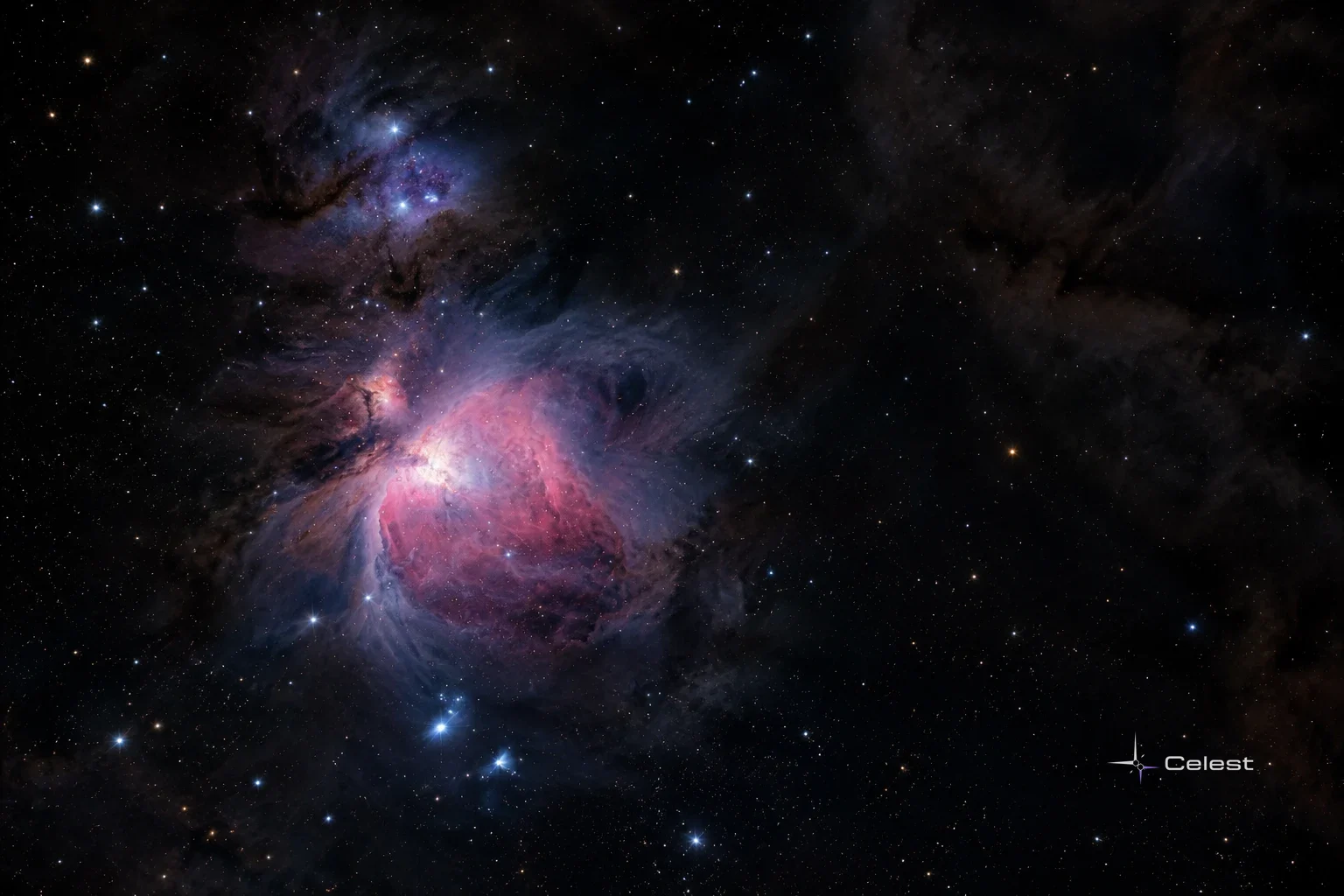
A nebula is a vast cloud of gas and dust drifting between the stars, and the famous ones stand out for how they're lit, shaped, or caught in the act of building or ending a star.
Some nebulae are stellar nurseries; others are the wreckage left after a star dies. About nine in every ten atoms inside a typical nebula are hydrogen, almost all the rest is helium, and only a trace is oxygen, carbon, neon or nitrogen, according to Britannica.
The word itself comes from the Latin for "mist" — astronomers once called any faint fuzzy smudge in the sky a nebula, even distant galaxies, before telescopes were good enough to tell the difference. Today the label sticks to genuine clouds of interstellar gas and dust, the kind you can browse in Celest's deep-sky guide.
How it works
Star-forming clouds and the remains of dying stars follow different histories. These processes explain the main appearances you see in famous nebulae:
- Clumping — gas and dust in a star-forming cloud gather into denser patches.
- Collapse — turbulence inside a patch stirs up knots of gas; if a knot gets dense enough, its own gravity pulls in more material and it starts to collapse.
- Protostar — a growing young star forms at the center of the collapsing material. Some of the surrounding gas and dust settles into a rotating disk that feeds the protostar and may later form planets and smaller bodies.
- Illumination — once a star switches on nearby, its radiation either ionizes the surrounding gas so it glows on its own (an emission nebula) or simply lights up the dust like a torch through fog (a reflection nebula).
- Aftermath — clumps that never ignite stay dark, blocking light from whatever sits behind them; stars that finish their lives scatter their outer layers as a planetary nebula, if they were Sun-sized, or a supernova remnant, if they were far heavier.
Many of the sky's brightest nebulae, including the ones you can pick out with a beginner's telescope using Celest's constellation guide, sit at different points along that chain — some still forming stars, others showing what's left once a star is gone.
The colors you see aren't what the camera shows
Photographs of nebulae usually show deep red from ionized hydrogen and cool blue from scattered starlight, and it's easy to expect the same view through an eyepiece. It won't happen that way.
Human eyes aren't sensitive enough to pick up faint color in dim light, so a nebula through binoculars or a small telescope usually looks grey, soft-edged and noticeably fainter than any photo. Astrophotographers get those vivid colors by leaving the camera shutter open for minutes at a time, often with filters tuned to specific wavelengths.
Checking tonight's sky before you go out still helps, since knowing where an object sits and how high it climbs makes the faint smudge easier to find in the first place.
Not every nebula makes stars
Star formation gets most of the attention, but it isn't the whole story. Stars form from clouds of gas and dust, yet not all nebulae are actively forming stars — some are simply debris left behind, doing nothing more dramatic than drifting and dispersing.
Planetary nebulae are a good example of a name that misleads. Early observers, looking through modest telescopes, saw a small fuzzy disc that reminded them of a planet — not because a planet was involved. They form when a Sun-sized star, near the end of its life, puffs off its outer atmosphere into space.
Comparing famous nebulae by type
Grouping well-known nebulae by category makes the differences easier to hold onto, since each type formed a different way and looks different for a reason.
- Emission nebulae: the Orion Nebula (M42) is a bright nebula visible without optical aid from a dark site — a small misty smudge below Orion's Belt in a dark sky, powered by four hot stars, the Trapezium, at its heart.
- Star-forming regions: NASA's Spitzer Space Telescope has imaged the Eagle, Omega, Trifid and Lagoon nebulae as active stellar nurseries; a 1950s distance survey of stars inside them gave astronomers some of the first evidence that the Milky Way has spiral arms.
- A hidden spiral clue: those four nebulae sit in a structure that pokes out from the galaxy's Sagittarius Arm at a steep angle — close to 60 degrees, against the arm's usual 12-degree tilt, a pattern first suggested by that 1950s distance work.
- Supernova remnants: the Crab Nebula (M1), in Taurus, is the wreckage of a star that exploded in the year 1054; it's visible in a small telescope, though its filaments only really resolve in a much larger one.
- Bright emission target: the Lagoon Nebula (M8), in Sagittarius, shows up in 10x50 binoculars as a noticeably brighter patch with the beginnings of a core, set in a crowded, star-rich stretch of the Milky Way.
See it for yourself
Orion's Belt is the easiest place to start, since the nebula hanging just below it, M42, is one of the famous nebulae bright enough to see without equipment from a dark site — as a faint misty patch, not a colorful photograph. Binoculars sharpen that smudge into a curving shape; a small telescope starts to reveal real structure.
Moonlight washes out faint nebulae fast, so it helps to check the Moon's phase before heading out and pick a night closer to new Moon. A darker sky, away from city glow, makes the same object noticeably easier to hold onto.
Give your eyes a full twenty minutes to adjust before deciding a nebula "isn't there." Most of them were always going to look like grey mist — and that mist has been drifting, glowing or fading for longer than any human has been watching.
Leave a comment
Comments appear after moderation.