What Is a Deep-Sky Object, Really?
A grey smudge at the eyepiece and a glowing nebula in a photo can be the same object. The gap between them comes down to how light behaves, not what you're doing wrong.

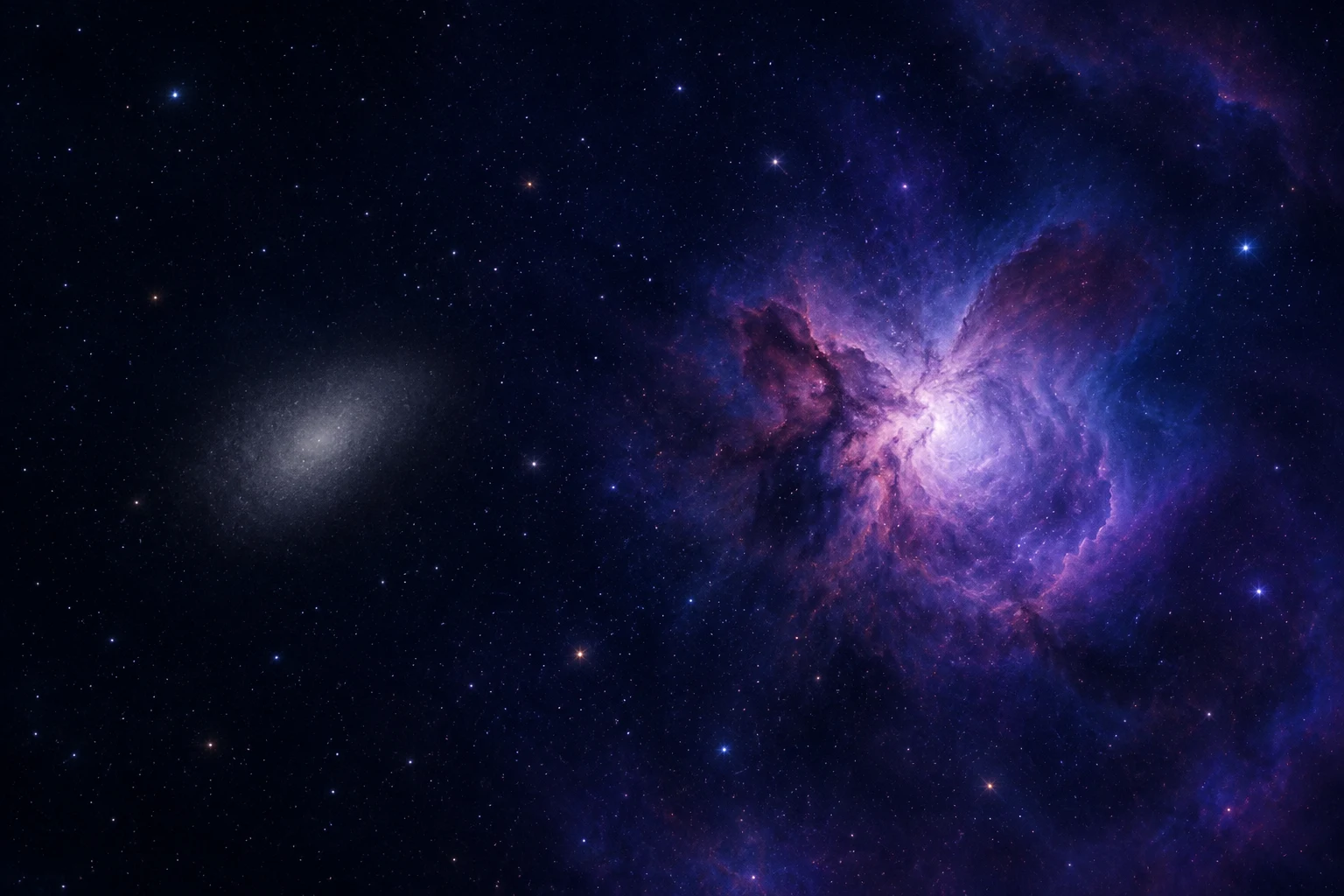
In amateur observing, a deep-sky object usually means a star cluster, nebula or galaxy beyond the Solar System — the targets many observers explore after the Moon and planets. It's a practical label, not a claim about physics: it tells you how to observe something, not what it's made of.
Here's the part that surprises most newcomers: through binoculars or a small telescope, many nebulae and galaxies look like faint grey smudges, not the colorful images you've seen online.
The term traces back to Sky & Telescope's "Deep-Sky Wonders" column, which debuted in the magazine's very first issue in 1941 and toured a small patch of sky each month for binoculars and small scopes.
Explore the range of them in Celest's deep-sky objects guide.
How it works
Four things stack up to decide whether a given deep-sky object is an easy binocular target or a serious telescope project.
- One label, many kinds of object — the term covers open and globular star clusters, diffuse and dark nebulae, planetary nebulae, supernova remnants, galaxies, galaxy groups, quasars and gravitational lenses. It's a catch-all, not a family tree.
- Faint light spread thin — many of these objects are enormous as seen from Earth, so their light gets stretched across that whole shape. A galaxy can carry a flattering brightness rating and still look almost invisible because each patch of it is dim — that's surface brightness, and it matters more than the number on the label.
- Your gear sets the floor — naked eyes reach roughly magnitude 6 under a genuinely dark sky, and every step up in aperture pushes that limit deeper (larger magnitude numbers mean fainter).
- Darkness and filters buy back contrast — moving away from city light and checking observing conditions before heading out restores contrast that streetlights erase; a suitable narrowband filter can improve the contrast of emission and planetary nebulae by passing their strongest emission lines. It is not a general remedy for reflection nebulae, galaxies or star clusters.
To put numbers on that gear scale: naked eyes reach about magnitude 4 under city glow and magnitude 5 in the suburbs.
Binoculars push that to about magnitude 10, a 4-inch telescope to about 12.5, an 8-inch to about 14, a 12-inch to about 15, a 16-inch to about 16, and the Hubble Space Telescope all the way to roughly magnitude 30.
Put those four together and you get the real picture: aperture decides what you could theoretically see, but size, spread-out light and sky darkness decide what you'll actually notice at the eyepiece.
Moonlight adds its own glare on top of all that, washing out the same faint contrast a filter tries to protect — check the Moon guide for its phase before you commit to a target.
They won't look like the photos
Cameras and your eye do fundamentally different jobs. A single ten-second exposure barely registers a faint nebula, but a camera or smart telescope that stacks many short exposures over time can build up the same signal as one 1,200-second (20-minute) exposure — enough to reveal color and structure your retina was never built to collect in real time.
That's why a reflection nebula, where dust scatters starlight, shows up distinctly blue in a photograph but reads as a pale gray haze at the eyepiece. An HII region, where ultraviolet light strips electrons from hydrogen atoms that later recombine and glow red, follows the same pattern: vivid in pictures, gray through glass.
Planetary nebulae add a naming trap on top of that. Despite the name, they have nothing to do with planets — early observers thought their small round shape resembled one. Through a telescope, most look pale blue, green or simply gray, not the vivid color a camera collects given enough time.
Magnitude isn't the whole story
A star is a single point of light, so its magnitude tells you almost everything about how easy it is to see. Extended objects — nebulae, galaxies, clusters — don't play by that rule, because the same total light gets spread across a much larger patch of sky.
That's the reason a face-on spiral galaxy can be listed as an easy small-telescope target on paper and still defeat a first-time observer: the light is real, but it's diluted across a disk wide enough that surface brightness drops below what the eye can register, even in dark conditions.
Celest's night sky guide can help you check what's actually well placed from your location before you commit to one.
Some categories dodge this problem better than others. Open clusters like the Pleiades or the Beehive resolve into individual points of starlight rather than staying a single smudge, which is often why they're easier beginner targets than a diffuse galaxy of similar listed brightness.
See it for yourself
The following are useful starting points under dark skies. Binoculars help, and the best season depends on your location.
- The Pleiades or the Beehive cluster — the Pleiades show several separate stars to the naked eye, while the Beehive is often a faint hazy patch. Binoculars reveal many more stars in both.
- The Andromeda Galaxy (M31) — from a dark site, naked eye shows an elongated hazy patch; binoculars make it obviously non-stellar and easy to hold steady.
- Dark lanes in the summer Milky Way — sweep binoculars through Sagittarius, Scorpius and north toward Cygnus for patches where the stars thin out or vanish; those gaps are dust clouds blocking the starlight behind them.
Check the light pollution map before choosing a site — the darker the sky, the more of this list resolves rather than staying a formless glow. Once you know what a smudge is supposed to look like, the picture stops being a letdown and starts being a clue about what's really out there.
Leave a comment
Comments appear after moderation.