What Is a Galaxy? A Beginner's Explanation
A galaxy holds stars, gas, dust and dark matter together through gravity. Its shape and changing star population reveal a history far bigger than one star.

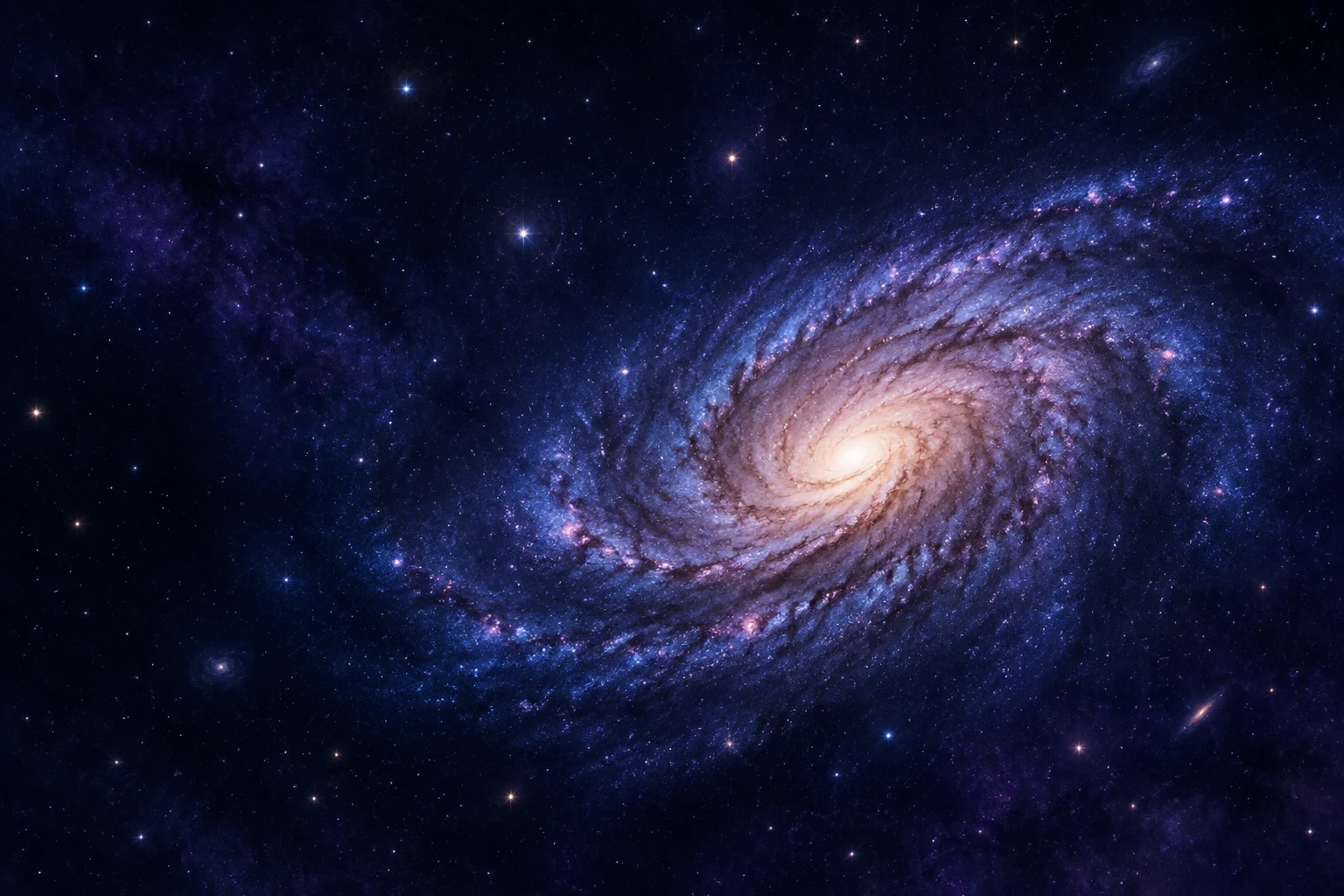
A galaxy is a gravitationally bound system of stars, planetary systems, stellar remnants, gas, dust and dark matter, all held together by their own gravity. They range from small dwarf systems to giant galaxies containing trillions of stars, with the largest extending more than a million light-years across.
The essential point: gravity ties every piece — visible and invisible — into one connected system, not a loose crowd of stars that happen to share the same patch of sky.
Distinguishing the smallest galaxies from large star clusters can be difficult. Astronomers study their stars, motion and inferred dark matter rather than applying a simple size cutoff.
The deep-sky objects Celest catalogs, from clusters to full galaxies, sit at different points along that same scale.
How a galaxy works, from dark matter to stars
In the standard picture of early galaxy formation, dark matter — matter that doesn't give off light but still pulls with gravity — clumps into haloes that form deep gravitational wells for gas to fall into.
- Haloes collapse and merge. Dark matter clumps under its own gravity and merges with neighboring clumps, building larger gravitational wells over time.
- Gas falls in and cools. Hydrogen and helium sink into these wells and cool enough to condense into dense, dark clouds.
- Stars ignite. Gravity compresses the coolest, densest gas until nuclear fusion starts, and a new generation of stars lights up.
- Feedback pushes back. Supernova explosions and outbursts from a central supermassive black hole blast gas outward, slowing or pausing further star formation.
- Galaxies merge and grow. Collisions with neighboring galaxies, playing out over roughly a billion years, reshape the whole structure and can trigger fresh bursts of star birth.
Most of a galaxy's mass never shows up as light in this story. Dark matter generally accounts for much of the total mass. Most large galaxies also have a supermassive black hole at the center; the proportions vary between systems.
Every galaxy you can point out in the night sky guide is running some version of this same sequence, just at a different stage.
Why a galaxy isn't just a spiral nebula
Through early telescopes, galaxies looked like faint, fuzzy smudges with a spiral or elongated shape — what 18th- and 19th-century astronomers called spiral nebulae. Most assumed these were unresolved star clusters inside the Milky Way, not separate star systems of their own.
In 1610, Galileo Galilei pointed a telescope at the Milky Way and found it was made of an enormous number of faint, individual stars rather than a continuous glow.
By 1750, Thomas Wright proposed the Milky Way might be a rotating body of stars held together by gravity, seen edge-on as a band across the sky — an idea Immanuel Kant expanded in 1755.
The label took a long time to catch up with the idea. Harlow Shapley pushed for the word galaxy, while Edwin Hubble kept using nebulae even after showing these objects lay far outside the Milky Way. The naming didn't fully settle until after Hubble's death in 1953.
A fuzzy patch in an old star catalog still isn't automatically a galaxy — some really are clusters or nebulae inside our own.
One theory, many shapes
Astronomers sort galaxies into three broad shapes: spiral, elliptical and irregular. The Milky Way is a spiral, built from a central bulge, a flattened disk where spiral arms host active star formation, and a far larger, sparser halo of old stars and globular clusters that can span up to 400,000 light-years across.
Elliptical galaxies look like flattened spheres, hold little gas or dust, and are dominated by older stars packed more densely toward the center. Irregular galaxies have no real symmetry at all, usually the result of a past gravitational tug or collision with another galaxy.
Sizes vary hugely. Most galaxies span 1,000 to 100,000 parsecs, roughly 3,000 to 300,000 light-years.
The Milky Way's bright stellar disc is roughly 100,000 light-years across. A galaxy has no hard outer surface: its faint halo extends beyond the more obvious disc, so a quoted diameter depends on what is being measured.
Where the Milky Way fits
The Milky Way isn't alone. It belongs to the Local Group, a small cluster of galaxies it dominates alongside the Andromeda Galaxy, and the Local Group in turn sits inside the much larger Virgo Supercluster. At the biggest scales, these structures link up into sheets and filaments wrapped around vast, nearly empty voids.
Counting all of them is harder than it sounds. One widely cited estimate puts the observable universe's galaxy population between 200 billion and 2 trillion; a separate research summary rounds that to roughly 2 trillion. Both describe the same universe — they just come from different counting methods.
See it for yourself
From a suitably dark site, Andromeda can appear as a faint smudge without a telescope. The Magellanic Clouds are naked-eye southern targets, while Triangulum is much more demanding and not a reliable beginner sighting. Your latitude and sky darkness decide which is accessible.
Moonlight washes out that faint glow fast. Check the Moon guide before you head out, since even a partial Moon can hide a galaxy that's otherwise visible.
A dark sky matters just as much. Use the light-pollution map to find a spot away from city glow, where that smudge actually has a chance to show up.
The light in that soft Andromeda smudge has travelled for about 2.5 million years. You are seeing another galaxy as it was long before modern humans existed.
Leave a comment
Comments appear after moderation.