Delphinus Constellation: A Small Pattern and a Lithium Clue
A temporary brightening in the Dolphin supplied a chemical clue: radioactive material that becomes lithium. The story connects a small constellation with the wider history of elements.

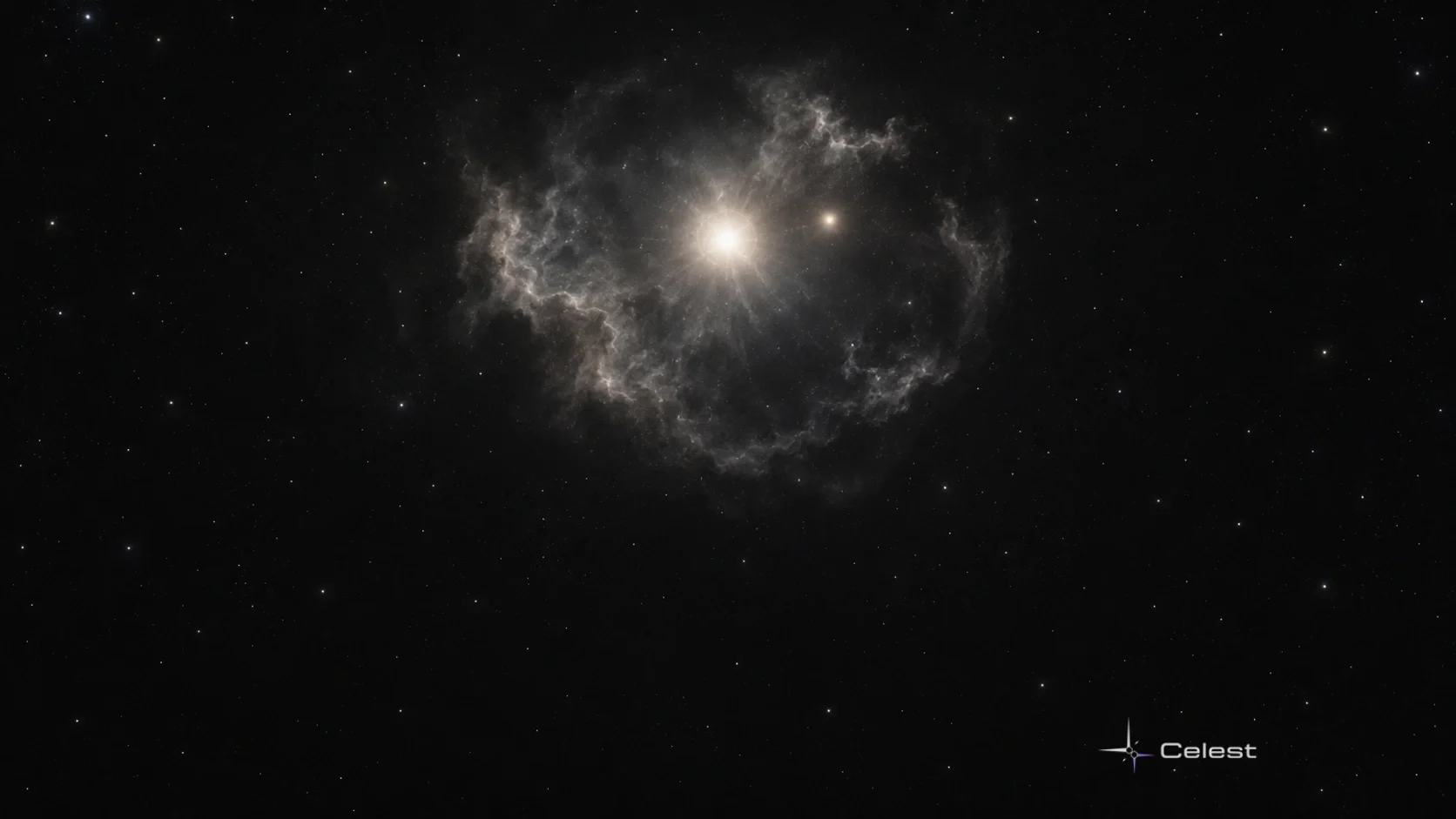
Delphinus is a small constellation with relatively few bright stars, just north of the celestial equator. It offers a manageable patch of sky to explore, but one of its most interesting stories comes from a temporary brightening observed in 2013.
The object, Nova Delphini 2013, helped connect stellar eruptions with the production of lithium. That is the chemical element used in rechargeable phone and laptop batteries. The observation concerns one cosmic production route, rather than the source of a particular battery on Earth.
Use the constellation guide to place Delphinus between Aquila, Sagitta, Pegasus and its other neighbours.
Delphinus at a Glance
- Sky position: just north of the celestial equator.
- Evening season: early northern autumn or early southern spring.
- Character: a small pattern with few bright stars.
- Star cluster: NGC 6934, a globular cluster.
- Historical eruption: Nova Delphini 2013, also called V339 Del.
- Chemical clue: radioactive beryllium that becomes lithium.
Where Can You See Delphinus?
Its position near the celestial equator makes the whole constellation seasonally available from almost everywhere except the far Antarctic. Your particular view still depends on location and time.
Open the live sky map and begin with its neighbours: Vulpecula, Sagitta, Aquila, Aquarius, Equuleus and Pegasus. Choose one nearby pattern you already recognise, then follow the chart towards the smaller Delphinus field.
A chart’s joining lines are recognition aids. Its boundaries assign sky regions, while larger star symbols usually indicate greater apparent brightness. They do not measure physical stellar diameters or show a connected structure in space.
What Happened in 2013?
A stellar system brightened in a classical nova eruption, reported on 14 August 2013. The system became known as Nova Delphini 2013, or V339 Del. It was an existing system undergoing an outburst, rather than a star being born at that moment.
Follow-up observations recorded its changing light.
A white dwarf lies at the centre of the nova mechanism. This is the compact core left by a star that has shed its outer layers. In a close pair, gas from the companion can gather on the dwarf’s surface, passing through a surrounding accretion disk.
Why Does Accumulated Gas Erupt?
As the layer grows, its temperature and density rise until nuclear reactions run away. The accumulated gas is blasted outward, causing the brightening. In a classical nova, the white dwarf itself remains intact.
That distinction matters when comparing a nova with other stellar explosions. The visible outburst describes expelled surface material, with an existing compact star still present.
The National Astronomical Observatory of Japan describes Subaru’s observations of this event using a high-dispersion spectrograph. Such an instrument separates light into fine wavelength detail, allowing researchers to search for the signatures of particular kinds of atoms.
What Was the Lithium Clue?
The decisive identification in the 2015 primary study was radioactive beryllium-7 in near-ultraviolet spectra. Beryllium-7 transforms into lithium-7, so detecting it in the expelled material supports lithium production during the eruption.
The team obtained those spectra 38–48 days after the outburst.
Isotopes are forms of the same element with different numbers of neutrons in their nuclei. Here, the researchers tracked beryllium-7 as evidence for the production of lithium-7.
What Does the 53.22-Day Half-Life Mean?
It describes the time in which half the radioactive beryllium nuclei in a sample would transform. The cited half-life is 53.22 days. It is not a deadline after which every nucleus has become lithium.
This explains why the short-lived precursor was a useful clue. Observations made soon enough after the eruption could identify material that would subsequently change into another element.
The link is chemical and spectral. An ordinary photograph can show the eruption’s brightness, while the spectrum supplies evidence about what its expelled material contains.
Does All Lithium Come From Novae?
No. The research places nova production alongside several other possibilities, including the early universe, cosmic-ray interactions with interstellar matter and processes in evolved stars. The observation adds evidence for one important channel.
It does not identify V339 Del as the supplier of the lithium in your own phone.
Other observations address different questions. Fermi detected gamma rays from V339 Del in August 2013, while visible-light spectra recorded signatures of expanding material. Those measurements concern the same event, but they do not all measure the same physical property.
What Else Can You Explore Here?
NGC 6934 offers a longer-lived subject within Delphinus. It is a globular cluster: a dense, approximately spherical group of stars held together by gravity. Its appearance and history differ from the temporary eruption in V339 Del.
Check the observing conditions before choosing a session, then try identifying the constellation field before examining a smaller cluster field. The 2013 brightening belongs to the historical record, not an event promised for tonight.
Delphinus brings together two scales of exploration. You can trace a small constellation with a chart, then follow a spectral clue into the chemical history of the galaxy. A brief brightening can reveal how stellar material joins a much wider story of elements.
Leave a comment
Comments appear after moderation.