Dumbbell Nebula (M27): A Star’s Gas Becomes a Nebula
A small telescope reveals a two-lobed cloud in Vulpecula. Close-up and infrared observations show a more complicated story: a star’s lost material is being reshaped, illuminated and gradually returned to the space between stars.

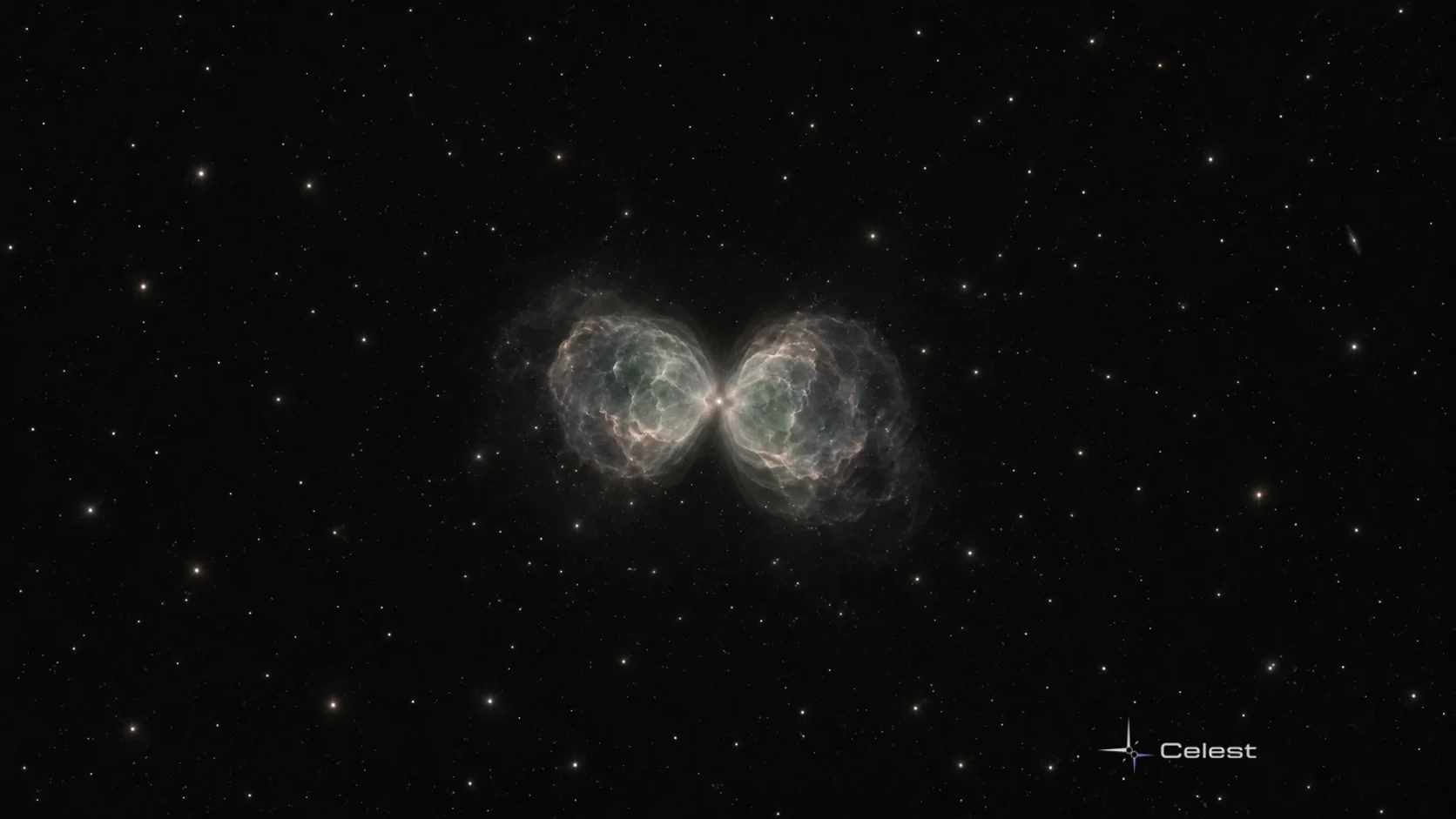
The Dumbbell Nebula, also called Messier 27 or M27, is a glowing cloud left by an aging star in Vulpecula. Its two bright lobes give it the familiar dumbbell outline. Start with the constellation guide to locate the small region of sky containing this object, roughly 1,300 light-years away.
The attractive shape is the beginning of the story. Inside the expanding cloud, dense concentrations of gas and dust are being illuminated and reshaped. Some of the material may eventually return to the space between stars and contribute to another generation of stellar birth.
M27 at a Glance
- Names: Dumbbell Nebula, Messier 27 and NGC 6853.
- Type: a planetary nebula produced by an aging star.
- Constellation: Vulpecula.
- Distance: roughly 1,300 light-years, with measurement uncertainty.
- Apparent magnitude: about 7.5 for the nebula as a whole.
- Discovery: Charles Messier recorded it in 1764.
Use the live sky to choose a suitable date and see Vulpecula’s position from your location. M27 is accessible with a small telescope; a dark setting helps its diffuse shape stand out. The dramatic detail in close-up research images belongs to a different scale of observation.
What Does a Small Telescope Reveal?
The useful first impression is a hazy patch with a brighter two-lobed structure. Depending on the view, the familiar shape can resemble a dumbbell or an apple core. Concentrate on that broad arrangement before trying to match every feature in a photograph.
NASA’s observing overview highlights September as a favourable time. Your own viewing window depends on location and date, so check the Moon when choosing a darker evening. Treat the listed magnitude as the combined brightness of an extended cloud, rather than the brightness of a single concentrated star.
Why Is It Called a Planetary Nebula?
The name comes from early telescopes, through which some small nebulae looked like planetary disks. M27 is instead material released by a star. The label records an earlier visual impression, while the modern classification describes a stage in stellar evolution.
Messier found it in 1764 while documenting objects that could confuse comet hunters. M27 became the first known example of its class. Its history connects a practical observing problem with a discovery that later helped astronomers understand how stars return material to their surroundings.
How Does the Lost Gas Become Bright?
As a low- or intermediate-mass star ages, it releases its outer layers. A hot central remnant remains and develops into a white dwarf. The remnant produces ultraviolet radiation that gives energy to the surrounding gas.
That energy changes the state of atoms and allows the gas to emit light. A visibly bright nebula can therefore surround a much smaller central object. Understanding the illumination connects the wide cloud with the star responsible for both its material and its continuing glow.
What Are the Knots Inside M27?
Hubble’s close-up view resolves numerous dense concentrations of gas and dust. Some have elongated tails; others appear more isolated. A typical knot spans about 17–56 billion kilometres, and the published description gives masses reaching approximately three times Earth’s mass.
Those figures make the fine-looking details physically enormous. They describe dispersed astronomical material, rather than solid objects with Earth-like surfaces. A knot’s appearance depends on its density, the radiation reaching it and its interaction with the surrounding flow.
The close-up comes from observations made in November 2001 and released in 2003. It covers a portion of the nebula. When comparing it with a whole-object photograph, first establish whether you are looking at the full two-lobed cloud or at structures within it.
How Do the Knots Change Shape?
One explanation involves stellar winds removing smaller particles around a denser concentration. The larger clump persists while surrounding material forms a trailing structure. The Hubble description also places developing knots near the boundary between hotter ionized gas and cooler neutral material.
As the nebula expands, the conditions around those concentrations change. That helps explain why the cloud contains several shapes instead of a collection of identical blobs. Researchers use their differences to investigate the physical processes acting on the released stellar material.
Why Do Infrared Images Look Different?
Optical images can select particular emissions and assign them display colours. In the Hubble close-up, oxygen is represented in blue, hydrogen in green, and sulfur and nitrogen in red. The palette helps separate signals that would otherwise be harder to compare.
Spitzer observed M27 in infrared light and found a different-looking arrangement of bright regions and clumps. Researchers interpreted some extended features as molecular hydrogen mixed with small quantities of heavier elements. The infrared view adds information about material that the familiar optical outline does not fully describe.
The red and green in that infrared picture are ways of displaying its measurements. Comparing wavelengths is useful because each observation responds to different physical conditions. No single colourful portrait supplies every part of the nebula’s story.
What Might Happen to This Material?
The central remnant’s ultraviolet radiation can break molecules apart. Even so, the Spitzer team suggested that much of the molecular material may survive and mix with gas in interstellar clouds. It could then help supply future regions of star formation.
That possibility connects the end of one star’s life with the ingredients for others. M27 shows more than a fading star’s decorative outline: it lets researchers examine how released material changes, survives and moves back into the wider galactic environment.
Leave a comment
Comments appear after moderation.