What Was the Lunar Module?
Only one machine has ever carried humans down to another world and lifted them back up again. Here's how the Apollo Lunar Module made that round trip.

- Published
- ◷
- 5 min read
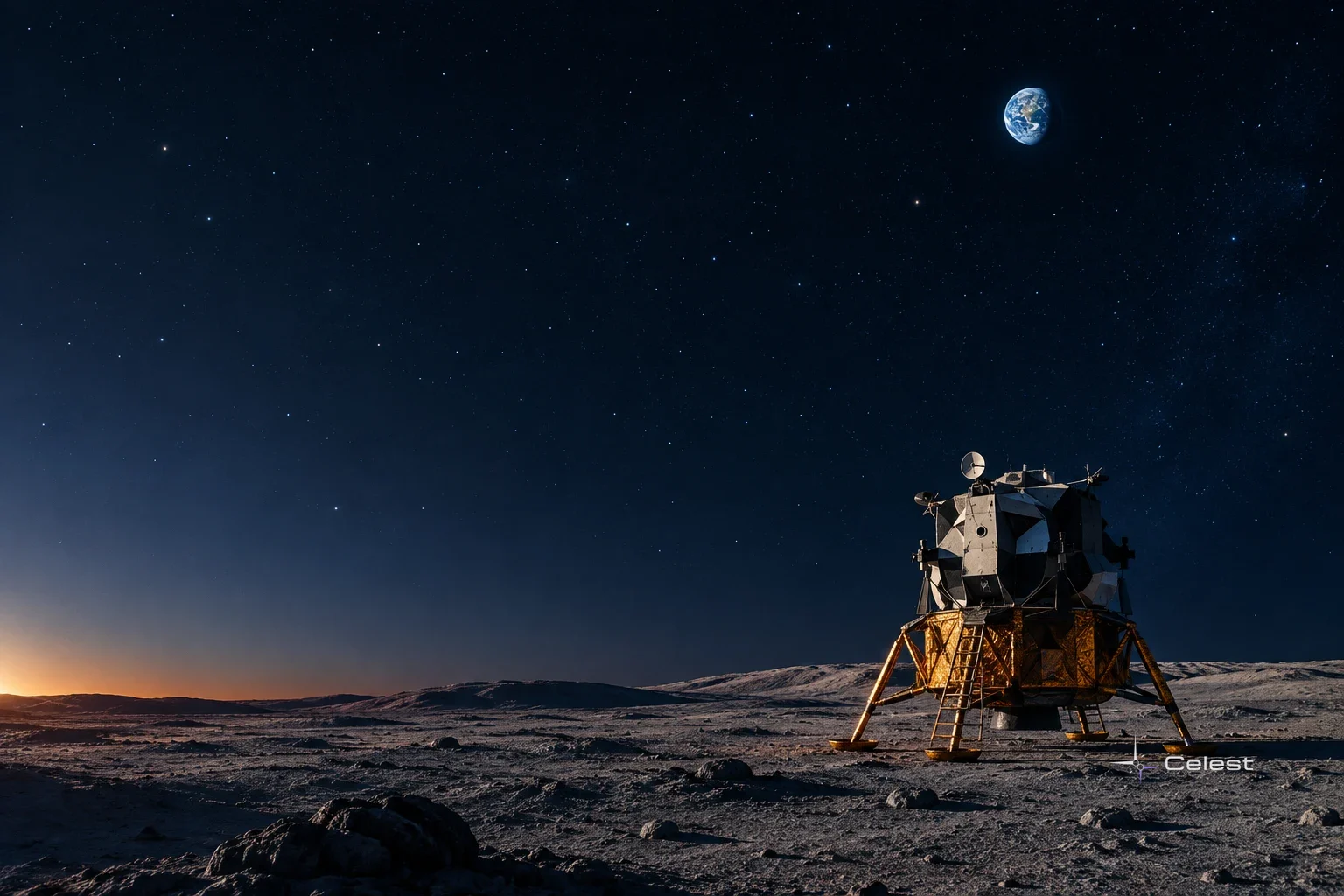
The lunar module was the two-stage spacecraft that carried two Apollo astronauts from lunar orbit down to the Moon's surface, then lifted them back up to meet the command module waiting overhead. NASA called it the LM, pronounced "lem" — short for its original name, the Lunar Excursion Module.
It's still the only crewed vehicle ever to land anywhere beyond the Moon's surface.
Grumman built fifteen of them for NASA, and the design gave the program more headaches than almost anything else in Apollo: the first uncrewed test flight slipped by about ten months, the first crewed flight by about three. Once it flew, though, the LM turned out to be the most reliable piece of the whole Apollo–Saturn stack.
For more spacecraft history and beginner-friendly explainers, browse Celest's astronomy guides.
How it works
Every Apollo landing followed roughly the same sequence, built around two separate rocket burns and a lot of careful handoffs between machine and crew.
- Folded ride to the Moon — At launch the LM sat directly beneath the command and service module, legs folded, tucked inside an adapter on top of the Saturn V's third stage. It stayed there through Earth orbit and the burn that sent the whole stack toward the Moon.
- Turnaround and checkout — Soon after that burn, the adapter opened and the command module separated, turned around, and docked nose-to-nose with the LM to pull it free. During the three-day coast, the lunar module pilot floated inside to power it up and test every system except the engines.
- Two burns down — In lunar orbit, the commander and pilot moved in, unfolded the landing legs, and separated from the command module. A 30-second burn dropped the LM's low point to about 15 kilometers (50,000 feet) above the surface; the descent engine then fired again for the slow trip down, the crew flying on their backs until the craft pitched upright around 210 meters (700 feet) up.
- Touchdown on manual — With roughly 610 meters (2,000 feet) left to the target, the commander took manual control, with enough fuel to hover for up to two minutes while picking a spot. Probes hanging below the footpads touched the ground first and lit a light telling him to shut off the engine.
- Half stays behind — the descent stage, with its landing gear, descent engine, and surface gear, never left the Moon. To go home, the crew fired the ascent stage's own engine, leaving the descent stage where it sat, and rejoined the command module in lunar orbit.
Abort was possible at almost any point in that chain: jettison the descent stage, fire the ascent engine, and climb straight back into orbit for an emergency rendezvous with the command module.
Not the whole story: what stayed on the Moon
A lot of people picture the lunar module coming home in one piece, the way a jet taxis back after a flight. It never did, and it was never built to. Because it flew only in the vacuum of space, the LM needed no streamlining and no heat shield — structurally, it could not have survived a pass through Earth's atmosphere.
Of the six lunar modules that landed, all six descent stages are still sitting where they touched down. The matching ascent stages lifted off, docked with the command module, and were then sent to crash into the Moon on purpose — except Apollo 10's, which was discarded into an orbit around the Sun instead.
Apollo 13 is the one real exception. Its LM, Aquarius, never landed at all. After an oxygen tank exploded in the command module on the way to the Moon, Aquarius became a lifeboat, keeping the crew alive for the trip home before re-entering Earth's atmosphere intact along with the crew capsule.
Two stages, one machine
The two halves of the LM looked and behaved differently from each other. The gold-and-black descent stage held the landing gear, the descent engine, and whatever science gear the crew set down on the surface. It was wrapped in thin, gold-tinted plastic film that reflected the Sun's heat and doubled as protection from micrometeoroids.
The silver-and-black ascent stage sat above it, holding the pressurized cabin and the ascent engine. Its skin was a nickel-steel alloy thinner than a human hair, painted black on one side to soak up heat and radiate it away on the other.
The descent engine could throttle, producing up to 44,316 newtons (9,870 pounds) of thrust; the ascent engine was fixed at 15,700 newtons (1,050 pounds), just enough to lift the lighter stage back to orbit. Sixteen small thrusters, fired automatically or by hand, kept the craft pointed the right way throughout.
Inside, the commander stood on the left and the lunar module pilot on the right, each gripping two control sticks — one to move the craft, one to tip it — with a small keyboard between them and two black-and-white attitude indicators on the panel ahead.
Standard LMs launched at about 15,200 kilograms (33,500 pounds); extended versions built for longer stays weighed roughly 16,400 kilograms (36,200 pounds) and could support a crew on the surface for up to 75 hours. NASA flew ten of the fifteen built, from the first uncrewed test in January 1968 to the final Apollo flight in December 1972.
See it for yourself
None of this hardware is visible from the ground. The six descent stages are on the Moon and far too small and unlit to pick out even through a large telescope, and the ascent stages either crashed there or, in Apollo 10's case, are drifting somewhere around the Sun. But you can stand next to one in person.
LM-2, one of the fifteen built and never flown to the Moon, hangs in the Boeing Milestones of Flight Hall at the National Air and Space Museum in Washington, DC, configured to match Apollo 11's Eagle. According to the Smithsonian, it still shows the split between the two stages exactly as it flew.
Look for a few specific things when you're there:
- The two-stage split — the gold-and-black lower half against the silver-and-black upper half.
- The folded-out landing gear — three of the four legs, extended as if ready to touch down.
- The twin control sticks — one for the commander, one for the pilot, side by side under the windows.
Afterward, step outside and pick out the Moon in tonight's night sky. The ground those legs were built to stand on is still up there, unchanged since the last one lifted off.
Sources
The facts in this article are based on the sources below. How we work: editorial policy.
Leave a comment
Comments appear after moderation.