Eridanus Constellation: A River of Stars and Spirals
A long celestial river leads from a rapidly spinning star to galaxies whose structures help explain the movement of gas and the birth of new stars.

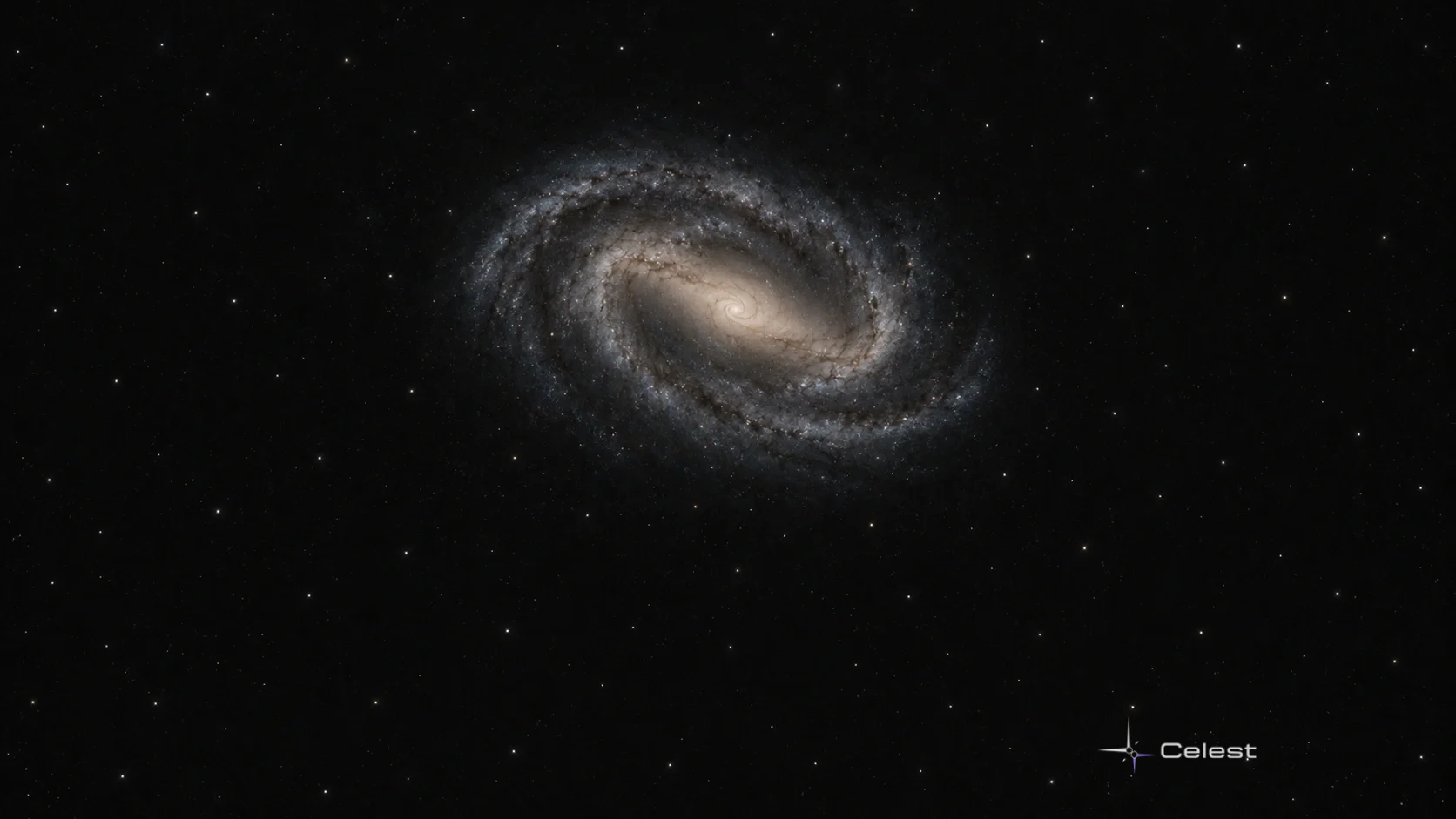
Eridanus is the River constellation, a long sky region stretching from near Orion far into the southern sky.
It contains Achernar, a rapidly rotating star, and galaxies whose bars, rings and smaller internal spirals reveal how differently stars and gas can be arranged.
The most striking detail belongs to NGC 1300: inside its large barred spiral lies another, much smaller spiral. It is part of the same galaxy. Comparing the two structures turns an attractive pattern into a question about how gas travels towards a galactic centre.
Eridanus at a Glance
- Official abbreviation: Eri.
- Traditional figure: The River.
- Evening season: Northern winter and southern summer.
- Southern bright star: Achernar, also called Alpha Eridani.
- Barred spiral galaxy: NGC 1300, roughly 69 million light-years away.
- Ringed galaxy: NGC 1291, approximately 33 million light-years away.
Finding the Reachable Part of the River
Start near Orion and Taurus, where the northern part of Eridanus begins. The figure extends a long way south rather than forming one compact outline. On the IAU education chart, its southern extreme approaches 60 degrees south of the celestial equator, the sky’s projection of Earth’s equator.
Open the constellation map and compare that long region with its northern neighbours.
Recognising a short section is a useful first result. You can then follow the chart through further stars without assuming that the whole river fits into the sky available from your latitude.
The complete constellation is visible from equatorial regions and much of the Southern Hemisphere. Northern temperate observers see a more restricted portion. Winter evenings favour the northern view; the corresponding evening season south of the equator is summer.
Use the live sky for your observing date and position. It helps separate the portion you can identify that evening from the full figure printed on an all-sky chart. This matters especially for Achernar, situated near the river’s far southern end.
Achernar’s Rotation Changes Its Shape
Achernar is the constellation’s brightest star. Its physical appearance is much less simple than a distant point suggests: rapid rotation makes the star wider around its equator than along its poles. A star can depart substantially from a spherical shape while still appearing point-like to an ordinary observer.
In 2003, ESO reported measurements made with the VLT Interferometer.
The instrument combined light collected by separate telescopes and measured Achernar’s apparent size along different directions. Those observations revealed the strongly flattened shape and challenged then-common models of stellar structure.
The research technique explains why a familiar-looking point of light can hide an unusual shape. Combining telescope signals provides information about angular scales far smaller than you can distinguish by eye. The scientific result concerns the star’s structure, rather than an oval you should expect to recognise in the sky.
A Smaller Spiral Inside NGC 1300
NGC 1300 is a barred spiral galaxy, roughly 69 million light-years away. Its large arms emerge from the ends of an elongated central bar of stars. That bar gives the galaxy a structure quite different from arms continuing directly into a central hub.
Hubble observations show an additional spiral within the central region, about 3,300 light-years across. This inner disk belongs to the larger galaxy. Seeing structure at both scales raises a physical question: whether the bar and the smaller spiral help move gas towards the centre.
Models described with the image suggest that gas can flow inward along the bar and then through the inner spiral. That is a proposed transport route, not a measurement proving that all the gas reaches one endpoint. The accompanying account did not identify an actively feeding nucleus in this galaxy.
The professional view combines observations through several filters and two adjacent telescope pointings. For an observing session, use a detailed chart to choose a faint object and check observing conditions. The resolved dust and inner spiral in the space-telescope image provide scientific context beyond basic galaxy identification.
New Stars Around an Older Centre
NGC 1291 offers a different arrangement. At approximately 33 million light-years, this galaxy has a central bar and an outer ring. A Spitzer image described by JPL in 2014 places older stars towards the middle while new stars in the outer ring heat surrounding dust.
The infrared view separates those populations using display colours. Red marks the warm, star-forming ring in that image; shorter-wavelength infrared emission from the older central stars is shown in blue. Those colours make the telescope’s measurements legible rather than reproduce a naked-eye view.
The interpretation links structure with the supply of gas. As central regions use up available star-forming material, activity can continue farther out. Motions associated with a bar can help concentrate gas in a ring, providing another place for stars to form.
Eridanus therefore contains more than a chain of foreground stars.
Its galaxies show that a bar or ring can help explain where stellar fuel goes and where new stars appear. The shape of a galaxy becomes evidence about its changing internal life.
Leave a comment
Comments appear after moderation.