Gemini Constellation: Two Landmarks, Very Different Stars
Castor and Pollux mark the Twins on a chart, but they do not share one physical system. Their contrast leads from easy winter landmarks to hidden stellar pairs and a cluster whose stars really did form together.

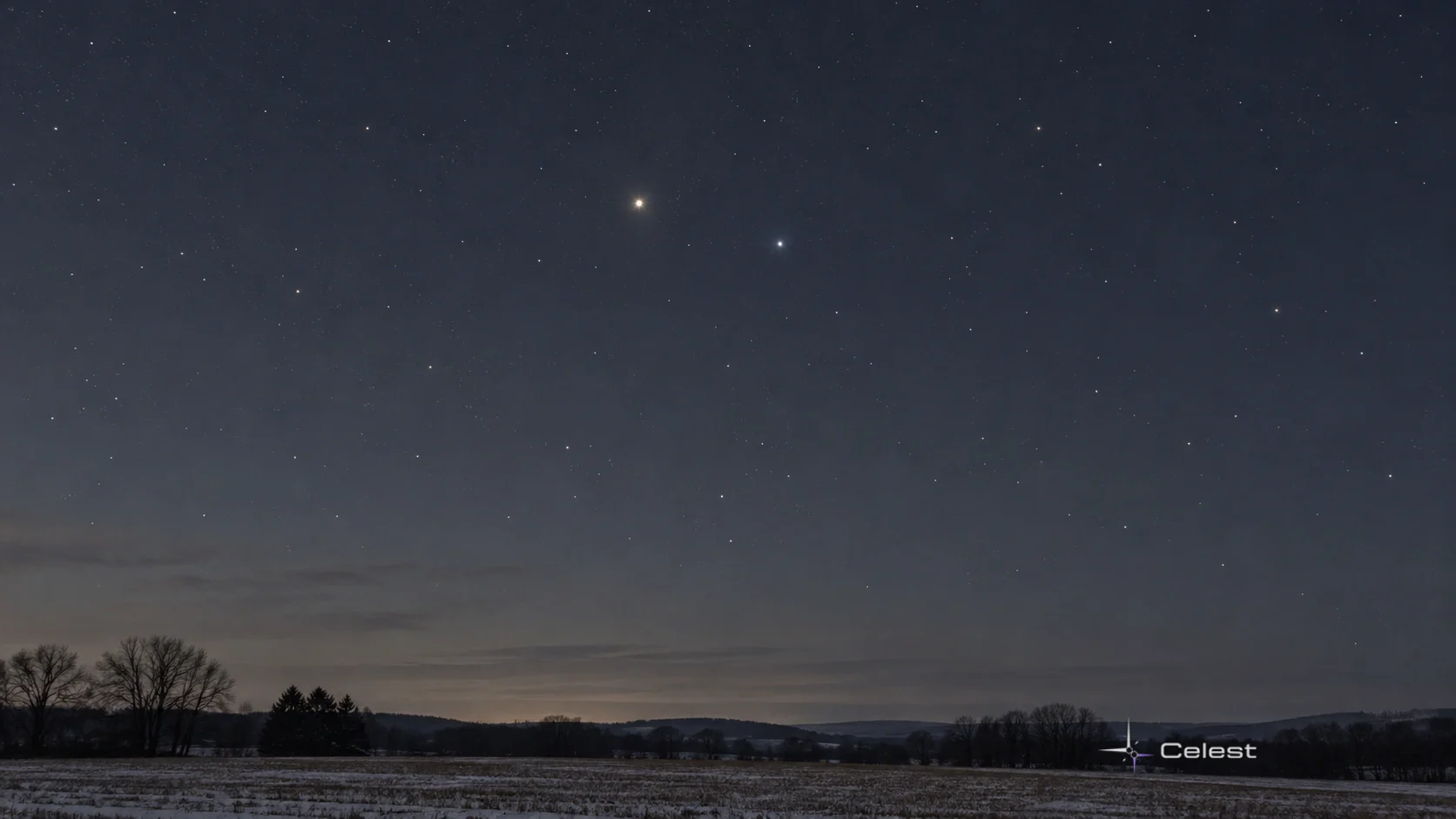
The Gemini constellation, the Twins, is recognised by Castor and Pollux, two bright winter landmarks near Orion. Their apparent partnership hides a major difference: Pollux is an evolved giant, while Castor is a system of six stars. Find the surrounding pattern in the constellation guide.
Begin with those two landmarks rather than the hidden components. Set the live sky map to your observing time and location, then compare Gemini with neighbouring Orion and Taurus. A printed drawing’s left and right are not fixed directions for every view.
Gemini at a Glance
The familiar pair identifies a region rather than one physical twin system.
- Traditional figure: the Twins.
- Official abbreviation: Gem.
- Brighter landmark: Pollux, an orange giant roughly 34 light-years away.
- Multiple-star landmark: Castor, a six-star system roughly 51 light-years away.
- Binocular highlight: M35, an open cluster near the figure’s foot.
- Northern observing season: winter, with local placement checked for the date.
The Two Heads Are Not a Bound Pair
Castor and Pollux sit close enough on the sky to frame the traditional Twins, but they do not orbit each other. Their separate distances also break the flat appearance: about 34 light-years for Pollux and 51 for Castor. A light-year measures the distance light travels in one year.
Pollux is the brighter apparent landmark. Its evolved giant stage and orange colour differ from Castor’s whiter appearance. Apparent brightness tells you how much light reaches Earth, while a star’s stage and multiplicity describe the physical system producing it.
The twin names belong to traditional sky figures, including Babylonian, Greek and Roman interpretations. They do not establish that the stars formed together. A constellation drawing connects apparent directions, so the first step toward understanding the stars is to separate that drawing from a physical relationship.
Castor Is Three Pairs Within One System
Castor’s bright appearance combines light from six stars. The brighter visible components, Castor A and B, each have a close stellar companion. The more distant Castor C, also called YY Gem, is another pair.
A binary consists of two stars orbiting one another. Castor therefore contains three binaries within a larger arrangement. It should not be pictured as six identical stars evenly spaced around one simple ring.
An amateur telescope may separate the brighter wide visual pair. Revealing that pair is a useful observation, but it does not expose all the close companions. The six-star description comes from measurements capable of investigating much tighter relationships than a casual view resolves.
Its orbits are also not all in one flat plane. A 2022 study found markedly different orientations among the inner and wider orbits. A simple diagram can introduce the hierarchy, provided it remains a schematic rather than a claim about measured angles or current positions.
M35 Is a Group With a Shared Origin
M35, also designated NGC 2168, is an open cluster near the foot of the Gemini figure. Its stars are loosely held together by gravity. Unlike the visual pairing of Castor and Pollux, they belong to a grouping with a shared formation history.
Open-cluster stars generally share a parent cloud containing gas and dust, giving astronomers related ages and chemical compositions to compare. A cluster offers a different kind of connection from the names assigned to distant apparent neighbours.
On a very dark night, M35 may appear as a faint diffuse patch to unaided eyes. Binoculars show a haze with some separate stars; a telescope resolves a more distinct grouping. The progression gives you a useful observing goal without requiring one particular star count.
How to Find the Twins
Northern winter provides a useful season. Identify Orion, then use the map to locate Gemini nearby and confirm the Castor-Pollux pair. The long figure extends toward Orion in the familiar drawing, with its feet nearer Orion’s head.
Check the surrounding pattern if one bright point initially sends you toward Auriga. Its main landmark, Capella, does not make the same conspicuous pairing with its next-brightest neighbour. Matching several stars gives you a firmer identification than choosing the brightest point alone.
For a second look, try the M35 field with binoculars or the bright Castor pair with a telescope. Check the observing conditions for the detail you want, and use the appropriate finder chart. Pattern recognition, a cluster view and separating a stellar pair are distinct successes.
Two Chart Dots Hide Different Architectures
The 2022 Castor analysis combined several kinds of measurement. An interferometer combines light from separated telescopes to investigate small angular details. Spectral shifts trace motion toward or away from Earth, while precise position measurements track the apparent orbit.
Together, those observations helped resolve close companions and reconstruct three-dimensional orbital relationships. The chart can still represent Castor with one dot. Knowing what lies behind that dot changes the winter view: two familiar landmarks introduce a stellar giant and an intricate collection of orbiting stars, rather than a matched pair of twins.
Leave a comment
Comments appear after moderation.