Messier 13: An Ancient Cluster With Varied Stars
A hazy patch becomes a crowded ball of stars under closer observation. Measurements of individual giants reveal that this ancient stellar group contains more chemical variety than its smooth outline suggests.

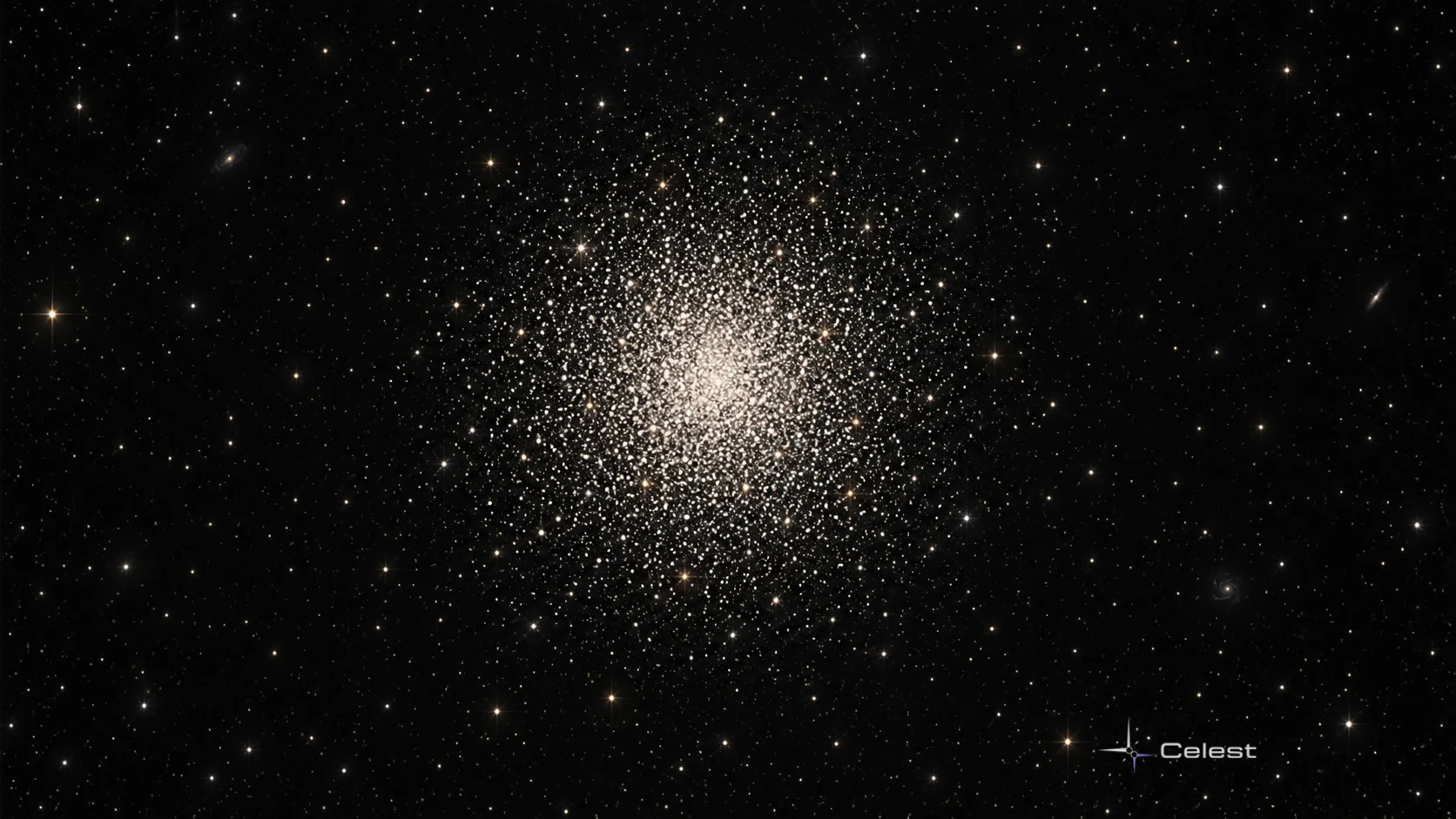
Messier 13, also called M13 or the Hercules Cluster, is a globular star cluster about 25,000 light-years away. Its compact, rounded appearance comes from a large population bound together by gravity. Begin with the constellation guide to place the cluster within Hercules’s four-star Keystone pattern.
A first view can resemble a small fuzzy patch. Closer observations separate numerous stars, and measurements of their light reveal differences hidden within the overall glow. M13 is useful both as an accessible observing target and as an ancient group in which researchers study how stars formed and evolved.
M13 at a Glance
- Other names: Hercules Cluster and NGC 6205.
- Type: a globular cluster in the Milky Way.
- Distance: approximately 25,000 light-years.
- Population: more than 100,000 stars.
- Overall width: roughly 150 light-years.
- Apparent magnitude: about 5.8.
Explore individual stars to compare colour and brightness before attempting the crowded cluster. A smooth-looking patch can contain many separate sources of light. Its listed magnitude describes their combined contribution, rather than a single star occupying the same small point.
How Can You Begin an Observing Session?
Find Hercules between Vega and Arcturus, then identify the Keystone. M13 lies along the side connecting Eta and Zeta Herculis, nearer Eta. Use the live sky for your location and date instead of applying one observing hour to every season.
The northern summer offers favourable evening opportunities, and NASA’s overview highlights July. Binoculars can show the cluster as a fuzzy object. A telescope can begin separating members, while a small instrument may still present a mostly rounded, unresolved glow.
Take time to compare the brighter centre with the outer parts. Check moonlight when choosing a darker session. Recognising a cluster and resolving many of its individual stars are different achievements, so judge your view by what the instrument actually reveals.
What Makes It a Globular Cluster?
Gravity binds a globular cluster into a compact, roughly spherical stellar group. Such systems can survive for billions of years and contain ancient populations. M13 belongs to the galaxy’s globular-cluster system, whose stars help researchers investigate the Milky Way’s past.
An open cluster usually presents a looser arrangement, while M13 becomes especially crowded toward its centre. That physical concentration explains why its stars merge visually at first. The difficulty of distinguishing the points belongs partly to the cluster itself, not simply to an observer overlooking an obvious pattern.
Why Is It Called Messier 13?
Edmond Halley discovered the cluster in 1714. Charles Messier added it to his catalogue in 1764, during the effort to distinguish persistent fuzzy objects from possible comets. Before individual stars were clearly separated, such a concentration could easily look like a nebulous patch.
The catalogue name preserves that observing history. Modern images explain the patch as many stars, while spectra provide information unavailable from its broad outline. The same object can therefore support very different questions as observing methods improve.
What Do Its Bright Stars Show?
The brightest reddish members include old red giants, which have expanded and become cooler at their surfaces. Blue-white stars are hotter. Colour and brightness help researchers compare stellar states, but they work with measured signals and models rather than assigning a complete history by colour alone.
Hubble portraits combine observations through selected filters, sometimes including infrared data. Those combinations show extraordinary detail and help separate different signals. An amateur view may resolve some members without reproducing the contrast, depth or colour range of the processed research image.
Can Their Light Reveal Different Ingredients?
Yes: spectra contain information about the relative quantities of elements in stars. A 2012 investigation measured oxygen, sodium and iron in a sample of 113 giant stars in M13. The team used the WIYN-Hydra spectrograph and examined the results alongside ideas about cluster formation.
The sample did not have one identical chemical pattern. Some stars showed much less oxygen relative to iron than others, and the oxygen-poor population was more concentrated toward the cluster’s centre. Those differences turn individual stars into evidence about the history of the group.
The number 113 describes the stars measured in that investigation. A detailed sample can reveal useful relationships without being a complete census. Researchers compare the chemistry, brightness and distribution of those stars to test explanations for the larger population.
Do Chemical Groups Mean Separate Birth Dates?
The observations identify chemical differences; they do not by themselves provide a complete sequence of distinct formation dates. The study discusses several populations and compares their behaviour with models. It also considers how a star’s later evolution can affect some of the quantities being measured.
That distinction matters because present-day composition is not always an untouched record of birth material. Formation conditions and subsequent changes both contribute information. Researchers need to explain the patterns together, rather than choosing an origin from one element alone.
In this investigation, the most oxygen-poor giants were interpreted as likely enriched in helium. Their later evolution could differ from that of other selected populations. These are model-informed conclusions about the measurements, with qualifications that remain part of the explanation.
What Does the Cluster Add to Galactic History?
M13 supplies a large ancient group whose stars can be compared within one physical environment. Images establish where its members lie and how their light is distributed. Spectra then add chemical information that its round outline cannot supply.
When you find the fuzzy patch in Hercules, you see the combined light of an enormous stellar group. Research goes further by asking which stars differ, how they evolved and what those differences reveal. The cluster’s beauty and its scientific value meet in that step from a smooth glow to many individual histories.
Leave a comment
Comments appear after moderation.