Hyades: A Nearby Star Cluster Slowly Spreading Out
The broad V in Taurus is the bright part of a physical stellar group. Former members extend much farther through the galaxy, leaving clues to the cluster’s history and the gravitational forces around it.

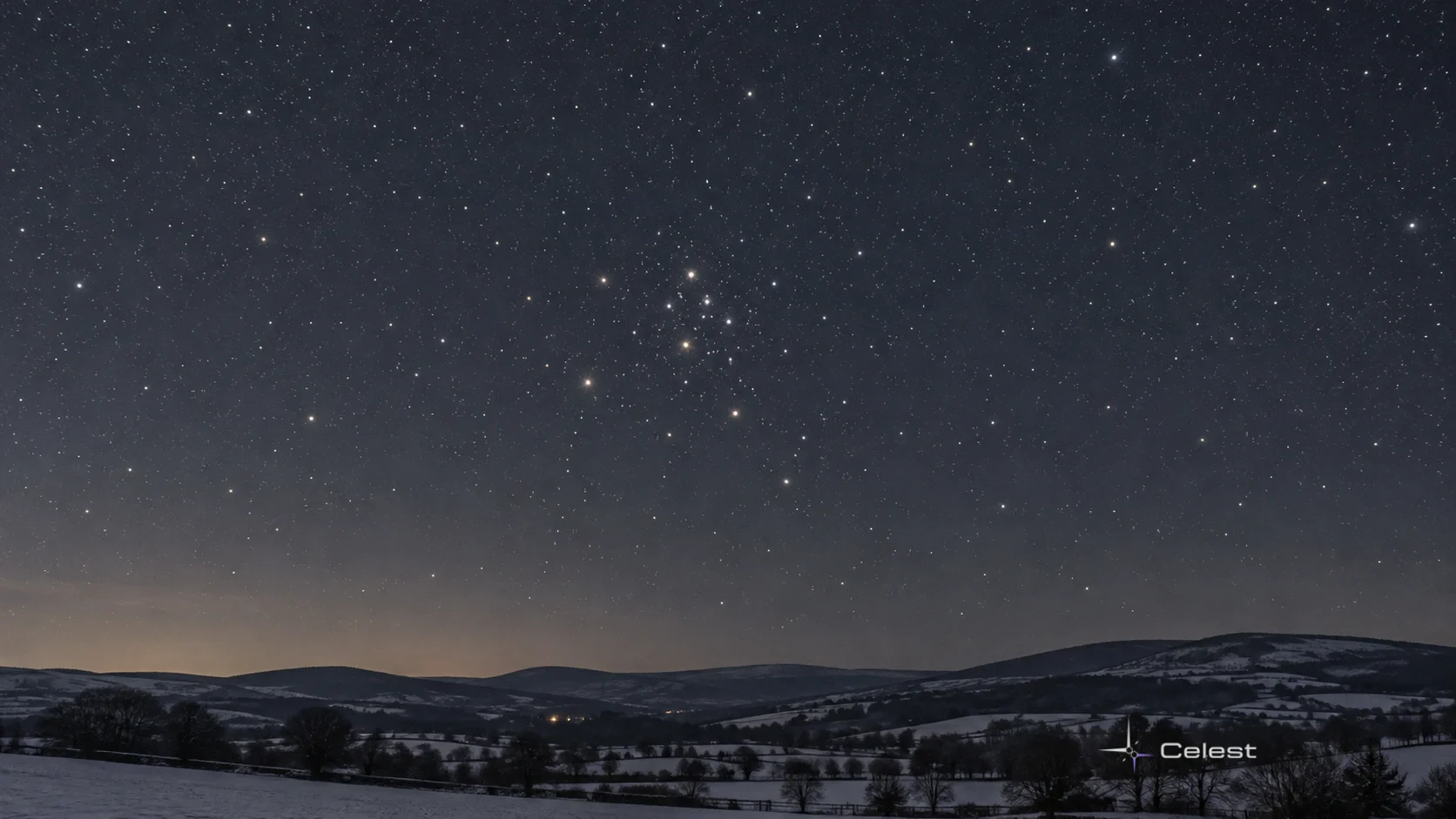
The Hyades are a nearby open star cluster in Taurus, at a distance of about 153 light-years. Their brighter stars form the broad V associated with the bull’s head. Use the constellation guide to place the group in the sky, then notice how widely its stars are spread compared with the compact Pleiades nearby.
The visible pattern is a convenient beginning, rather than the full extent of the stellar family. Researchers have identified candidate former members far from the central cluster. Those stars can help reveal how a group gradually mixes into the wider population of our galaxy.
Hyades at a Glance
- Object: a nearby open star cluster in Taurus.
- Distance: approximately 153 light-years for the central group.
- Age: roughly 600–700 million years.
- Recognisable pattern: the broad V of the bull’s head.
- A foreground neighbour: orange Aldebaran appears in the V but is not a member.
- Beyond the bright group: extended leading and trailing stellar tails.
Explore individual stars when comparing brightness and colour. An apparent pattern tells you where to look, while measurements tell researchers which objects share a physical history. That difference matters even in a group close enough to recognise without a telescope.
What Does a First View Show?
The Hyades make a wide gathering of points, rather than a compact knot. Binoculars can reveal fainter stars in the region and make the loose arrangement easier to inspect. Aldebaran gives the view a conspicuous warm-coloured landmark, but it lies in front of the cluster.
For northern autumn and winter evenings, Orion and Taurus provide useful neighbouring patterns. Check the live sky for your own location and date. Compare the broad Hyades with the smaller-looking Pleiades without expecting either visible outline to provide a complete list of members.
What Connects the Cluster’s Stars?
Stars in an open cluster formed together from a shared environment. Their ages and initial chemical properties are broadly similar, making them useful for studying how different kinds of stars develop. The Hyades are hundreds of millions of years old, older than the Pleiades and much older than the newborn population within the Orion Nebula.
Shared origin does not require the members to remain in one tight group forever. They move within the cluster and around the galaxy. A current cluster portrait is therefore one stage in a longer evolution, rather than the permanent arrangement of an unchanging family.
How Do Stars Leave the Cluster?
Gravitational encounters between members gradually change their velocities. Some move toward the outer parts of the group, where the galaxy’s pull can carry them away. The process changes which stars remain near the centre, even while those stars continue their lives elsewhere in the Milky Way.
The escaping population forms two extended structures called tidal tails. One stretches ahead of the cluster along its galactic motion and the other behind. These are distributed stars, rather than the gas-and-dust tail of a comet. Their arrangement records the cluster’s interaction with its surroundings.
How Were the Distant Members Found?
Gaia measures stellar positions, distances and motions with great precision. Researchers search those measurements for objects whose behaviour is consistent with a connection to the Hyades. A 2018 preprint, published in 2019, found clear evidence of leading and trailing tails within a limited search volume.
The 2021 investigation widened the picture by combining the observations with a computer model. Earlier leavers can follow paths that no longer closely match the central cluster’s present motion. Accounting for that evolution helped recover candidates extending across thousands of light-years.
The membership search is not a complete census with an exact sharp boundary. Its result depends on the available measurements, selection rules and model. Those limits explain why an older, smaller sample and a later extended search can describe different portions of the same evolving system.
Why Are the Two Tails Uneven?
The 2021 study found fewer candidates in the trailing structure. A simulated close encounter with a massive concentration of matter could reproduce the asymmetry. The responsible object was not securely identified; a dark-matter concentration was discussed as a possible explanation, rather than an established detection.
A 2023 study also examined how much unequal population could arise through statistical variation in escaping stars. In its model, the Hyades required additional dynamical processes. That adds a useful constraint without naming a unique cause for the observed arrangement.
Why Is a Nearby Cluster Useful?
A shared age and chemical environment let researchers compare stars without treating every difference as a completely separate origin. In the Hyades, they can study stellar evolution in a group much nearer than many other clusters. Its departing members also provide information about the forces acting within our galaxy.
The bright V and the extended population answer different questions. The first is a familiar sky landmark. The second is a way to investigate how gravitational interactions change a stellar group, and how those changes persist after individual stars have moved farther away.
Departing Stars Preserve a Shared History
At a first glance, you see a broad pattern. With precise measurements, researchers can connect it with a much larger past population and examine where the group has lost members. The Hyades are useful because the visible core, escaping stars and galactic environment can be studied together.
That gives the familiar V another meaning. It is a surviving part of a stellar group that has spent hundreds of millions of years changing. Stars beyond its obvious outline can still carry evidence about their shared past, turning separation into information about the cluster and the galaxy around it.
Leave a comment
Comments appear after moderation.