Lacerta Constellation: A Cluster and a Galaxy in Disguise
A northern sky region contains a real stellar family and a galaxy whose jet once made it seem like a variable star. Start with the neighbouring constellations, then discover what the light reveals.

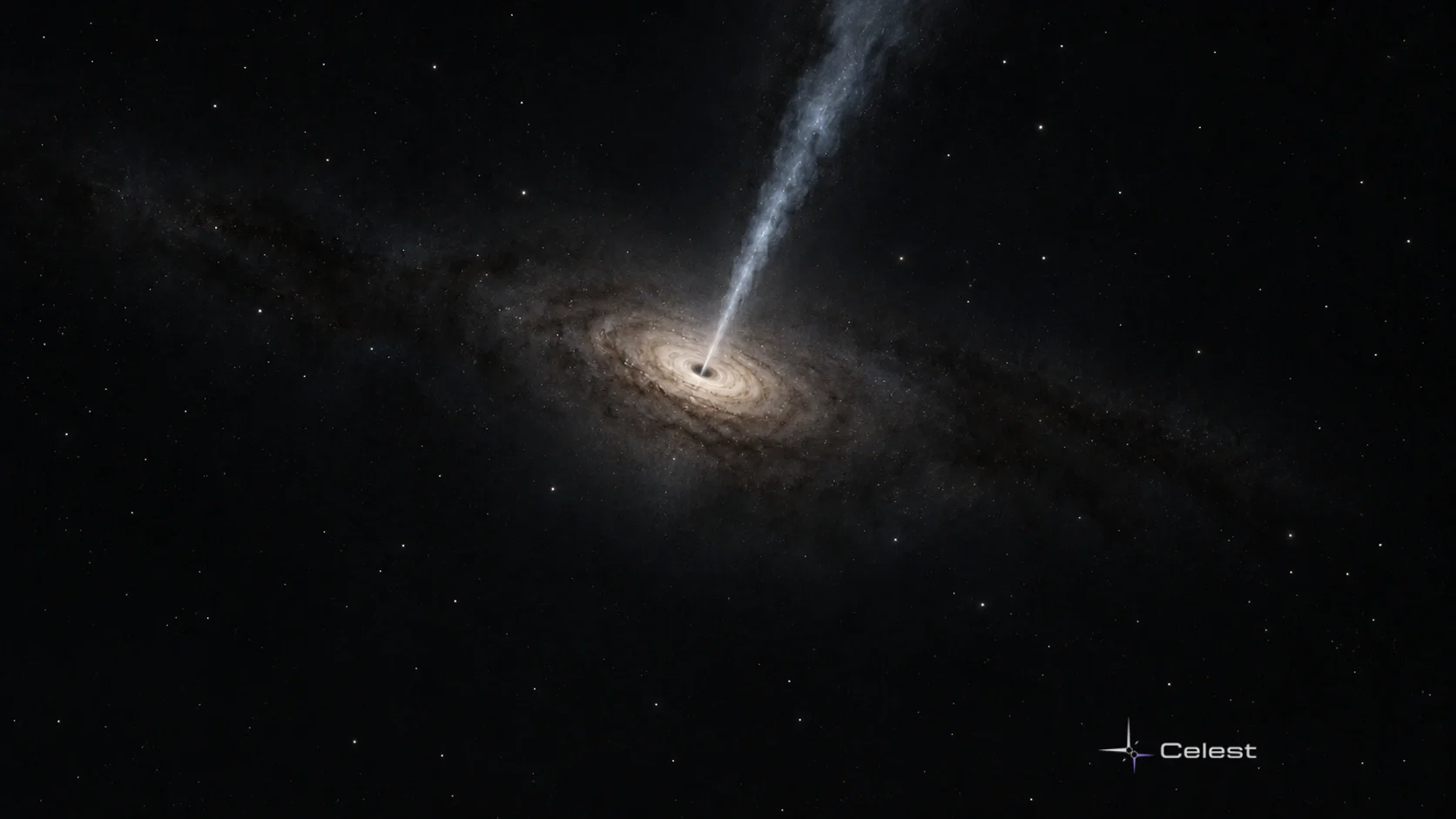
Lacerta is a northern constellation containing a star cluster and a much stranger-looking point of light. NGC 7243 is a group of stars; BL Lacertae was once mistaken for a changing star but is an active galaxy with a powerful stream of particles directed roughly toward Earth. Find the region in the constellation guide.
Northern autumn evenings offer a useful starting season. The same region is best placed in southern spring, with less of it accessible farther south. Use the live sky map to orient the chart for your position and time, rather than treating a printed map’s top edge as a fixed direction overhead.
Lacerta at a Glance
These landmarks help separate the map from the objects inside it.
- Name: Lacerta, the Lizard.
- Official abbreviation: Lac.
- Sky region: northern, beside Cygnus and Andromeda.
- Evening season: northern autumn or southern spring.
- Star cluster: NGC 7243.
- Active galaxy: BL Lacertae.
A constellation gives an address on the sky. The objects assigned to that address can have different origins and distances; finding a familiar outline is only the first stage of learning what produces its light.
Find Lacerta Through Its Neighbours
Start with the surrounding regions you already recognise. Cygnus and Andromeda provide two useful sides of the search area; Cepheus, Cassiopeia and Pegasus complete the neighbouring regions on the official chart. Compare that frame before trying to assign names to every point inside it.
The IAU Office of Astronomy for Education map distinguishes Lacerta’s boundary, its stellar pattern and NGC 7243. Follow the named stars first, then locate the cluster symbol. This keeps a region, an outline and an individual object from becoming three versions of the same thing.
Chart symbols also tell you where to concentrate. Larger star dots indicate greater apparent brightness. Letters such as alpha and beta identify stars, although their alphabetical order does not always reproduce the actual brightness ranking.
If faint points disappear into skyglow, check the observing conditions and choose a darker setting. Scattered urban light removes contrast from the star field. Binoculars can extend the view once the surrounding pattern is secure; a detailed chart helps keep that wider field connected to the correct region.
NGC 7243 Is a Physical Group of Stars
NGC 7243 is an open cluster: a relatively loosely bound family of stars associated with a shared formation episode. That physical history differs from the drawing used to recognise Lacerta. Cluster membership has to be tested through observations, rather than decided by which points look close together.
A study by Jilinski and collaborators, published in 2003, examined stellar positions recorded across 97 years. The researchers measured the apparent motions of 2,165 stars and selected 211 cluster members within their survey’s brightness limit. That selection describes a particular study, not a promise of 211 stars in your eyepiece.
Motion and brightness measurements help distinguish the group from other stars along the same direction. Comparing a cluster’s members also helps astronomers investigate stellar development, because the stars generally share an age while differing in other properties.
Open clusters tend to disperse gradually over hundreds of millions of years. Their stars then join the wider galactic population. A present-day concentration can therefore preserve evidence of a common beginning without staying a compact family forever.
BL Lacertae Turned Out to Be a Galaxy
BL Lacertae initially appeared to be a variable star, meaning a star whose observed brightness changes. Its stellar-style name survived a major change in interpretation. The source is a blazar, an active galaxy whose central engine sends a particle jet approximately along our viewing direction.
Gas falling toward the central black hole forms a hot disk. Some material is redirected into two opposing jets, travelling at speeds close to that of light. Looking nearly along one jet makes its radiation especially conspicuous across a range of wavelengths.
This is why the apparent point of light can be misleading. An ordinary sky pattern identifies its direction, while radio, optical and X-ray measurements investigate the much more energetic system responsible for the emission.
The X-rays Expose a Microscopic Process
NASA’s account updated in 2025 describes an experiment that tested competing explanations for the X-rays. IXPE observed BL Lacertae for seven days in late November 2023, alongside ground telescopes recording radio and visible light. The scientists compared polarization: the preferred orientation of the waves making up the light.
The visible light was strongly polarized, but the X-rays showed a much weaker polarization signature. In the X-ray data, the researchers established an upper limit instead of measuring a strong signal. The difference mattered because electron-based and proton-based explanations predicted different signatures.
The contrast supported Compton scattering. In this process, a fast electron interacts with a photon, a particle of light, and changes its energy. Jet electrons can boost infrared photons into the higher-energy X-ray range.
That conclusion concerns the studied source and observation. Blazars change, so further observations and other examples help test how their behaviour differs. A bright point can reveal much more than its brightness: even the orientation of its light can identify the particles producing it.
Leave a comment
Comments appear after moderation.