Lepus Constellation: A Star Cluster and Two Brown Dwarfs
Below Orion, the Hare leads to an old star cluster, gas expelled by an aging star and a companion whose hidden double nature changed its interpretation.

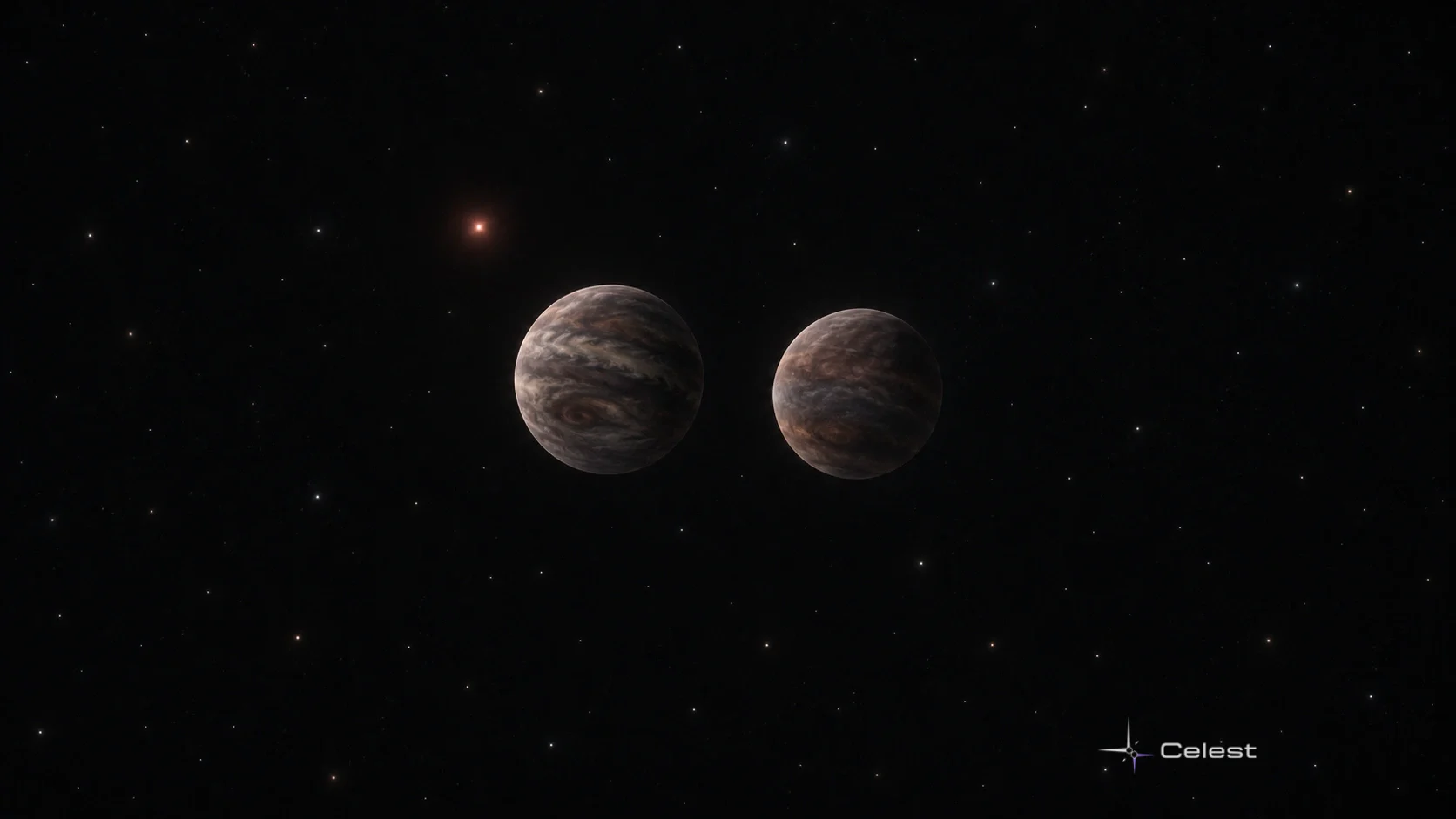
Lepus is the Hare constellation below Orion, with Arneb as its brightest star. This winter sky region leads to Messier 79, a dense star cluster, and IC 418, gas shed by an aging star. It also contains a faint companion to a star that turned out to be two objects.
Those companions are brown dwarfs: bodies too low in mass to sustain the sustained conversion of hydrogen into helium that powers ordinary stars. Their discovery as a pair solved a mismatch between how much mass astronomers inferred and how little light they received.
Lepus at a Glance
- Official abbreviation: Lep.
- Brightest star: Arneb.
- General evening season: Northern winter.
- Star cluster: M79, approximately 41,000 light-years away.
- Expanding stellar shell: IC 418, approximately 2,000 light-years away.
- Close companion pair: Gliese 229 Ba and Bb.
Finding the Hare Below Orion
Start with Orion, then compare the region beneath it with the constellation map. Lepus has neighbours including Eridanus, Canis Major and Columba. The Hare’s outline helps organise the stars, while its official boundary identifies the sky area to search.
Northern winter is a useful evening season.
Check the live sky for the constellation’s orientation on your chosen date. Its whole area can be seen from temperate northern latitudes, including Romania, at suitable times of year. The corresponding favourable evening season in the Southern Hemisphere is summer.
For a first observation beyond its main stars, consider M79. NASA’s catalogue favours January and describes the cluster’s centre as a small diffuse patch in binoculars. Resolving individual stars requires at least a medium-sized telescope in that guidance.
Choose observing conditions with faint objects in mind, then use a detailed M79 chart to confirm the cluster. Identifying its combined light is already a different observation from recognising the foreground constellation stars.
M79 Faces Away From the Galactic Centre
M79 is a globular cluster, a roughly spherical stellar group. It lies about 41,000 light-years from Earth and about 60,000 light-years from the centre of the Milky Way. Earth is between the cluster and our Galaxy’s central region.
That arrangement explains its unusual direction on the sky.
Many familiar globular clusters appear towards the Galactic centre, but M79 lies in the opposite direction. Our position inside the Milky Way changes how its structures are distributed across our sky.
The cluster also contains stars whose appearances complicate a simple age judgement. Alongside red giants, aging stars that have expanded and cooled, Hubble found blue stragglers: stars bluer and brighter than expected among an old cluster’s residents.
Mergers or transfer of matter between neighbouring stars are proposed explanations. Such processes can give a star a younger-looking appearance without requiring a new generation of star formation throughout the cluster.
IC 418 Glows After a Star Sheds Its Layers
IC 418 is a planetary nebula, an expanding cloud expelled by an aging star. It lies approximately 2,000 light-years away. The name describes a historical class of nebulae, rather than planets forming around the central remnant.
Its exposed stellar core supplies the energy for the glow.
Ultraviolet radiation from that hot core excites the surrounding gas, which emits light. In the published image, filters isolate radiation from different elements and assigned colours separate those contributions. Fine woven-looking textures give IC 418 its Spirograph nickname.
The texture’s origin was uncertain in the 2000 Hubble description. The broader stellar sequence is better established: a red giant loses its outer layers, the gas expands and gradually disperses, and the remaining compact core cools as a white dwarf.
The bright shell is therefore a temporary phase in a star’s evolution. Its appearance records material leaving the star while the exposed remnant still supplies enough radiation to illuminate it.
A Faint Companion Reveals a Hidden Pair
Gliese 229 B was confirmed as a brown-dwarf companion in 1995. For years, its light seemed too faint for the mass inferred if it were a single body. In 2024, a Caltech-led team resolved it into Gliese 229 Ba and Bb.
Two lower-mass bodies made the mass and brightness agree.
The team combined light from four VLT telescopes with GRAVITY to distinguish the components. CRIRES+ supplied another test through their spectra, which separate light by wavelength. Molecular signatures shifted as the bodies alternately moved towards and away from Earth.
The pair complete a mutual orbit in about 12 days. A 2025 analysis refined the orbital measurements and found agreement between the imaging and spectral data. The close pair travels around the parent red dwarf as part of the larger system.
Finding two bodies resolves this particular brightness puzzle without settling how such close companions form. The result gives future searches a concrete possibility to test: some apparently single, unusually faint companions may conceal pairs whose individual light makes physical sense.
Leave a comment
Comments appear after moderation.