Lyra Constellation: Vega, a Four-Star System and M57
Vega is the easy landmark, but the small constellation around it holds a multiple-star system and the remains of a star. Different observing tools reveal different parts of the story.

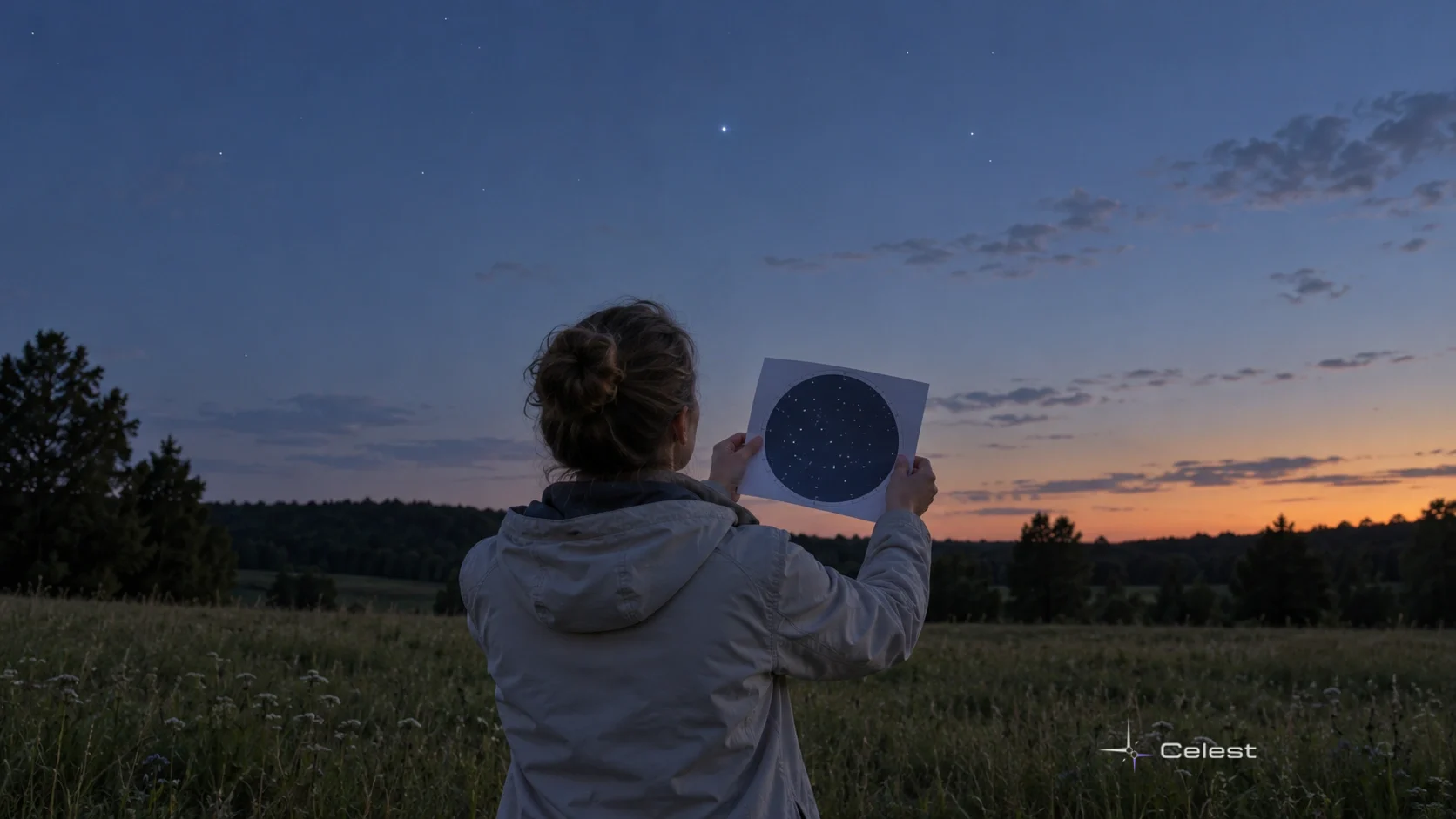
The Lyra constellation is a small region of the northern sky, easiest to approach through its brightest star, Vega. Fainter stars nearby make a compact parallelogram. The traditional name refers to a lyre, a musical instrument, but a modern constellation is a bounded area of sky rather than an object shaped like a harp.
Begin with the constellation guide, then compare the pattern with your evening sky.
The live sky map helps you set the orientation for your location and time instead of copying a fixed direction from an old chart.
Lyra at a Glance
- Sky region: a northern constellation.
- Official abbreviation: Lyr.
- Bright landmark: Vega, one corner of the Summer Triangle.
- Fainter pattern: a small parallelogram near Vega.
- Multiple-star highlight: Epsilon Lyrae, the Double Double.
- Nebular highlight: Messier 57, the Ring Nebula.
Let Vega Lead You Into the Pattern
Vega stands out strongly from the fainter stars around it. It is one of the three prominent points of the Summer Triangle, alongside Altair and Deneb. Recognising those landmarks gives you a larger pattern before you examine the smaller constellation.
The parallelogram is less obvious than Vega. Binoculars can help bring its weaker stars into view, especially when city glow makes the pattern difficult to distinguish. Use a chart to check the arrangement rather than assuming every faint star near the bright one belongs to the same drawing.
A June guide may place Lyra in the eastern evening sky, while a later date shows it elsewhere. The useful permanent idea is the relationship between Vega and the nearby pattern. The clock time and direction belong to a particular observing session.
A Traditional Lyre and a Modern Sky Region
In Greek mythology, the lyre is associated with the musician Orpheus. Other traditions pictured different figures in this region; NASA/JPL discusses an eagle among them. The same bright points can support different cultural stories.
The International Astronomical Union defines Lyra by its boundary, as it does the other official constellations. Those boundaries give astronomers a consistent way to name where an object appears. They do not turn the stars into one physical group.
There is no single distance to Lyra.
Vega is about 25 light-years away, while the Ring Nebula is much farther away along another direction within the region. Their apparent neighbourhood on a chart does not mean that they sit together at the same depth in space.
A Point That Resolves Into More Stars
Epsilon Lyrae is known as the Double Double. It can look like a single point with unaided eyes, while an optical view separates a wider pair. With sufficient resolution, each part separates again, revealing four stars.
That makes it a useful example of what an instrument changes. A bigger or steadier view does not create extra stars; it separates light sources that were blended in the earlier image. Telescope resolution and atmospheric steadiness matter, so a particular view is not guaranteed by magnification alone.
For a beginner, recognising the system’s position is a worthwhile first step. Keep the four-star result as something to explore with suitable equipment or an experienced observer, rather than a pass-or-fail test for your first session.
The Ring Nebula Is a Different Kind of Ring
Messier 57, also called M57 or the Ring Nebula, lies roughly between the stars Sheliak and Sulafat. It is a planetary nebula: a glowing cloud of material from an evolved sun-like star. The name is historical, not a statement that a planet sits inside a set of rings.
The nebula has an apparent magnitude around 8.8. Magnitude describes how bright an object appears in the sky, with larger numbers indicating fainter objects. A telescope is needed to explore its ring-like detail.
A detailed Hubble image reveals complicated gas structure and uses colour to help distinguish the material; it is not a prediction of the colours a beginner will see through an eyepiece.
NASA’s comparison of an amateur image with a Hubble image is a useful reminder. The object is the same, but the instruments collect and resolve its light differently. Finding its place on a chart comes before expecting the detail in a space-telescope portrait.
How to Explore Lyra in Your Own Sky
Choose a session when Vega and the surrounding region are well placed above the local skyline. Check the Moon’s phase, since a bright Moon can make the weaker stars less obvious. Start with Vega, confirm the neighbouring pattern, then compare one feature at a time with the map.
Binoculars offer a broad view of the area. Keep them steady and avoid sweeping too quickly: recognising a few neighbouring stars is more helpful than briefly passing over many unidentified points. A telescope is the next step for the Double Double or M57.
Use a current chart for orientation, then compare your view with examples made through similar equipment. A detailed space-telescope portrait answers different questions from a first visual observation.
A Small Pattern With Several Layers
Lyra lets you move from a bright familiar star to fainter patterns, then to a multiple system and the remains of an evolved star. Each step changes the kind of detail you can recognise.
On a first visit, learning the pattern around Vega may be enough. Later, the Double Double and Ring Nebula give you different questions to explore. A small patch of sky becomes a route through several kinds of stellar history.
Leave a comment
Comments appear after moderation.