M81 and M82: Two Galaxies, One Gravitational Story
A spiral galaxy and its elongated neighbour share a view near the Great Bear. Their connection reaches beyond appearance: gravity, newborn stars and powerful gas flows.

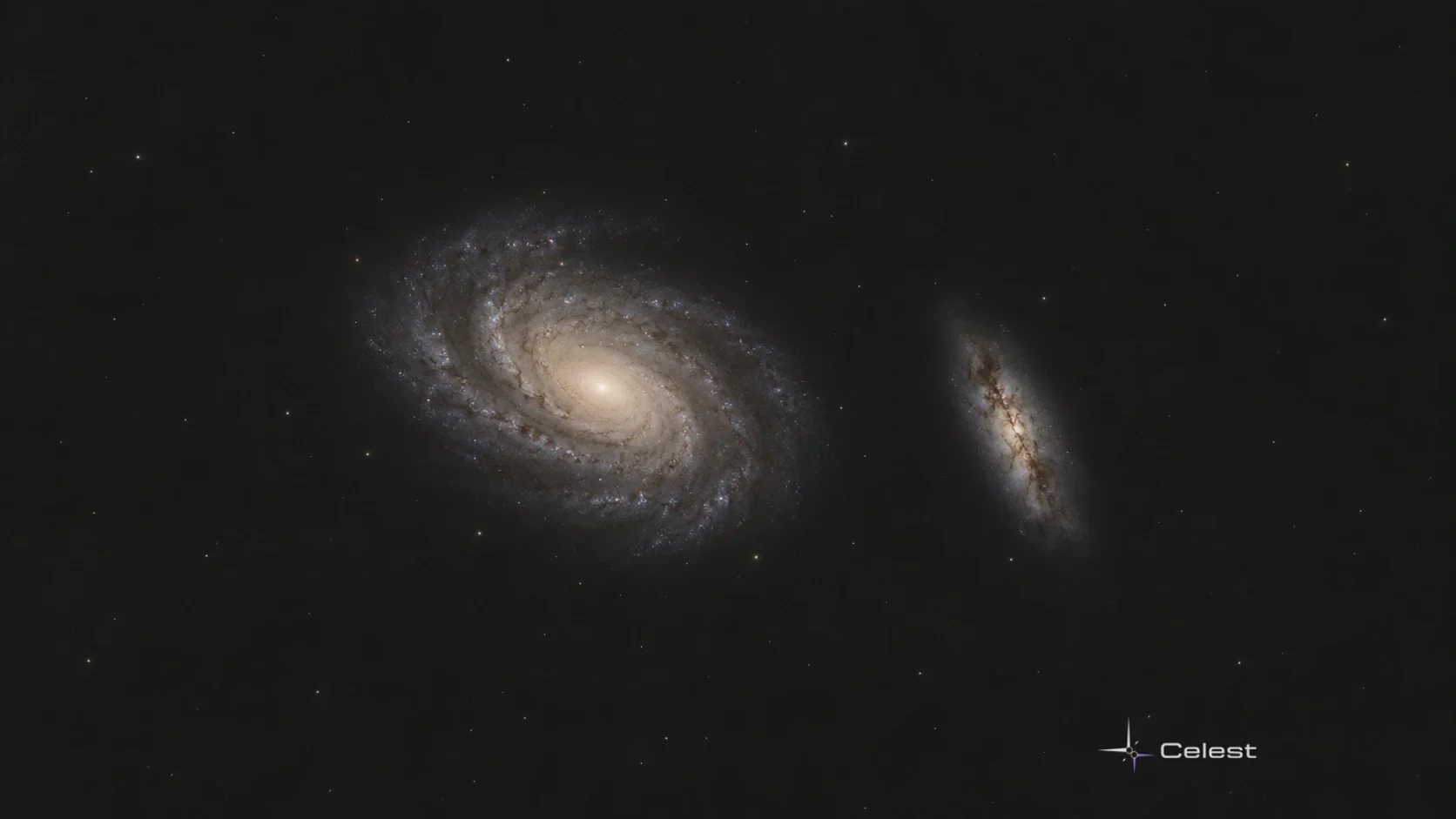
M81 and M82 are two neighbouring galaxies in Ursa Major, the Great Bear. M81 is a spiral with a bright centre and winding arms. M82 looks more elongated and is often called the Cigar Galaxy. Through binoculars or a small telescope, the pair can appear as two faint patches in the same field.
Their connection is more than a convenient alignment for observers. Gravity links their histories, and M82 forms stars at an unusually intense rate. Those newborn stars also change the gas around them, helping drive material away from the galaxy’s central region.
M81 and M82 at a Glance
- Constellation: Ursa Major.
- M81’s catalogue distance: approximately 11.6 million light-years.
- M82’s catalogue distance: approximately 12 million light-years.
- Apparent magnitudes: about 6.9 for M81 and 8.4 for M82.
- Discovery: Johann Elert Bode identified both in 1774.
- General northern observing season: spring, with April noted in NASA’s catalogue.
Apparent magnitude measures brightness as seen from Earth. A galaxy’s combined light is spread across an area, so those numbers do not turn either object into a bright, sharply defined star. The catalogue distances give an approximate scale; their small numerical difference is not a measurement of the space between the galaxies.
What Can You Look for Through a Telescope?
Start by placing Ursa Major with the constellation guide. A broad low-power view can hold both galaxies, making their different outlines easier to compare.
Use the sky map for your chosen evening to connect the brighter constellation stars with the pair’s position.
M81 is the easier bright-centred patch to recognise. A small telescope can distinguish its core, while M82 has a narrower appearance. Try comparing the shapes before searching for fine details. Space-telescope images show far more structure than the subtle light you are likely to recognise at an eyepiece.
Why Do Their Shapes Look Different?
M81’s spiral arms include young hot stars and dusty lanes, while its central bulge contains an older population. A broad detailed image brings those components together. You are looking at several stages of stellar evolution arranged across one galaxy, not one uniform collection of stars.
M82’s disk is tilted so that we see an elongated outline. Dust and intense activity near its centre add further complexity. Its gas streamers extend above and below the disk in detailed observations, which is why many published images look much more dramatic than a simple cigar-shaped eyepiece patch.
How Are the Galaxies’ Histories Connected?
NASA links M82’s intense star formation with gravitational interaction with M81. Hubble studies have examined dense groups of stars that preserve clues to earlier activity. Their ages and present locations help researchers reconstruct a past encounter, rather than watch that encounter unfold.
The important connection is between gravity and the conditions for forming stars. A galaxy’s neighbour can change its material and structure, leaving consequences visible much later. The timing and details of individual past passages require models, so a single precise encounter date would oversimplify the history retained in these descriptions.
What Does a Starburst Mean in M82?
A starburst is an unusually intense episode of star formation. NASA’s 2024 Webb report described M82 as creating new stars about ten times faster than the Milky Way. This compares rates; it does not mean M82 contains ten times as many stars or makes exactly ten new stars each year.
Hot new stars emit radiation and streams of particles, and later supernovae add energy to the surrounding gas. Together these effects help drive a galactic wind: an outflow of gas and particles. The star guide explains the stellar life stages behind this activity.
What Did Webb Add to the Picture?
In 2024, Webb examined M82’s centre in near-infrared light. That view resolved dusty structures and small bright sources that could be individual stars or star clusters. It also traced cooler material in the wind through emission from small carbon-bearing molecules.
The molecular structure resembled that of hotter ionised gas. Because the molecules should not last long under strong irradiation, the team suggested possible replenishment from cooler material. This remains a question to investigate, not a complete account of every strand seen in the image.
How Fast Does the Hot Gas Move?
A March 2026 XRISM result measured superheated central gas moving at over three million kilometres per hour. The team used X-rays from iron to examine its temperature and motion. Broadening of the light’s spectral features revealed rapidly moving material along our viewing direction.
The reported temperature was around 25 million degrees Celsius. Together, the heat and speed appear sufficient to drive the cooler large-scale outflow. These values describe the hot measured component; they cannot be assigned to every filament in a colour photograph. Other effects, including cosmic rays, may still contribute.
What Remains Unexplained?
The team calculated that the central region sends outward gas equivalent to seven solar masses each year. A steady-wind model accounted for four solar masses in the cooler flow. The remaining difference raises a real question about where that material goes and whether some leaves through another route.
That uncertainty adds meaning to the pair’s appearance. M82 is not simply using gas to build stars; its stellar activity also changes where gas travels. M81 and M82 show how a neighbour’s gravity, the birth of stars and the movement of material can become parts of one continuing galactic story.
Leave a comment
Comments appear after moderation.