Messier 15: An Old Cluster With a Dying Star’s Cloud
The dense cluster in Pegasus contains a rare planetary nebula. Its gas, central remnant and old stellar environment offer complementary clues to one star’s evolution.

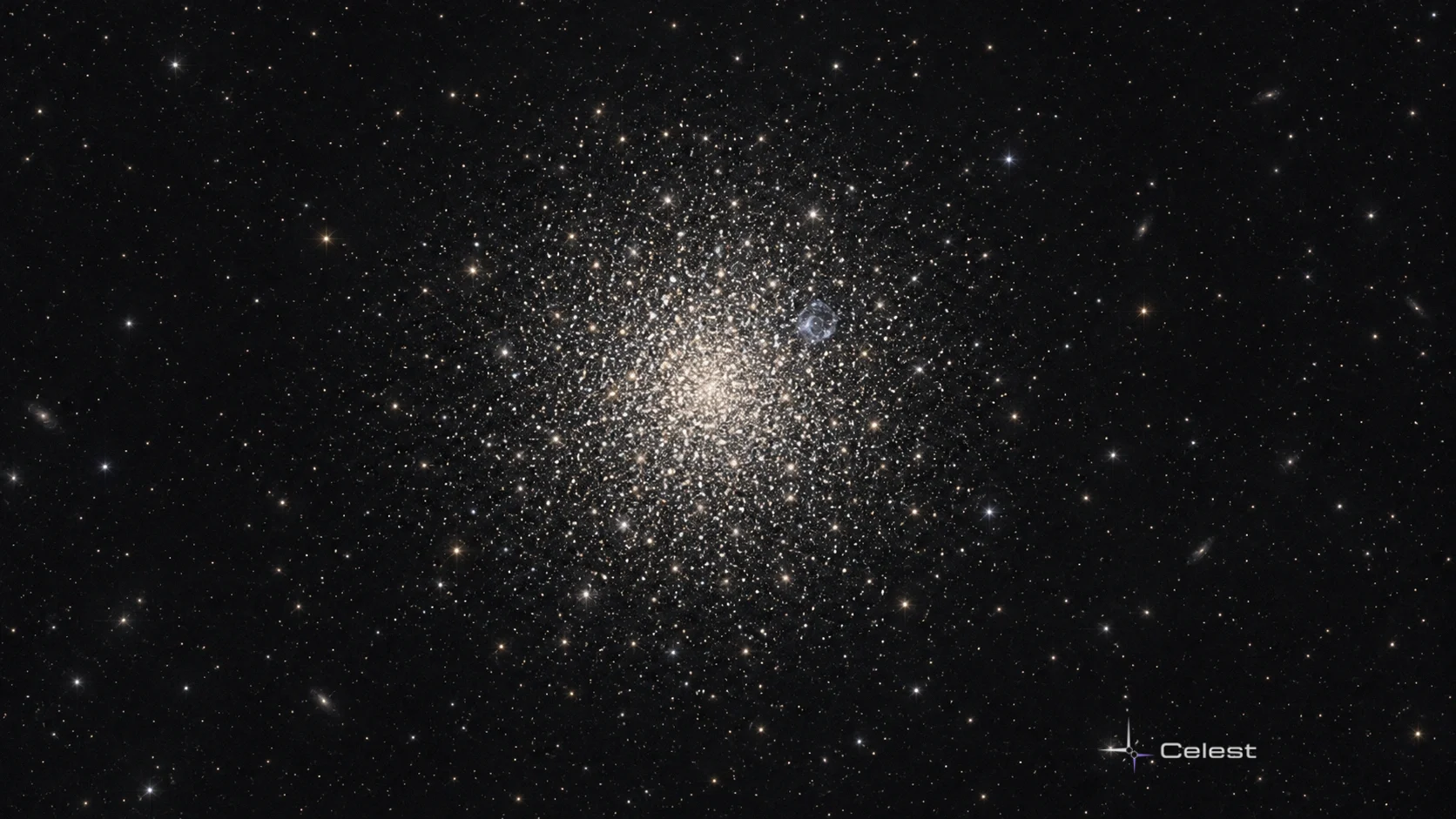
Messier 15 is a very old globular star cluster in Pegasus, roughly 34,000 light-years away. Its stars form a tightly concentrated group, with a bright centre and a more scattered outer population. Embedded among them is Pease 1, a small cloud of gas released by a star near the end of its life.
That cloud gives M15 an unusual second story. A cluster dominated by ancient stars provides context for studying a brief stage of stellar evolution. Researchers can examine the gas and the central remnant together, then compare their properties with explanations of the star’s earlier history.
Messier 15 at a Glance
- Catalogue name: M15, also NGC 7078.
- Type: a globular cluster in the Milky Way.
- Constellation: Pegasus.
- Population: more than 100,000 stars.
- Apparent magnitude: 6.2, for the cluster’s combined light.
- Age: approximately 12 billion years.
NASA’s catalogue gives a distance of 33,600 light-years, while other Hubble descriptions round it to 35,000. About 34,000 is a useful general scale. These are approximate descriptions of the same distant cluster, rather than a reason to present one rounded value as an exact measurement.
What Does a First View Show?
M15 can be recognised as a small patch through binoculars. NASA recommends September as a general observing month. Begin with Pegasus among the constellations, then check the live sky for a suitable direction on your chosen evening.
The cluster is more concentrated toward its centre. A visual impression and a detailed Hubble photograph show different levels of detail, so identifying the cluster is a useful first goal. Pease 1 is a much smaller feature within that crowded view and is a separate observational challenge.
Jean-Dominique Maraldi discovered M15 in 1746 while looking for comets. Later instruments revealed that the hazy object consists of an enormous stellar population. Today, images made from different wavelength bands distinguish stellar points and gas that might otherwise blend together.
An Ancient Population in a Dense Centre
A globular cluster is a large, roughly rounded group of stars held together by gravity. M15’s population is very old, and its central concentration has made it useful for studying how dense stellar systems evolve. The bright core is the combined light of many stars.
Its central mass distribution has also prompted research into a possible intermediate-mass black hole, between typical stellar remnants and giant galactic-centre black holes in mass.
A 2024 study argued that a fast-moving star’s reconstructed path and properties support an origin in M15 and an ejection involving such an object. This is an inference from measurements and models, rather than a direct image of the cluster’s hidden centre.
What Is Pease 1?
Pease 1 is a planetary nebula within M15, recognised by Francis Pease in 1928. A planetary nebula is a glowing envelope of gas shed by an evolved star. The historical name comes from its appearance in early telescopes, not from the creation of a planet.
The first recognised planetary nebula belonging to a globular cluster was found here. Such associations are rare. Compatible positions and motions help establish whether a nebula belongs to the population. That shared setting lets researchers study the nebula alongside the cluster’s stellar history.
The gas cloud and the cluster have different ages. The ancient stellar population can contain an object passing through a much shorter late-life stage. A recently released envelope therefore does not imply that the entire cluster has just formed.
Why Does the Gas Glow?
An evolved star can lose its outer layers, exposing its hot central remnant. Energetic radiation from that remnant excites the surrounding gas. Atoms then emit light at particular wavelengths, allowing instruments to distinguish the nebula from nearby stars.
Different nebulae arise through different processes. Some are regions where stars form; a planetary nebula records matter released by an aging star. The physical context matters more than the fact that both appear as attractive clouds in photographs.
Use the star guide to explore the stages leading from an ordinary star to a compact remnant. Pease 1 links those stages to a specific object inside a cluster whose broader population is already well studied.
Images Reveal More Than a Coloured Spot
A study published in 2000 used Hubble observations spanning seven days. It examined the central star’s light and took detailed images in selected emission bands. The nebula showed two elliptical shells and a brighter arc, surrounded by a fainter envelope.
An image’s colours help display observations through different filters. They are not a direct instruction about what your eye should see. Looking at structure and the kinds of light recorded gives a more useful explanation than simply calling Pease 1 a blue spot.
Chemistry Helps Test the Star’s Past
In 2015, researchers combined observations from ultraviolet to far-infrared wavelengths. Their analysis measured abundances for ten elements in the gas and seven in the central star. They also found evidence for carbon-bearing dust and molecules.
Comparing the gas with the remnant helped them test evolutionary models. Their interpretation favoured an earlier interaction that increased the progenitor’s mass. A 2000 analysis had also proposed a merger history. These are explanations inferred from the surviving properties, not observations of the original event.
The distinction is useful: finding a shell establishes something about the star’s later life, while explaining its unusual properties requires more evidence. Chemistry, luminosity and models address different pieces of that history.
A Small Cloud in a Much Older Story
For your own first view, begin with the whole cluster and return after learning its surrounding stars. Its central glow is already a connection to an ancient part of the Milky Way. The tiny nebula becomes a separate story through detailed observations.
Pease 1 makes that story more than a catalogue of old stars. Its gas and central remnant preserve clues about the route one star took through the same environment. An ancient cluster can contain a brief, changing phase that helps researchers test how stellar histories unfold.
Leave a comment
Comments appear after moderation.