Messier 35: Two Star Clusters at Different Distances
M35 is a young group of stars in Gemini. Its compact-looking neighbour, NGC 2158, adds a second story to the same view: greater distance and a much older population.

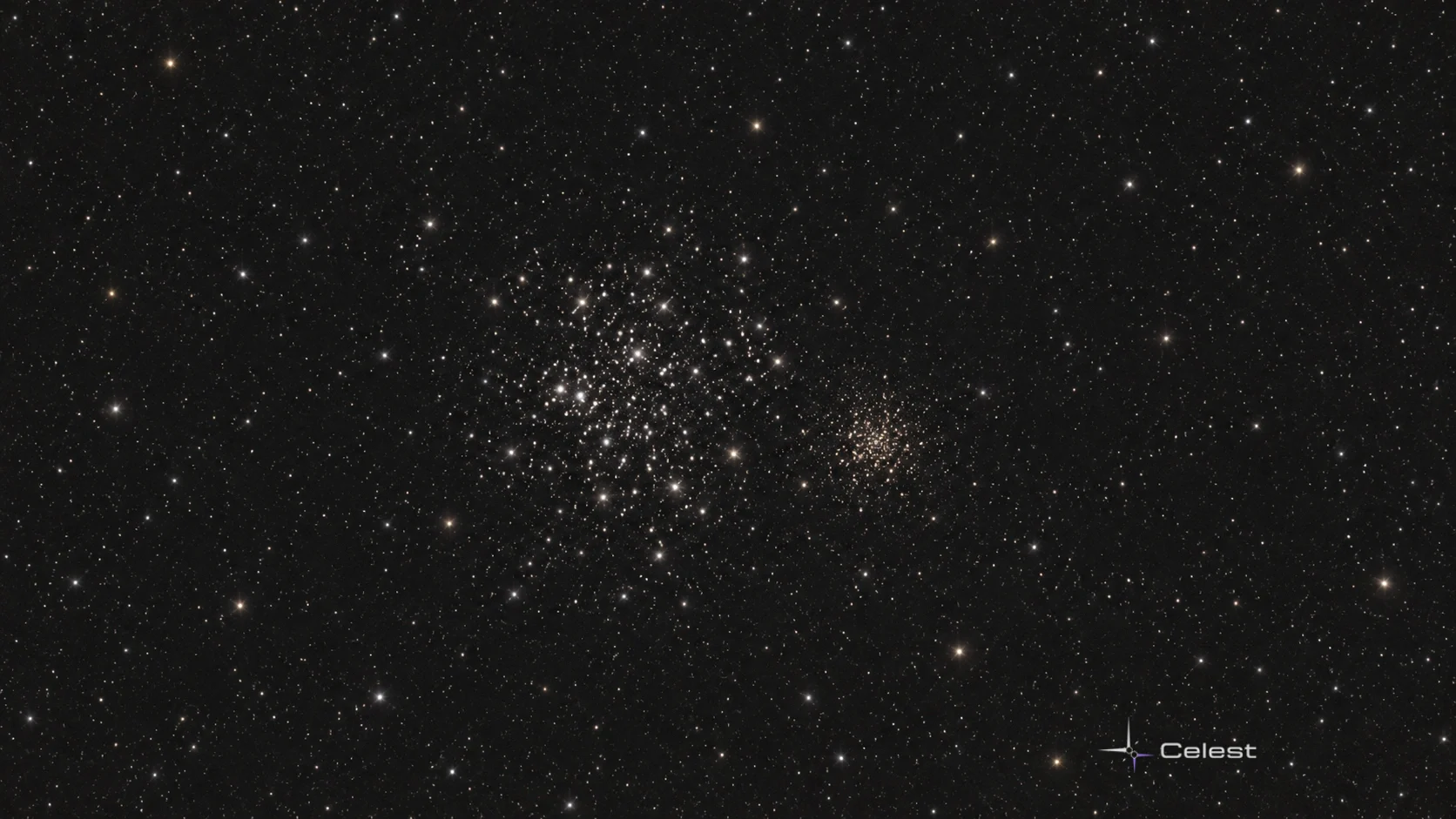
Messier 35, usually shortened to M35, is an open star cluster in Gemini. Hundreds of its stars form a broad group that is rewarding to explore through binoculars or a small telescope. A second, smaller-looking cluster can appear nearby in the same view. That apparent neighbour, NGC 2158, is much farther away.
The pair makes M35 more than a pleasing collection of bright points. It is a useful introduction to the difference between a pattern in the sky and the arrangement of objects in space. Start with the constellation guide to place Gemini, then look more closely at what the field contains.
Messier 35 at a Glance
- Other names: NGC 2168 and the Shoe Buckle Cluster.
- Object type: an open cluster, a loosely bound group of stars.
- Constellation: Gemini.
- Approximate distance: 2,800 light-years in NASA’s Hubble catalogue.
- Approximate age: 150 million years.
- Apparent magnitude: about 5.3 for the cluster’s combined light.
- Physical span: roughly 30 light-years in the same catalogue.
These figures describe the group approximately. Apparent magnitude measures how bright its light appears from Earth; it does not mean that each star is bright enough to see separately. The catalogue’s distance is a useful scale, though other observing guides publish different estimates.
Where Can You Find M35?
Look toward Gemini during northern winter evenings. Its bright stars Castor and Pollux help identify the constellation, while M35 lies farther along the pattern, near the twins’ feet. Use the sky map for your chosen evening to connect those familiar stars with the cluster’s position.
Begin by recognising the constellation in a wide view. Then use binoculars to inspect the foot region rather than searching for a bright point called M35. The cluster is an extended group, so its appearance differs from that of a lone star.
Observers describe M35 as occupying about half a degree of sky, roughly the apparent width of the full Moon. A field wide enough to hold the whole group is helpful. You can increase magnification later if you want to study how individual points gather into small chains and gaps.
What Can You See Through Binoculars?
NASA describes a misty patch with some stars that can be distinguished individually. A telescope reveals more of the cluster’s brighter members. The mix of visible points and unresolved light gives it depth, even before you start recognising separate patterns inside it.
Try comparing the whole cluster with a smaller part of it. Which stars stand out first? Where does the background haze remain? An experienced BAA observer describes curved chains that become especially apparent through an eyepiece. Your instrument and sky determine how much of that structure you can distinguish.
The fainter compact patch nearby is NGC 2158. It is a separate open cluster, and it may be harder to recognise than M35. Its smaller appearance is partly a consequence of its greater distance, so a small patch in an image is not automatically a physically tiny group.
Why Do the Two Clusters Look Like Neighbours?
Their light reaches us from almost the same direction. A photograph or eyepiece view records that shared direction, while flattening the distance between them. The BAA account describes their apparent overlap as a viewing alignment rather than a physical association.
NASA’s 2025 description also contrasts the groups’ ages: M35 is relatively young, while NGC 2158 has a much older stellar population. The latter’s more yellowish overall light contrasts with the conspicuous blue stars in M35. One frame therefore holds two groups at different stages in their histories.
Do Different Colours Mean Different Birth Dates?
Not necessarily. Stars in an open cluster tend to form from a shared gas-and-dust cloud, so they begin with broadly similar ages. Their masses can differ, however. A more massive star uses its fuel faster and can reach a later stage while a lower-mass member continues a much longer life.
M35 itself contains both hot blue stars and cooler orange or red giants. A giant is a star that has expanded during its evolution. These differences help researchers examine stellar change within a common environment. You can explore the individual stars guide when you want to connect colour with stellar properties.
How Does This Field Help Researchers?
A study presented in 2017 analysed K2 observations of the field containing both clusters. Overlapping starlight made precise brightness measurements difficult, so the team used a method that subtracts images to isolate changes. Their resulting records followed the light of thousands of catalogue stars across the observed field.
That research sample is broader than the membership of either cluster. The 3,960 stars in its abstract are objects measured within the image field, not a newly established M35 population. This distinction matters whenever a striking photograph is accompanied by a star count.
Hubble’s published close-ups have another purpose: they were taken to check changes in instrument sensitivity. They show selected parts of M35, rather than its entire extent. An attractive image can therefore serve calibration, brightness research or a wide-field overview, depending on what the observers need to measure.
What Does the Pair Reveal About the Galaxy?
Open clusters provide groups whose shared origins make stellar comparisons useful. Over long periods, the Milky Way’s gravitational influence can also disperse their loosely held members. Their current appearances are chapters in longer histories of formation, evolution and eventual separation.
When you next find M35, give the fainter neighbouring patch a moment too. The two groups share a view from Earth, but not a single distance or age. Recognising that difference turns a pretty field into something richer: a glimpse of several layers of our galaxy at once.
Leave a comment
Comments appear after moderation.