Messier 5: Ancient Stars and Millisecond Pulsars
The old star cluster in Serpens contains rapidly rotating neutron-star remnants. Optical images and patient radio measurements reveal different parts of a much longer stellar story.

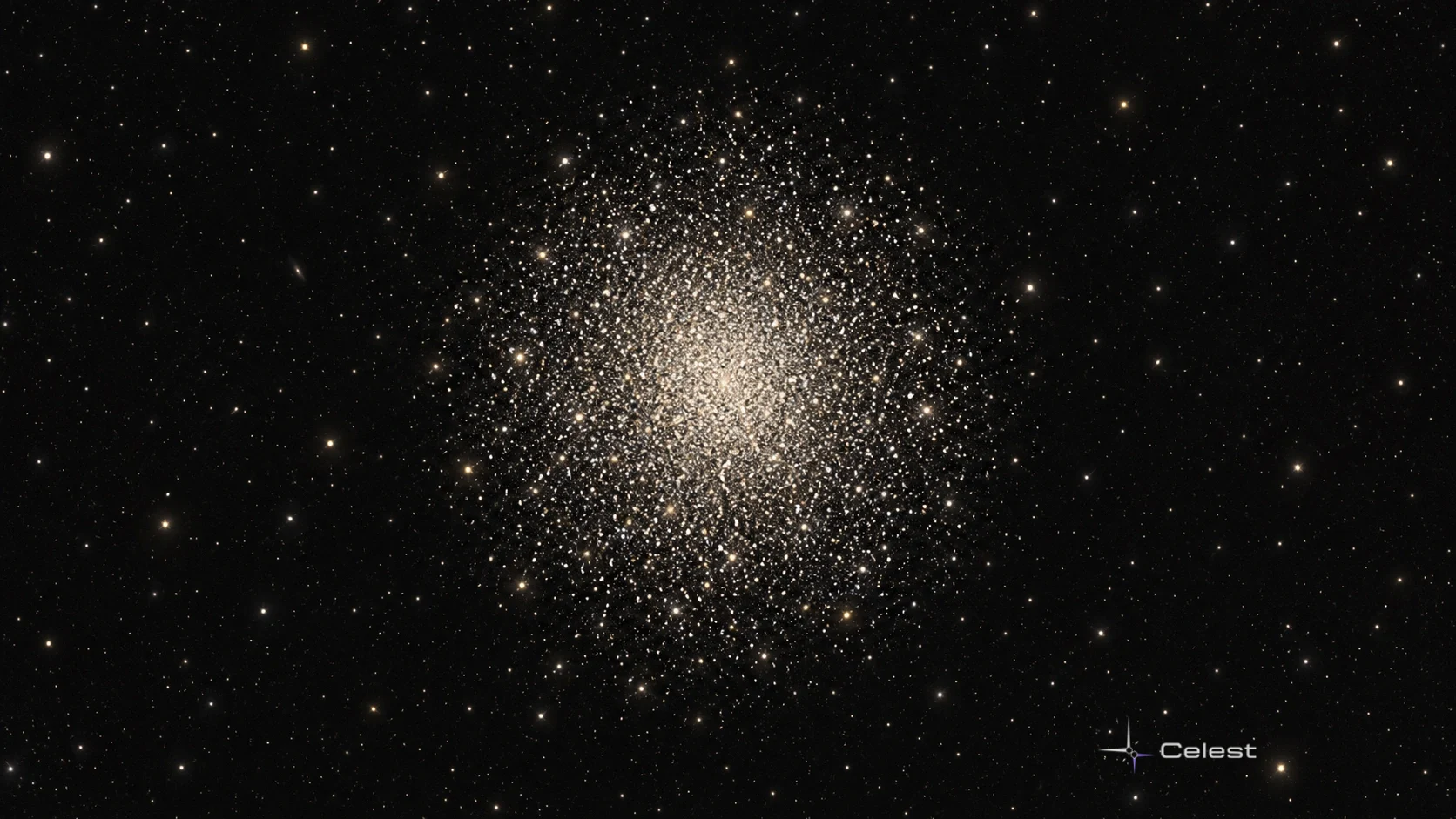
Messier 5 is an ancient globular star cluster in Serpens, about 25,000 light-years away. Through binoculars it appears as a small hazy patch. Its main stellar population is older than 12 billion years, yet some compact stellar remnants there turn so quickly that researchers measure their rotations in milliseconds.
That combination makes M5 interesting beyond its crowded portrait. Optical images reveal the cluster’s stars; radio observations reveal pulses from dense remnants called pulsars. By recording when those pulses arrive, astronomers can investigate rotation, orbits and properties that a still photograph cannot show.
Messier 5 at a Glance
- Other designation: NGC 5904.
- Type: a globular cluster in the Milky Way.
- Constellation: Serpens, in its head region.
- Apparent magnitude: 5.7, describing its combined brightness.
- Approximate distance: 25,000 light-years.
- A useful observing season: northern late spring and early summer.
Start with the constellation guide to recognise the surrounding region. M5 is a collection of stars sharing a gravitationally bound system. The fuzzy impression in binoculars comes from their combined light, while images with much greater resolving power separate many individual points.
An Old Cluster With More Than One Story
Gottfried Kirch discovered M5 in 1702. NASA identifies June as a favourable general observing month. Its apparent magnitude gives a useful brightness reference, but a spread-out patch behaves differently from a single star with the same combined brightness.
The cluster contains stars at different stages of evolution. A star’s current appearance depends on its mass, history and interactions, so the population is more complicated than a set of identical old lights. Hubble images help researchers examine those differences; observations in other kinds of light add information about compact remnants.
The star guide helps place these stages in a star’s wider life.
What Is a Pulsar?
A pulsar is a rotating neutron star whose radiation beams sweep across space. A neutron star is the extremely dense remnant left after the core of a sufficiently massive star collapses. When a beam crosses our direction, instruments detect a pulse.
The lighthouse comparison explains the timing: the beam turns with the object, and we receive a signal when the geometry lines up. A regular pulse therefore carries information about rotation. That is a different physical process from a normal star whose surface expands and contracts, changing its brightness.
Some pulsars rotate in a few milliseconds. Researchers study these signals with suitable radio telescopes and other observatories. The tiny remnant can provide precise timing information even though an ordinary view of the whole cluster shows none of that rapid behaviour.
M5B Turns in Milliseconds
One pulsar in the cluster is called M5B. An analysis revised in 2008 reported a rotation period of 7.95 milliseconds. A millisecond is one thousandth of a second, so this is a very short interval for a complete turn.
The same study described M5B as part of a binary system: two objects orbiting their shared centre of mass. Its reported orbital period was 6.86 days. Rotation and orbit are separate movements, measured on dramatically different timescales in this system.
Pulse timing helps keep track of both. As the pulsar moves around its orbit, the arrival pattern contains information about that motion. Years of measurements can reveal small changes that would be difficult to understand from a short observing session.
How Can an Old Remnant Spin Quickly?
An isolated pulsar loses rotational energy over time and slows down. In a close binary, material flowing from a companion can instead help speed up its rotation. Astronomers call this recycling: the remnant gains material and rotation can become faster.
This mechanism helps explain why some old neutron stars spin more rapidly than younger isolated pulsars. The name describes a physical process, rather than the formation of a completely new star. It is a general explanation for millisecond pulsars; reconstructing any particular object’s history still requires evidence about its own system.
In M5, the old population and the quickly rotating remnants show why age alone does not determine every property we observe.
Decades of Data Improve the Picture
Work released in 2023 analysed 34 years of radio observations from Arecibo and FAST. The study improved timing descriptions for M5’s known pulsars and reported another discovery. Its long observing span helped researchers measure motions and orbital effects more accurately.
For M5B, the updated analysis still indicated that the neutron star is likely unusually massive. That interpretation depends on measurements and their physical model. The work also used Hubble data to identify white-dwarf companions in three other systems, showing how optical and radio observations can complement each other.
Gamma Rays Add Another Test
A 2024 study examined 15 years of Fermi gamma-ray data from M5’s direction. Gamma rays are a highly energetic form of light. The team looked for pulses matching the known radio pulsars, but found no significant individual gamma-ray pulsations in that analysis.
The overall emission was consistent with contributions from millisecond pulsars, while a diffuse component could not be ruled out. Studying the combined signal and identifying an individual source are different tasks. The result adds a useful constraint without settling every origin question.
Begin With the Patch, Then Read Its History
Use the live sky to check M5’s position on your chosen evening. For a first attempt, look for the small patch in binoculars and return to it once you know the surrounding stars. A visual impression and a detailed photograph offer different levels of information.
M5’s deeper story comes from combining those views with timing. The same ancient cluster can preserve evidence in surviving stars, compact remnants and their companions. A signal repeating every few milliseconds becomes useful because astronomers patiently follow it for years, turning a brief repeating signal into a record of stellar evolution.
Leave a comment
Comments appear after moderation.