Monoceros Constellation: New Stars and a Revealing Flash
The Unicorn constellation contains stars still forming in the Rosette cloud and a distant star whose flash made surrounding dust visible in changing photographs.

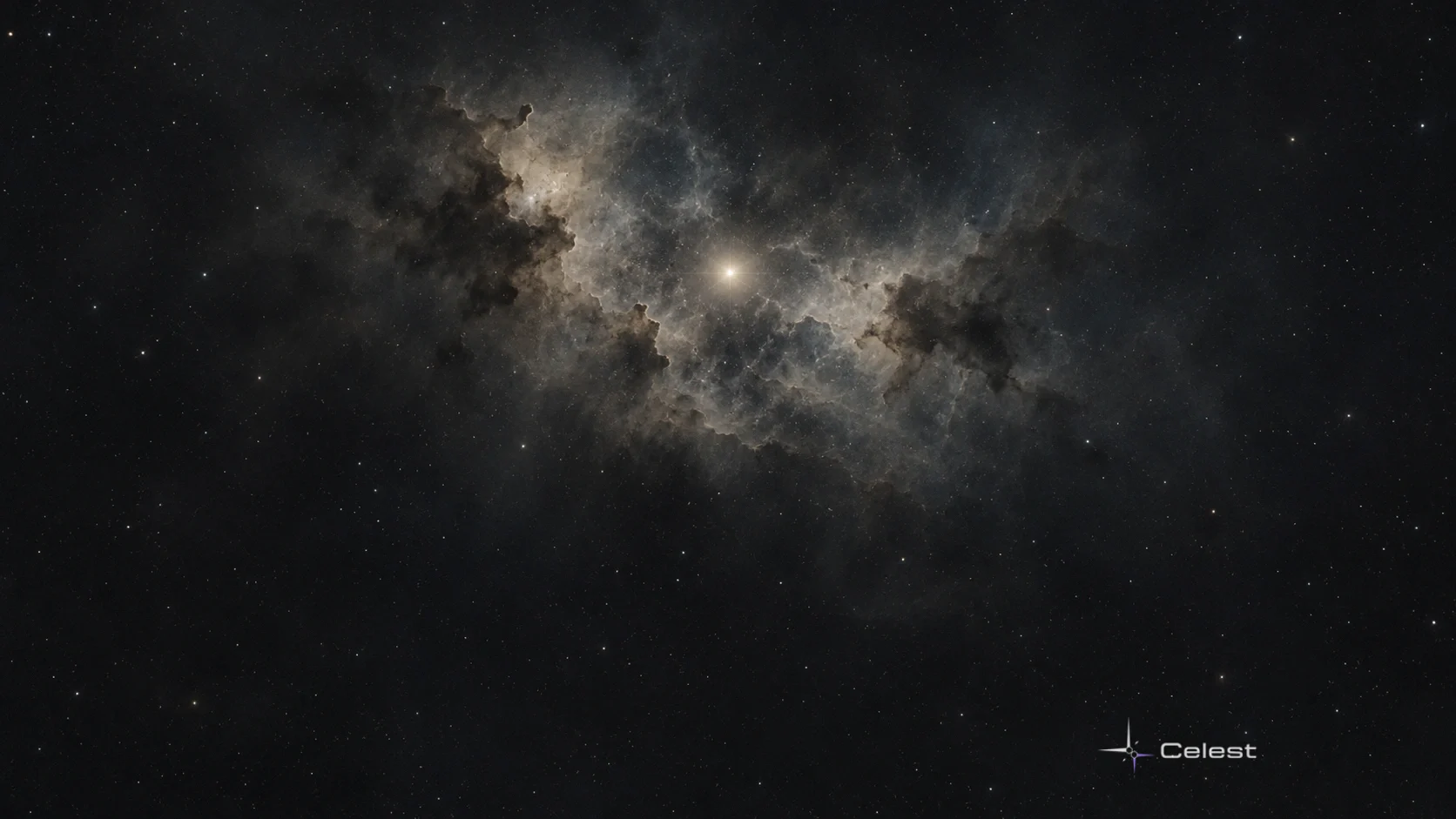
Monoceros is the Unicorn constellation, a sky region near Orion containing young star clusters, the Rosette Nebula and a star whose sudden brightening lit up surrounding dust. The pattern gives those objects a shared address. Their distances and physical stories are very different.
V838 Monocerotis provides its most unusual example. Light from an outburst reached Earth in 2002; photographs then revealed changing dusty structures around the star. The changes show a flash travelling through existing material, allowing astronomers to examine surroundings that had previously been difficult to see.
Monoceros at a Glance
- Official abbreviation: Mon.
- Sky location: Across the celestial equator, near Orion.
- Evening season: Northern winter and southern summer.
- Young cluster: NGC 2244, associated with the Rosette Nebula.
- Other open clusters: M50 and NGC 2506.
- Light-echo star: V838 Mon, approximately 20,000 light-years away.
Finding Monoceros Among Its Neighbours
Start with the surrounding patterns rather than searching for an obvious unicorn outline. The IAU education map shows Orion and Gemini among its neighbours, together with Canis Major, Canis Minor, Lepus, Hydra and Puppis. Comparing those neighbours gives you a manageable patch of sky to explore.
Use the constellation map to identify the region and its boundaries. A constellation is an officially defined area of sky; the familiar connecting lines are a guide to its traditional figure. Its objects need not belong to the same physical system.
Monoceros crosses the celestial equator, the sky’s projection of Earth’s equator. That position makes at least part of the region available from every terrestrial latitude at some time of year. The whole constellation is visible except from the most northerly and southerly polar locations.
Northern winter evenings are a useful starting season. Check the live sky for the region’s position at your chosen time before comparing it with your chart. This makes the observing plan specific to your date and position without attaching one fixed viewing hour to the constellation.
The chart also provides several individual destinations. M50, NGC 2506 and NGC 2244 are open clusters: relatively loose groups of stars formed together. Selecting one cluster is a clearer observing goal than expecting every object marked within Monoceros to appear in a single view.
Young Stars Within the Rosette Cloud
The Rosette Nebula is a star-forming cloud associated with the young cluster NGC 2244, roughly 5,000 light-years away. The cluster and the surrounding nebula are distinct parts of this environment. One is a group of stars; the other includes the gas and dust around them.
In its 2010 account, ESA described Herschel observations that revealed young stars inside dusty cocoons. These developing stars are called protostars. Some of the objects highlighted in that image were growing into massive stars, while smaller features included young stars with masses closer to the Sun’s.
Infrared Reveals Dust’s Own Emission
Herschel collected infrared light emitted by dust, at wavelengths our eyes cannot see. Combining several wavelengths gave researchers a way to examine the cloud’s different conditions. Display colours helped distinguish that information; they describe the observations rather than an unaided-eye view of the nebula.
The older stars also change the cloud. Their radiation erodes and shapes some dusty structures, and the energy they supply can help trigger later star formation. A stellar birthplace is therefore active: newly formed stars begin influencing the material from which further stars may emerge.
For your own session, choose a named cluster and compare what you record with a chart, keeping the surrounding nebula as a separate challenge. Consult observing conditions when choosing the evening. Fine dust structures in space-telescope images provide scientific context, rather than a promise of the same view through your instrument.
A Flash That Illuminated Existing Dust
NASA places V838 Monocerotis about 20,000 light-years away in this constellation. A light-year is the distance light travels in a year. The outburst observed in 2002 therefore tells us when its light arrived here, not when the distant star physically emitted it.
The star brightened for several weeks. Afterwards, Hubble photographs showed changing patterns in the surrounding dust. That phenomenon is a light echo: light from the flash reaches dust, is redirected towards us and arrives by a longer route than light coming straight from the star.
Different parts of the dusty environment light up in succession. A photograph can therefore look as if a cloud is expanding, even though the newly visible structures were already there. What travels outward through them is the pulse of illumination.
Later observations reveal further sections of that environment. The delay and changing appearance are useful information: they connect a particular observing date with the dust then scattering light towards Earth.
The Echo Becomes a Probe of the Cloud
A 2012 study compared Hubble measurements from different dates and filters with model echoes. Its authors used the changing brightness to investigate the dust’s thickness and scattering behaviour. They inferred that much of the diffuse material probably remained from the interstellar cloud where the stars formed.
That interpretation gives the story a consequence beyond striking photographs. An exceptional flash can briefly make its surroundings measurable. Monoceros contains both stars still being assembled and a star whose brightening revealed otherwise obscure dust: light helps expose the environments around stars, as well as the stars themselves.
Leave a comment
Comments appear after moderation.