The Moon: Our Nearest World and Its Changing Light
The Moon keeps a familiar face toward Earth, yet a different angle of sunlight can transform the view. Its dark plains and bright craters tell parts of a much older story.

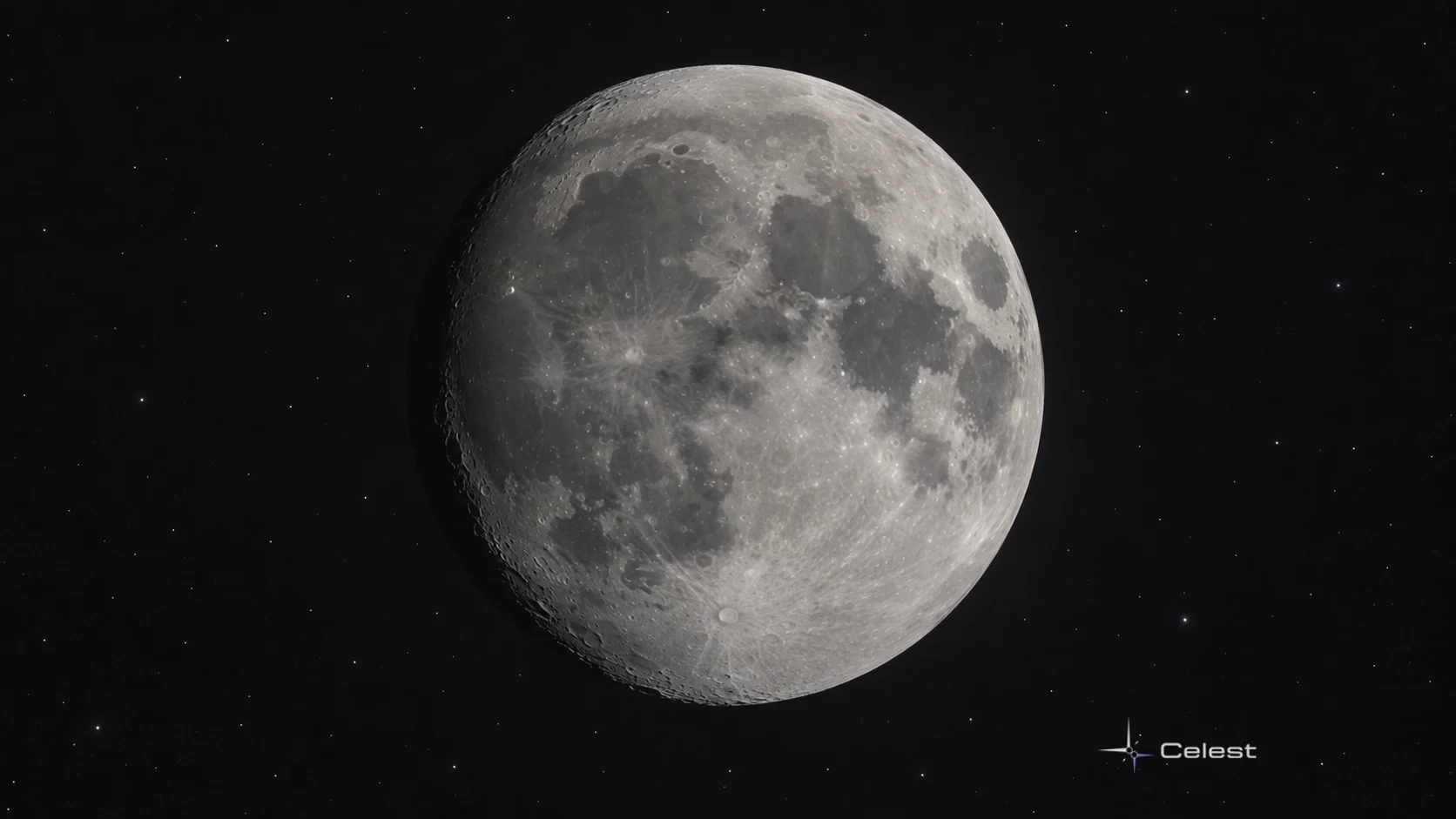
The Moon is Earth’s natural satellite: a rocky world that travels around our planet. It is our nearest celestial neighbour, at an average distance of about 384,400 kilometres. What you see as moonlight is sunlight reflected from its surface, rather than light the Moon produces itself.
Its familiar face makes it an especially good place to begin observing. You can recognise the larger dark patches with your eyes, then use binoculars to explore craters and ridges. Changes in illumination and phase make the same landscape look different from one evening to another.
The Moon at a Glance
- Object: Earth’s rocky natural satellite.
- Radius: roughly 1,740 kilometres.
- Average distance: about 384,400 kilometres from Earth.
- Orbit and rotation: roughly 27.3 days for each.
- Phase cycle: approximately 29.5 days.
- First observing tools: your eyes, followed by binoculars or a small telescope.
Why We See a Familiar Face
The Moon rotates. It completes a turn on its axis in about the same time it takes to orbit Earth, which keeps approximately the same hemisphere facing us. This is synchronous rotation. A body that travelled around Earth without turning would gradually show us different sides.
You can check its current position on the live sky map. That synchronisation does not make every view identical. A small apparent wobble, called libration, sometimes brings extra terrain near the edge into view. Different observations can bring roughly 59 percent of the surface into view altogether. You cannot see that entire amount in one image from Earth.
The far side is the hemisphere that normally faces away from us. It is not a permanently dark hemisphere. Both sides experience sunlight and night as the Moon moves around Earth and the Sun illuminates it from different directions.
Changing Light on the Same World
The ordinary sequence of lunar phases comes from our changing view of the Moon’s sunlit half. At full Moon, most of the hemisphere facing us is illuminated; at a crescent, only a narrow sunlit portion is visible. Earth’s shadow causes a lunar eclipse, not the normal monthly phases.
There are two useful timescales to keep separate. An orbit takes around 27.3 days, but the pattern of phases repeats after about 29.5 days. During the orbit, Earth and Moon also travel around the Sun. A little extra time is needed to return to the same illumination geometry.
The Moon phase guide explains that sequence in more detail. For observing, the practical consequence is that the Moon is not in one fixed direction at one fixed time. Its rising and setting times change through the month, and it can be visible during daylight as well as at night.
Dark Plains, Bright Craters and an Old History
The broad grey patches you can see with unaided eyes are often called lunar seas, or maria. They are not water. They are ancient volcanic plains, where lava filled large basins formed by impacts and later solidified. Brighter highlands provide a different landscape around them.
Craters record impacts, while some bright rays mark material thrown outward from a strike. A binocular view begins to separate those large patterns into terrain. You are looking at a rocky landscape with different histories, rather than markings painted onto a smooth sphere.
A leading explanation for the Moon’s origin involves a large collision with the young Earth and material that later gathered into a satellite. Scientists continue to investigate the details. Apollo samples and spacecraft observations provide evidence about lunar rocks, terrain and composition.
The Moon has an extremely thin exosphere instead of a substantial atmosphere like Earth’s. Water ice has been found in some permanently shadowed polar areas, but it is not a liquid sea in the familiar grey patches. Nor is it something ordinary binoculars reveal as a bright ice field.
How to Observe the Moon
For a first session, choose an evening when the Moon is partly illuminated and comfortably placed above nearby buildings. Check the observing date and the sky map for your location, rather than assuming yesterday’s position still applies. A partial phase gives you a useful boundary between the bright and dark portions.
That boundary is the terminator, the divide between lunar day and night. Sunlight arrives at a low angle there, casting long shadows from crater rims and mountains. The shadows make relief easier to recognise. Full Moon shows the familiar overall face, but often gives a flatter impression of the terrain.
With binoculars, steady your elbows or support the instrument before adding magnification. A wobbling view hides detail that the optics might otherwise show. Begin with one dark plain or large crater, compare it with a lunar map, and return on another evening to see how its illumination changes.
A telescope can reveal finer ridges, valleys and smaller craters. It does not make every lunar object visible: the instrument, atmospheric conditions and lighting still limit the view. Do not expect to identify Apollo hardware from a backyard telescope simply because high-resolution orbiter images show the landing sites.
Familiar Does Not Mean Finished
You do not need a rare event to make another lunar observation worthwhile. The movement of the day-night boundary gives familiar terrain new shadows, and libration can reveal a little more near the edge.
The same nearby world rewards repeated visits.
Choose a feature you can recognise and follow it on two or three evenings. Instead of asking only which phase you saw, notice what that phase did to the landscape. That is the first step from recognising the Moon to reading its surface.
Leave a comment
Comments appear after moderation.