Pegasus Constellation: An Autumn Square, a Surprise Planet
Pegasus is easy to approach through four stars forming a large square. The same sky region leads toward a dense star cluster, a distant galaxy and the Sun-like star whose unexpected planet helped transform astronomy.

The Pegasus constellation, the Winged Horse, is often easiest to recognise through the Great Square, a large pattern of four stars. Its familiar shape leads toward objects very different from those corner stars. Compare Pegasus with neighbouring Andromeda in the constellation guide.
Autumn evenings suit northern observers, while southern observers have their corresponding spring view. Use the live sky map for your latitude and time: the square changes its apparent tilt, and visibility is not identical everywhere.
Pegasus at a Glance
The square is a starting point, while the official constellation covers a larger sky region.
- Traditional figure: the Winged Horse.
- Official abbreviation: Peg.
- Main landmark: the Great Square, an asterism rather than a separate constellation.
- Shared pattern: Alpheratz belongs officially to Andromeda.
- Star cluster: dense M15, about 34,000 light-years away by a rounded NASA reference.
- Planetary milestone: 51 Pegasi b, confirmed around a Sun-like star in 1995.
A Square With One Corner in Andromeda
Markab, Scheat and Algenib belong to Pegasus. The fourth corner, Alpheratz, is officially an Andromeda star. A recognisable pattern can therefore cross a constellation boundary without becoming a new physical system or changing either region’s official identity.
An asterism is a memorable arrangement of stars, such as this square. Constellations, in modern astronomy, are bounded regions covering the sky. A pattern helps your eyes navigate; a boundary tells astronomers which region contains a particular direction. The two serve different purposes.
Start by matching all four corners to the chart, then compare the adjoining Andromeda pattern. Avoid relying on a remembered upright drawing. The apparent shape turns as the sky moves, and recognising the surrounding field is more useful than expecting one fixed orientation.
M15 Is a Real Group Beyond the Pattern
M15 is a globular cluster, a densely packed, broadly rounded stellar group within the Milky Way. Unlike the square’s apparent connection, its stars share a physical cluster. NASA’s catalogue places it 33,600 light-years away; about 34,000 is a useful rounded comparison, not a precision measurement made with binoculars.
Its light becomes strongly concentrated toward the centre. Binoculars can reveal the cluster under suitable conditions, but identifying the object is a different achievement from resolving its crowded core. A detailed photograph combines information your eyes and a small instrument do not collect in the same way.
Inside M15, Pease 1 is a planetary nebula: gas expelled by a dying star. The historical term refers to the appearance of such clouds in telescopes, not to planets. Finding the cluster does not mean you will also identify this small structure in its dense stellar background.
That mixture makes M15 more than a collection of identical points. An ancient stellar group can still contain stars moving through later evolutionary stages. Its crowded light contains individual histories, even when the first observation shows only a faint concentration.
NGC 7331 Lies Far Beyond Our Galaxy
NGC 7331, also called Caldwell 30, is an inclined spiral galaxy about 45 million light-years away. Its broad resemblance to the Milky Way concerns properties such as shape and size; it is not a duplicate of our home galaxy.
Hubble images distinguish dusty lanes, young stellar groups and an older central population. Their coloured detail comes from particular observations and processing. Recognising an extended galaxy in a telescope is different from reproducing the contrasts of a long photographic exposure.
NASA’s guide says sky glow leaves mainly the central core visible, while darker conditions and larger telescopes can reveal more of the arms. Treat those arms as a harder observing goal, not a required feature of a successful first look.
Build the Session From the Square Outward
Recognise the naked-eye pattern first, then select a separate detailed finder chart for M15. Check the observing conditions before deciding whether to attempt the fainter galaxy. Keep the broad orientation map and the magnified field distinct: each answers a different part of the search.
Try recording what you actually notice: a concentrated glow, an extended centre or a few distinguishable stars. Compare that description with the photograph afterwards. A modest observation becomes more useful when it separates direct sight from what later imaging reveals.
An Unexpected Planet Changed the Search
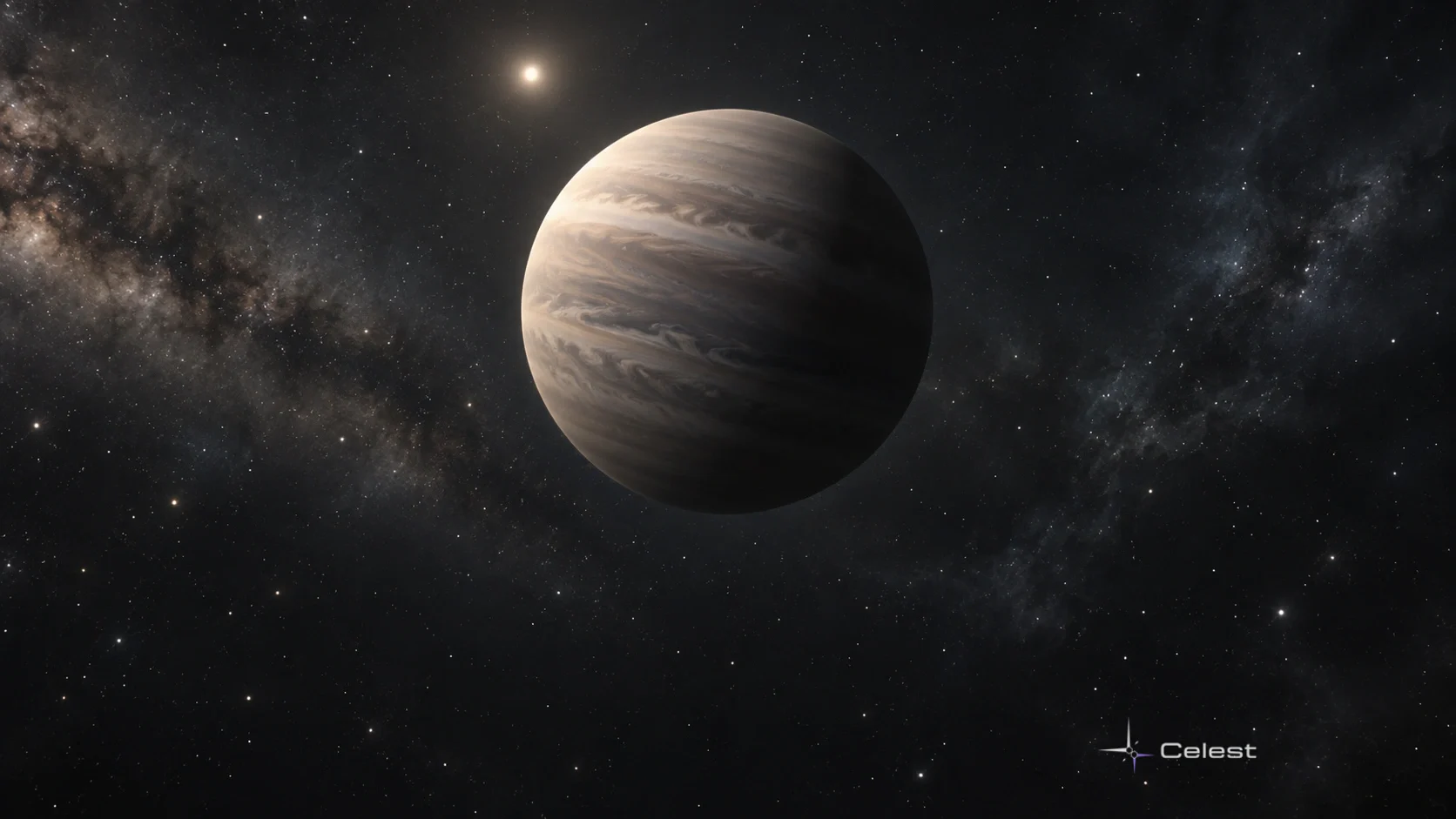
The same constellation includes the Sun-like star 51 Pegasi. Its giant planet, 51 Pegasi b, completes an orbit in about 4.2 Earth days. That is its year. It belongs to the hot Jupiters, giant planets orbiting far closer to their stars than Jupiter orbits the Sun.
Michel Mayor and Didier Queloz announced the discovery in 1995. It was a landmark confirmation around a Sun-like star, while planets around pulsars had already been reported in 1992. Calling it the first exoplanet without that distinction would erase an important part of the history.
The discovery used radial velocity: the planet’s gravity makes its star move slightly toward and away from us. Astronomers track that motion through changes in starlight. Seeing the host as a point in the sky would not let you pick out the planet beside it.
NASA’s historical account describes how the surprising short orbit prompted researchers to re-examine their data and find more hot Jupiters. Pegasus therefore offers more than a useful drawing. One unexpected world helped reveal how assumptions based on our own Solar System could narrow the search elsewhere.
Leave a comment
Comments appear after moderation.