Perseus Constellation: Young Clusters and an Eclipsing Star
Perseus offers several ways to read a star field: a bright landmark with a surrounding cluster, two young groups that may share a birthplace and a star system whose eclipses change the light we receive.

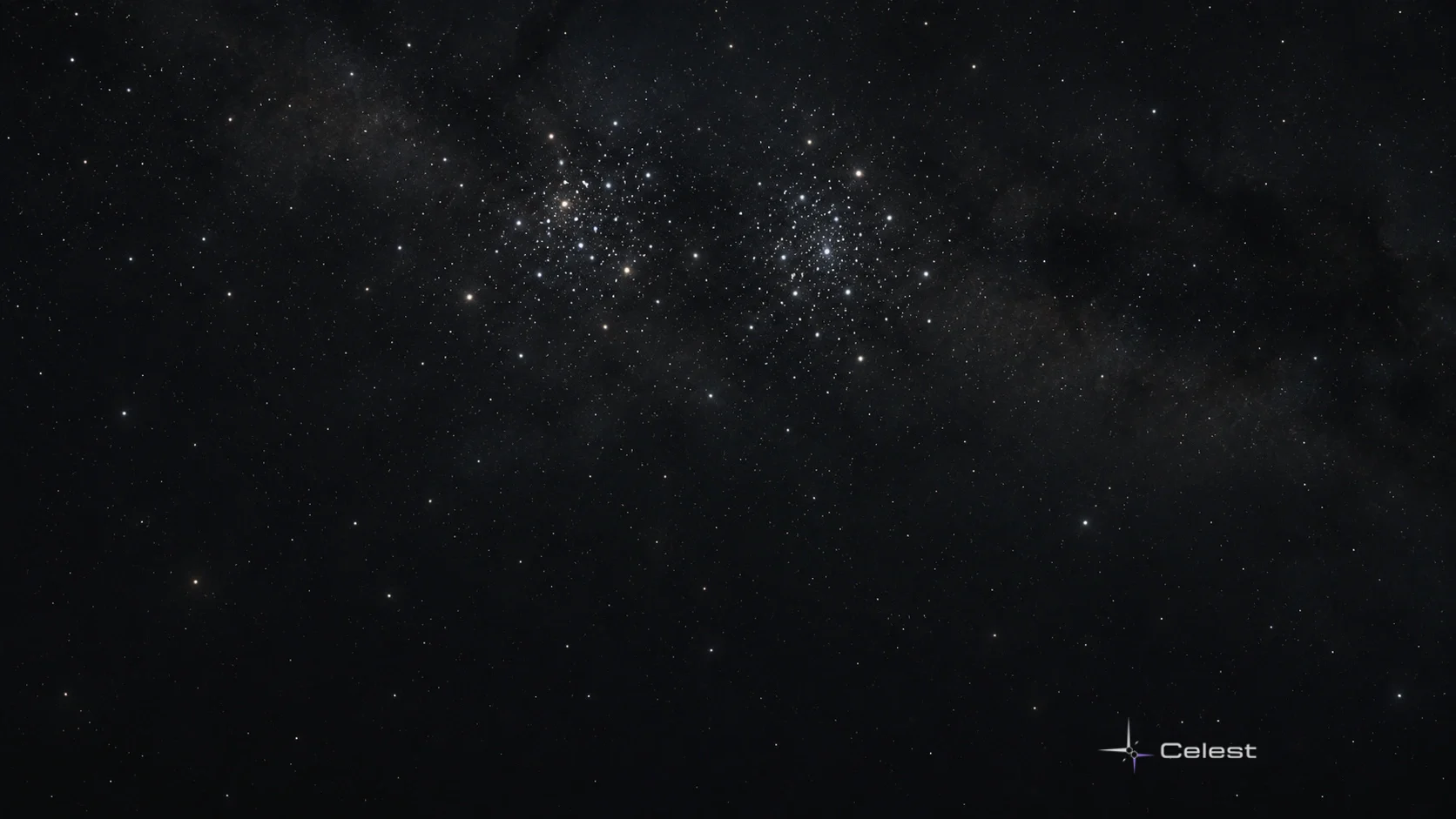
The Perseus constellation contains the Double Cluster, two groups of young stars that binoculars can distinguish, and Algol, a star system whose eclipses alter its brightness. Begin with bright Mirfak and compare Perseus with neighbouring Cassiopeia in the constellation guide.
Winter evenings are a useful northern season, while southern observers have a corresponding summer view where latitude allows. Set the live sky map to your time and location. Perseus is a region of sky, so its stars and clusters do not all share one distance.
Perseus at a Glance
Different observations reveal different relationships inside the same apparent figure.
- Traditional figure: the hero Perseus.
- Official abbreviation: Per.
- Bright landmark: Mirfak, also called Alpha Persei.
- Binocular highlight: NGC 869 and NGC 884, the Double Cluster.
- Changing light: Algol, a triple system containing an eclipsing binary.
- Meteor connection: the Perseids’ apparent radiant, rather than their physical source.
Mirfak Belongs to a Larger Stellar Group
Mirfak is the constellation’s brightest star. Some surrounding stars belong with it to the Alpha Persei open cluster. An open cluster is a relatively loose stellar group, as distinct from the outline connecting stars into a mythological figure.
Use Mirfak as an anchor before trying to follow the complete hero drawing. Compare its surrounding field with the oriented chart. Some points share a physical group, while others simply appear in the same direction; their proximity on the page is not enough to decide membership.
One Hazy Patch Becomes the Double Cluster
NGC 869 and NGC 884, also called h and chi Persei, form the Double Cluster. They lie in Perseus, in the field between its bright landmarks and Cassiopeia. NASA’s Caldwell catalogue places the pair about 7,500 light-years away: light needs roughly that many years to cover the distance.
Under dark conditions, unaided eyes may register the pair as one hazy patch. Binoculars or a small telescope distinguish two concentrations. Keeping both within a broad view helps reveal the pair’s character instead of beginning with a tightly magnified field that loses its surroundings.
These cluster fields hold hundreds of stars that are hot and young. That description does not mean every physical member will appear in your instrument. Faint stars, background objects and a photograph’s exposure all affect the apparent field; an illustration is a guide to the idea rather than a membership map.
One Hubble image of NGC 884 uses a single visible-light filter and is displayed in blue. It records a selected part of one cluster, not both complete groups. The assigned colour should not become an expectation that every stellar point will look blue in binoculars.
Algol Changes Because Stars Eclipse
Algol contains three stars, including a close pair whose orbit produces eclipses. One member obscures some light from the other along our line of sight. The changing brightness belongs to the system’s combined received light, not a single star switching off and restarting.
NASA’s observing account gives the main repetition as two days, twenty hours and forty-nine minutes, about 2.9 days. The pronounced dimming lasts roughly ten hours. Those are reference intervals, not a prediction that an eclipse will begin at a particular hour tonight.
Use a current eclipse prediction and a vetted comparison chart if you want to follow it. Record brightness estimates and times, comparing the same field rather than relying on memory. Rapid atmospheric twinkling is a different effect from a gradual eclipse tracked across hours.
The Perseids Borrow the Constellation’s Name
The Perseid meteors appear to radiate from the direction of Perseus. A radiant is that apparent meeting point of meteor paths. It gives the shower its name, while the particles themselves originate from comet 109P/Swift-Tuttle.
Earth encounters that debris, and the material produces luminous streaks while interacting with our atmosphere. The constellation’s distant stars do not launch the meteors. Mid-August is the general peak season, but planning a specific year requires a separate shower forecast and observing conditions.
Give the Wide Field Time Before Magnifying
Begin by matching Cassiopeia and Perseus on the chart, then identify Mirfak. Check the observing conditions before the Double Cluster search. Choose a broad field that preserves both groups, and compare the direct view with photographs only after noting what you actually see.
If you also want to observe Algol, treat it as a separate timing task. Finding its field and watching an eclipse are different goals. A useful first session can establish the landmarks and cluster pair even when the variable star is not near an eclipse.
A Pair Can Preserve Clues to a Shared Birth
The Double Cluster’s physical proximity matters as much as its appearance. NASA’s 2025 description places the groups a few hundred light-years apart and estimates each at about thirteen million years old. Their similar ages and neighbourhood support a likely origin within the same star-forming region.
These ages are inferred from stellar properties and models, rather than read from a clock. Research descriptions give somewhat different values, so the common-history interpretation is more useful here than an exact birthday for every star.
The binocular pair can therefore lead to a deeper question about the Milky Way: how did one region produce related stellar groups? Distance and age evidence turn two pleasing patches into a possible shared chapter of star formation. The connection comes from measurement, with the original cloud’s full history still open.
Leave a comment
Comments appear after moderation.