Pisces Constellation: A Planetary Clue From 1917
Pisces links familiar sky geometry with an archival puzzle. A faint stellar remnant’s recorded light became evidence to reconsider long after the glass plate was made.

Pisces, the Fish, crosses two important lines on a sky map: the celestial equator and the ecliptic, the Sun’s apparent yearly path. Its evening stars make an autumn subject in the north, while objects within the same constellation take you to very different distances.
Use the constellation guide to place Pisces beside Pegasus, Andromeda and its other neighbours. A distant spiral galaxy offers one observing challenge. A much nearer white dwarf contributes a different story: old starlight that acquired a new meaning almost a century after it was recorded.
Pisces at a Glance
- Traditional figure: the Fish.
- Evening season: northern autumn or southern spring.
- Sky geometry: crosses the celestial equator.
- Sun’s path: includes the March equinox point.
- Galaxy: M74, about 32 million light-years away.
- Historical record: a 1917 spectrum of van Maanen’s Star.
Why Is Pisces Part of the Sun’s Path?
The ecliptic passes through its mapped region. The IAU educational map places the Sun in Pisces from roughly mid-March to mid-April, including the March equinox, where that path crosses the celestial equator.
That is a statement about the Sun’s position among the constellations.
For evening stargazing, the useful seasonal reference is northern autumn or southern spring. Check the live sky map for your location and time, then trace the portion of Pisces available in your sky. At extreme polar latitudes, not every part is visible.
What Can You Use to Recognise the Region?
Its neighbours provide a starting framework: Andromeda, Pegasus, Aquarius, Cetus, Aries and Triangulum.
Begin with a nearby pattern you already know, then follow the chart towards Pisces.
Larger dots on a chart usually represent stars that look brighter from Earth. The joining lines help you recognise the figure, while the boundaries assign objects to a sky region. Those conventions organise the view without implying that the stars share a physical structure.
What Makes M74 a Challenge?
Its light is spread over an extended area.
Although professional images show a nearly face-on spiral with organised arms and dust lanes, a small telescope can show only a faint patch.
NASA places M74 roughly 32 million light-years away. That distance belongs to the galaxy, not to every star in the constellation. A shared direction on the sky can contain objects separated by enormous depths.
Try treating recognition of the faint patch as a useful observing result before comparing it with detailed photographs. The photographs collect and display information beyond a brief visual impression.
What Is the Story of the 1917 Plate?
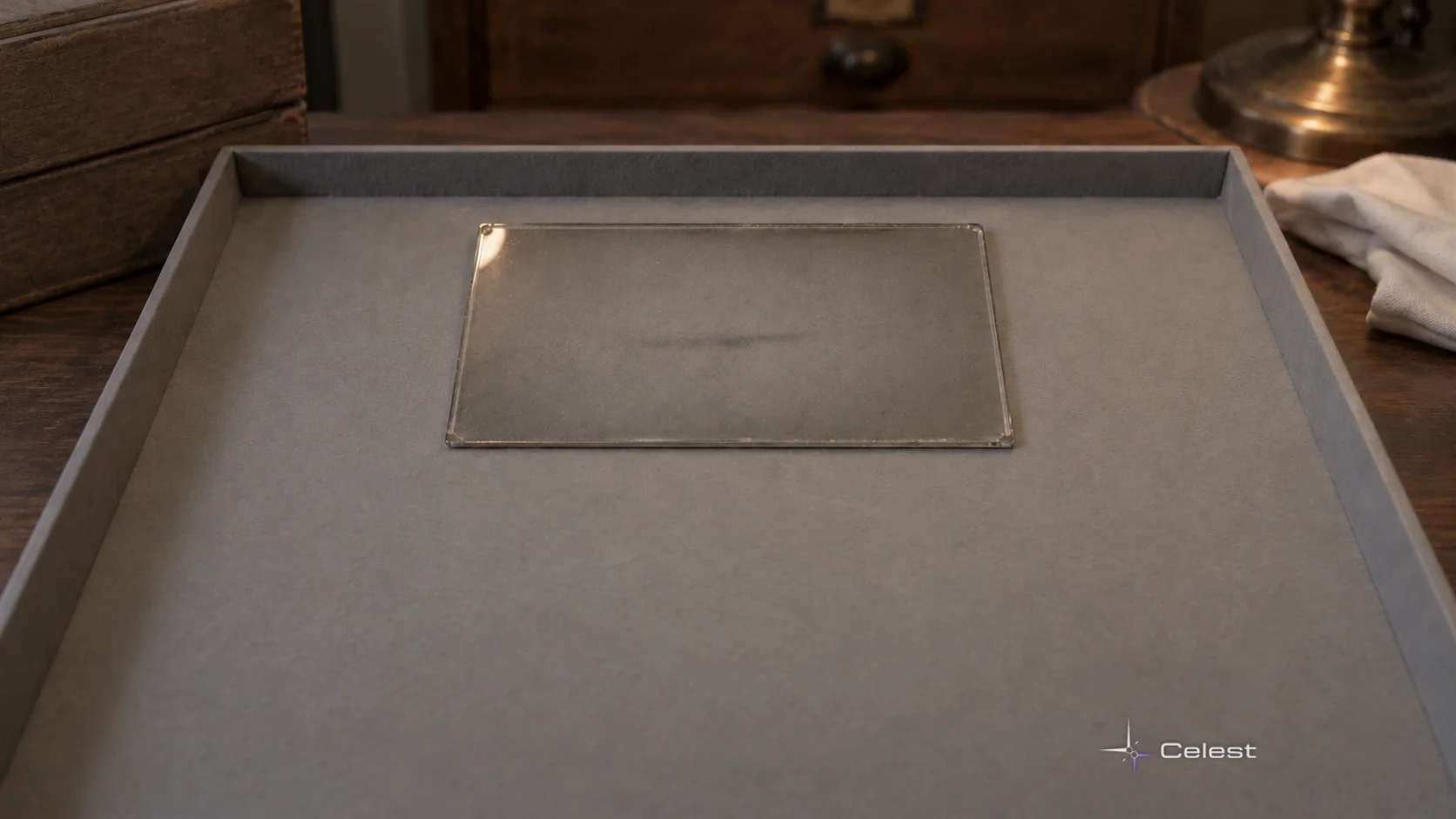
In the NASA account, the plate shows the spectrum of a white dwarf, van Maanen’s Star, about fourteen light-years away. A white dwarf is the compact core left by a star after it has shed its outer layers.
Adriaan van Maanen identified the faint star through its motion in 1917. Walter Adams recorded its light on a glass photographic plate at Mount Wilson. The archived sleeve carries the date 24 October 1917.
The star also appears in an early note about rapidly moving stars in Pisces. Its historical discovery and the later interpretation of the spectrum belong to separate parts of the story.
What Did the Spectrum Preserve?
Chemical clues.
A spectrum separates starlight into wavelength detail; absorption features mark places where particular kinds of material remove some of that light. The Carnegie account identifies calcium, magnesium and iron in the historical record.
Heavy elements in a white dwarf’s visible layers raise a question.
The star’s strong gravity should draw them down into its interior, so their presence calls for an explanation involving replenishment from outside.
Astronomers call this atmospheric pollution: a change in the outer composition caused by supplied material. The terminology identifies the chemical clue, rather than an image of a planet beside the star.
How Can Planetary Debris Supply the Material?
Small rocky bodies can be directed towards a white dwarf and broken into debris, which then reaches the star. Gravitational interactions with planets provide a proposed way to deliver that material.
Observations of dusty disks around some white dwarfs strengthened the wider interpretation. A 2016 review connected debris and atmospheric abundances with the chemistry and long-term evolution of planetary systems.
The class of systems supplies a physical explanation, while an individual star still requires its own evidence.
Was a Planet Discovered on the Plate?
The historical significance concerns indirect chemical evidence, recognised much later. Zuckerman discussed the retrospective interpretation in 2014, and Farihi examined the archival record for a 2016 review.
The plate did not provide a direct image or an orbital measurement of an individual planet. The preserved spectral features became useful when later research supplied a way to understand them.
Review the observing conditions when choosing an evening for Pisces, then select a practical subject from the visible region. You can explore a constellation with a chart while also learning from records that required professional instruments.
The archival lesson reaches beyond this one star. Keeping a measurement can preserve more information than its first observer knows how to interpret. New understanding can turn old starlight into a new scientific question.
Leave a comment
Comments appear after moderation.