Polaris: The North Star That Pulses and Has Companions
The apparently steady northern landmark changes in brightness and size. Its companions and surface features turn a familiar navigation star into a test of how stars evolve.

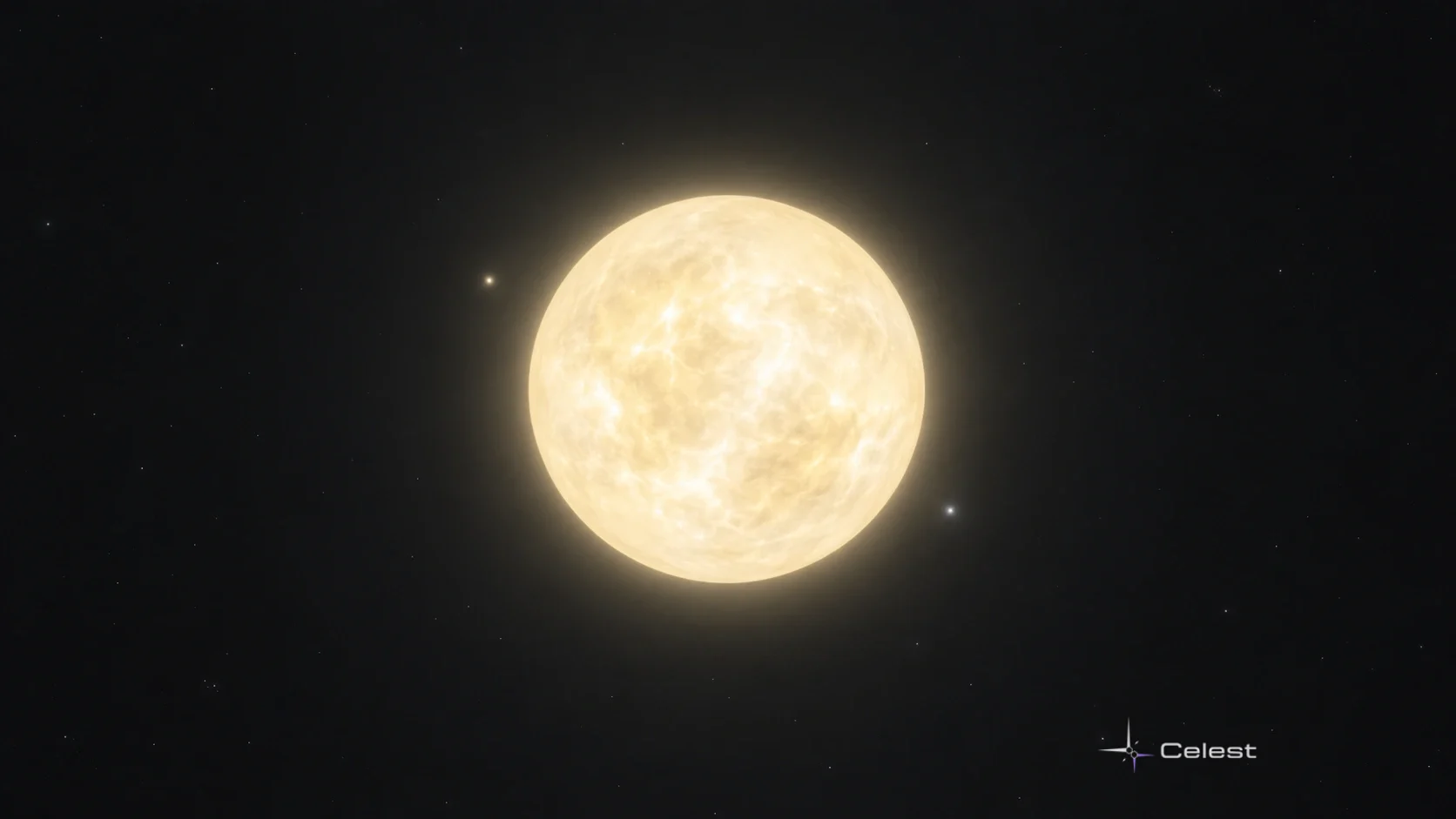
Polaris is the North Star, a yellow supergiant whose apparent position changes very little through the night. Its light is less steady: the star expands and contracts, growing brighter and fainter over roughly four days. Compare this familiar landmark with the other entries in the bright-star guide.
It also belongs to a triple-star system. One companion is close to the brilliant primary; another is much farther out. You can place the visible landmark within Ursa Minor using the constellation guide, then explore the physical star behind its useful direction.
Polaris at a Glance
The same point serves as a northern guide and a laboratory for stellar research.
- Other name: Alpha Ursae Minoris, or α UMi.
- Main star: a yellow supergiant and Cepheid variable.
- Distance: roughly 447 light-years in the IAU glossary.
- System: three stars, named Aa, Ab and B.
- Pulsation: approximately four days per cycle.
- Close companion’s orbit: roughly 30 years.
Steady Direction, Changing Light
Polaris lies near the north celestial pole, the direction in which Earth’s northern rotation axis points. Earth’s rotation makes surrounding stars appear to sweep around that pole. Polaris traces only a small circle because it is close to the centre of this apparent motion.
That geometry explains its usefulness for finding north. It does not require the star itself to emit a constant amount of light. Nor does Polaris have to be the brightest star in the sky to provide a helpful direction.
Its physical variations belong to a different process. As a Cepheid, Polaris has gas layers that expand and contract. Pressure and gravity act through the cycle, changing the star’s diameter and emitted light. The familiar nearly fixed point therefore hides a pulsating surface.
The variations are measured carefully with instruments. A glance at Polaris on consecutive evenings is not a reliable way to judge its cycle or identify the surface features. The star remains a small point for your eyes, while the underlying changes require quantitative observations.
The Companions Reveal More Than Company
The brightest component is Polaris Aa. Ab is a faint nearby main-sequence star, while B is the wider main-sequence companion. A modest telescope can separate the wide companion; the close one is much harder to isolate from the primary’s glare.
Hubble observations announced in 2006 directly revealed that close companion. The difficulty was both separation and contrast: a faint point close to a much brighter one can disappear into its light. Detecting it required the space telescope’s resolving power.
Following a companion’s movement provides something beyond a better picture. The orbit connects distance, motion and gravitational attraction, allowing astronomers to infer stellar masses. For Polaris, a close companion gives researchers a way to measure the pulsating primary rather than relying only on evolutionary predictions.
The 2024 analysis combined CHARA observations from 2016–2021 with other positional measurements and radial velocities. It derived a Cepheid mass of 5.13 solar masses, with 0.28 solar masses of uncertainty. The result also depends on the fitted orbital eccentricity, the orbit’s departure from a circle.
A Surface That Is Not Uniform
CHARA combines light from separated telescopes to examine angular details too small for ordinary observing. Its reconstructed images revealed bright and dark regions on Polaris that changed over time. These are specialised false-colour views, rather than what a backyard telescope shows.
The university’s 2024 report describes a diameter about 46 times the Sun’s. Size and mass are separate comparisons: a large outer envelope does not imply the same numerical increase in the amount of matter inside.
The surface regions might be associated with an approximately 120-day variation and stellar rotation. Researchers have not established that connection. This longer possible clock must also be kept separate from the four-day pulsation and the decades-long companion orbit.
How to Recognise the Northern Landmark
Start with the Big Dipper’s bowl. Its outer two stars point toward Polaris, which marks the tip of the Little Dipper’s handle. Check the live sky map to match the orientation for your evening rather than choosing the brightest point toward north.
From the Northern Hemisphere, Polaris can also give an approximate sense of latitude: its height above the horizon roughly matches your latitude. It is nearly overhead at the North Pole and lower as you travel south. The approximation follows its near-pole position.
A Nearby Star Tests a Much Larger Scale
Cepheids help measure cosmic distances because their pulsation periods relate to their intrinsic luminosities. Once that relationship is calibrated, comparing a Cepheid’s expected luminosity with its apparent brightness gives a distance estimate. Dust and measurement limitations still have to be accounted for.
Polaris offers a nearby test of the physics behind those useful stars. The 2024 mass result places it above the luminosity predicted by some evolutionary tracks for that mass. Explaining the difference helps test how models describe evolving stars, rather than making this familiar star a perfectly understood standard.
Its northern role will also change as Earth’s axis slowly precesses. Polaris is a convenient guide for our era; its pulsation, companions and changing surface give it a scientific importance that reaches beyond pointing north.
Leave a comment
Comments appear after moderation.