Regulus: The Star Distorted by Its Rapid Spin
The bright point beneath Leo's curved head is not a neat stellar sphere. Measurements reveal a swollen equator, unequal surface temperatures and a faint companion connected with its history.

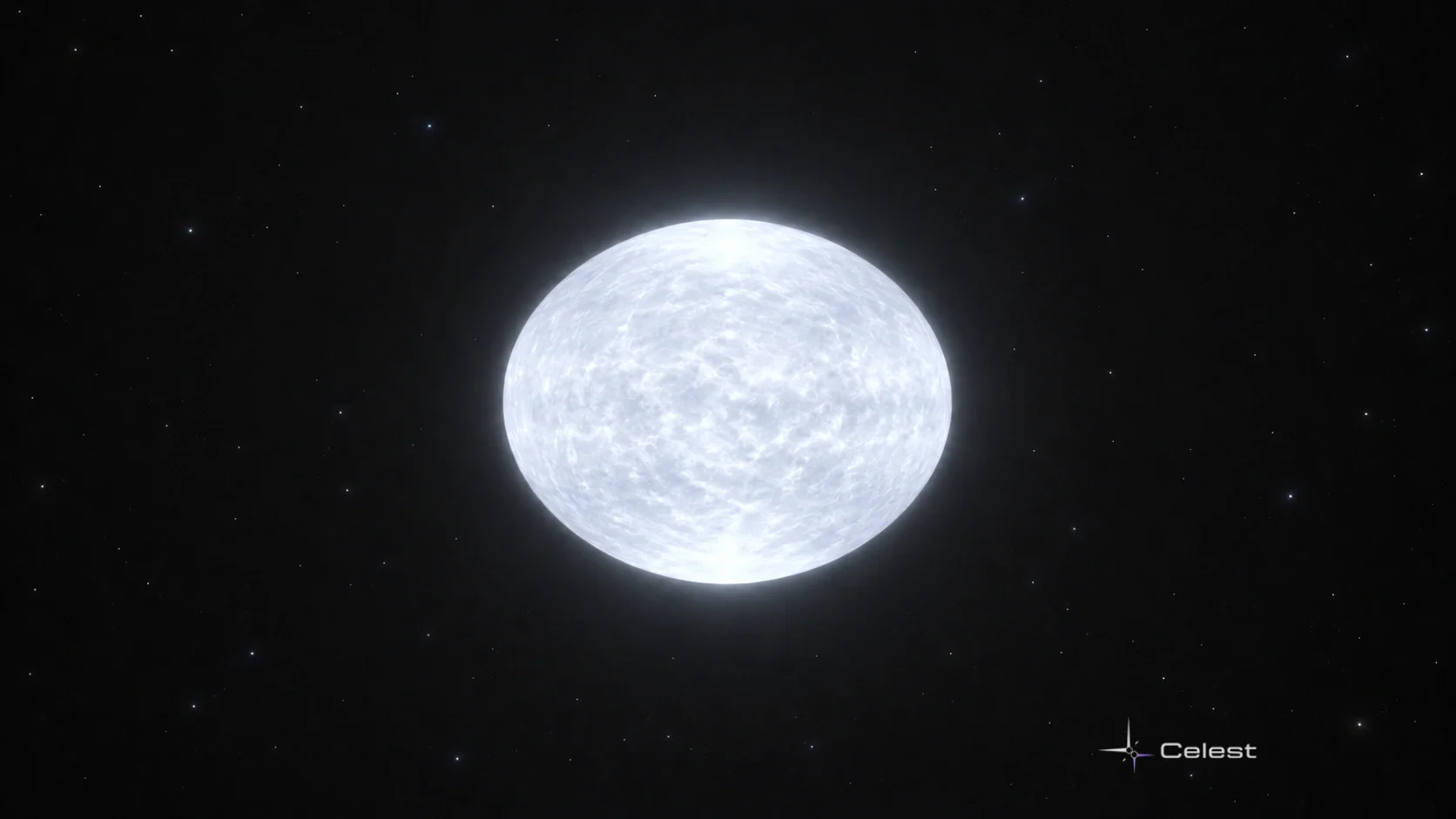
Regulus is Leo's brightest blue-white landmark, but its rapid rotation makes it wider around the equator than from pole to pole. It marks the bottom of the Sickle, the backward-question-mark pattern outlining the Lion's head. Compare it with other landmarks in the bright-star guide.
You can recognise that pattern with your eyes even though measuring the star's distorted shape requires specialised instruments. Use the constellation guide to connect the curved head with Leo's separate triangular hindquarters.
Regulus at a Glance
Its familiar position hides a star with an unusual shape and history.
- Other name: Alpha Leonis, or α Leonis.
- Star type: a blue-white B-type star.
- Distance: approximately 79 light-years.
- Sky position: the dot beneath Leo's backward-question-mark Sickle.
- Rotation: about 16 hours per turn in the 2005 CHARA model.
- Close companion: a faint stripped stellar core in an orbit of approximately 40 days.
Rotation Changes the Star's Shape
A rapidly rotating star does not have to keep a spherical shape. Its equatorial regions bulge outward, giving it an oblate figure: wider across the middle than along the spin axis. Regulus provides a measured example rather than simply a theoretical illustration.
A 2005 analysis combined CHARA interferometry with spectroscopy. Interferometry combines light from separated telescopes to probe much smaller angular details than an ordinary single-telescope view. The model fit gave an equatorial radius 32% larger than the polar radius and a rotation period of 15.9 hours.
Those results describe the star's physical form. They do not mean that a binocular observer sees an oval disc. In a normal sky view, Regulus remains a bright point; the detailed shape comes from specialised measurements and models.
The surface does not behave like one uniform-temperature sphere either. The poles are hotter and the equator cooler, an effect called gravity darkening. Rotation changes the effective pull felt at the surface, which affects the local temperature and the distribution of emitted light.
Close to a Model's Rotation Limit
In 2017, measurements of polarised light gave an independent way to examine the distortion. Polarisation concerns the orientation of light's oscillations. For Regulus, the measured effect changed sign between red and blue wavelengths, matching expectations for a rapidly rotating star.
The study estimated a spin rate of approximately 96.5% of the model's critical angular velocity. The reported uncertainty was 0.8 percentage points downward and 0.6 upward. Critical rotation is the threshold at which matter near the equator would cease to stay bound under those assumptions.
This is a physical comparison, not a countdown to an explosion. A high fraction of the critical rate tells astronomers that rotation strongly affects the star's structure. It does not supply a date when Regulus will break apart.
The associated research announcement described a surface speed of roughly 320 kilometres per second. This speed around the star and the percentage of critical angular velocity are related ways to describe rotation, but they are not interchangeable units.
A Faint Companion Offers an Explanation
Regulus is part of a multiple-star system. Its bright primary has a particularly faint close companion in an orbit lasting about 40 days. Wider companions seen in telescopic photographs are a different part of the system; they are not the close object responsible for this short orbit.
A 2020 study detected weak spectral features consistent with a pre-white-dwarf companion. That term describes a stripped stellar core progressing toward the compact white-dwarf stage. Extracting its light required combining detailed observations and accounting for the much stronger signal of the bright primary.
The researchers interpreted the system as one that had already exchanged material. Gas lost by the companion's earlier, larger form could have increased the primary's mass and spin. The remaining exposed core supplies evidence for that history.
The faint star therefore helps explain a property of the conspicuous one. A seemingly isolated bright point can carry the effects of interaction with a neighbour whose ordinary visible light is difficult to detect.
How to Find the Dot Beneath the Sickle
Northern spring evenings offer a useful season for Leo; southern observers see the constellation particularly well on autumn evenings. Look for the curved backward question mark, then identify the bright point at its base as Regulus.
The three stars forming the Lion's hindquarters lie beyond the head pattern, with Denebola as their brightest landmark. Comparing the two shapes helps you confirm Leo instead of choosing a bright star in isolation. Check the live sky map for the date and orientation of your view.
Regulus also sits close to the ecliptic, the Sun's apparent yearly path among the distant stars. Planets can pass through the same region of the sky. Such nearby-looking points are aligned along your view, rather than neighbours at the same distance.
The Spin Preserves a Different Stellar History
The companion's exposed core changes how the bright star is interpreted. Regulus's present mass and fast rotation need not be the result of a life spent alone. In the mass-transfer explanation, another star helped reshape the one you now recognise in Leo.
That history remains visible in measurable properties even when the two stars merge into one point for your eyes. The shape of a star can be evidence of a relationship, long after the strongest exchange of material has ended.
Leave a comment
Comments appear after moderation.