Rigel: Orion’s Blue Supergiant and Its Reflected Light
A bright point at Orion’s foot is an enormous hot star. Its light also reveals interstellar dust nearby, while small changes measured over time offer clues about the star’s interior and escaping gas.

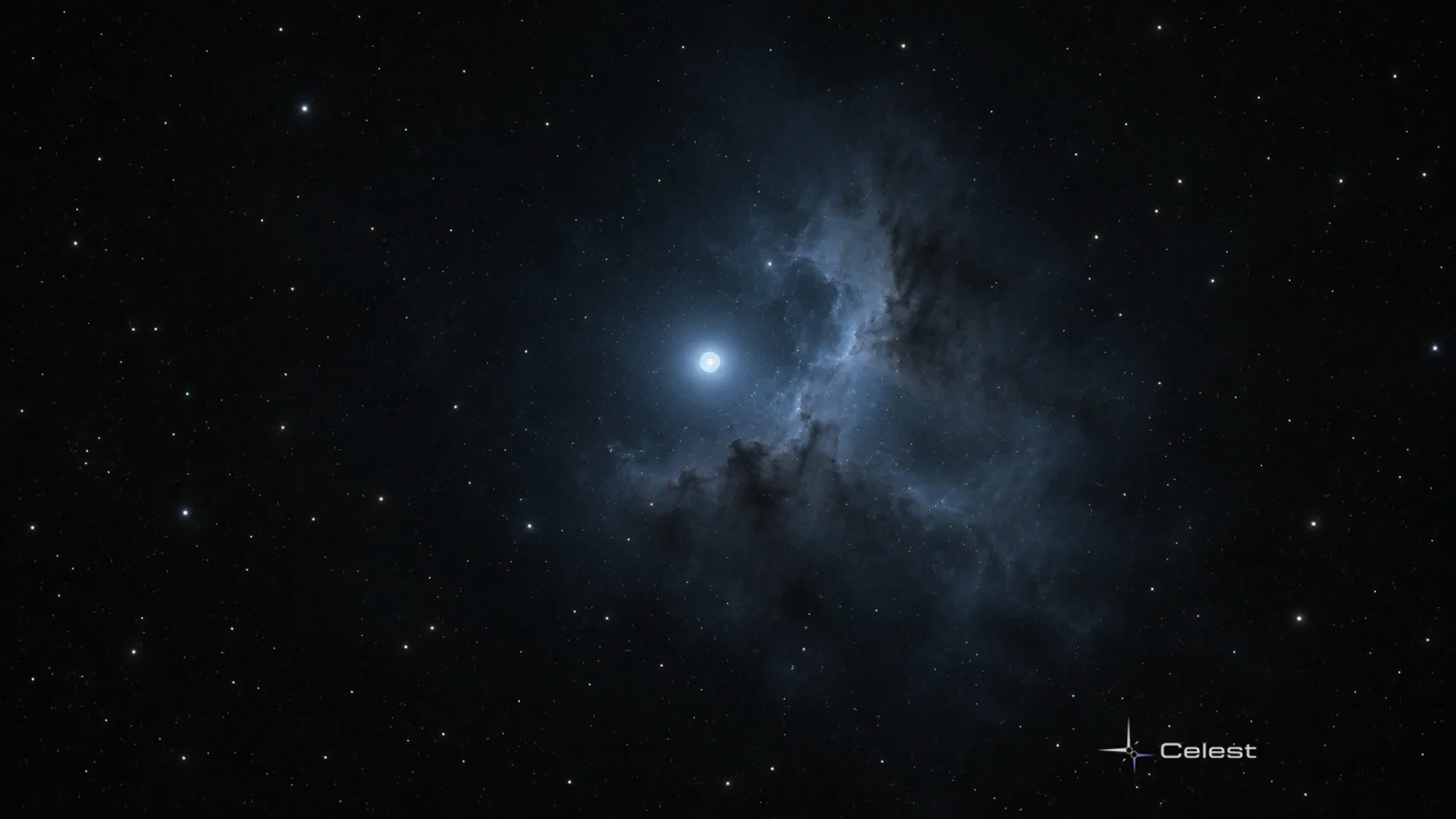
Rigel is a blue-white supergiant marking a foot of Orion, below the constellation’s three belt stars. Its hot surface creates a colour contrast with the orange-red shoulder star Betelgeuse. Compare these familiar landmarks in the bright-star guide.
Rigel’s light also illuminates a faint dusty cloud known as the Witch Head Nebula. Recognising the star and recording that cloud are different observing tasks. Set the live sky map to your observing date before connecting the bright foot with Orion’s surrounding pattern.
Rigel at a Glance
The bright point represents a massive evolved star, rather than an ordinary Sun-like object.
- Other name: Beta Orionis, or β Orionis.
- Star type: a blue-white B-type supergiant.
- Sky landmark: a foot of Orion, south of the belt.
- Distance: approximately 860 light-years in NASA’s general profile.
- Radius in a 2012 study: about 79 solar radii, with roughly 7 solar radii of uncertainty.
- Best evening season: northern winter or southern summer.
A Hotter Colour at Orion’s Foot
Rigel and Betelgeuse frame the belt with markedly different colours. Rigel’s surface is hotter, producing its blue-white appearance, while Betelgeuse looks orange-red. That contrast can be noticed without measuring either star’s physical surface through a telescope.
A 2012 analysis used an effective temperature of 12,100 kelvin, with 150 kelvin of uncertainty. Effective temperature describes a star’s overall surface emission; it does not give the temperature of its core. The same paper combined a measured angular diameter with distance to infer a radius of 78.9 solar radii.
The quoted radius had an uncertainty of 7.4 solar radii. It belongs with the adopted distance and observations, rather than being a perfectly sharp stellar edge measured by a casual observer. Rigel appears point-like in a normal view despite its enormous physical extent.
NASA’s profile describes the star as about eight million years old. It is nevertheless a supergiant, with a size and structure quite different from the Sun’s. The short chronological age and advanced stellar stage show why age alone is a poor way to compare stars with very different masses.
One Bright Landmark Includes More Stars
Rigel belongs to a multiple-star system. The main supergiant has a companion called Rigel B, described in the 2012 paper as roughly 9.5 arcseconds away. An arcsecond is 1/3600 of a degree, so this is a small angle on the sky.
Rigel B itself is a spectroscopic pair: observations of its light reveal two stars even when an image does not necessarily resolve both. That is different from recognising the system’s main landmark or seeing a wider companion beside it.
The names therefore matter when reading a photograph or a physical measurement. A temperature or radius for the bright supergiant does not automatically describe every component of the larger system.
Why the Dust Beside It Appears Blue
The Witch Head Nebula, catalogued as IC 2118, is a reflection nebula. Dust grains redirect light from Rigel toward us. The cloud is visible because nearby starlight reaches and illuminates it, rather than because each part of the cloud is a blue star.
Its colour has two contributors. Rigel provides blue-white light, and the dust scatters blue wavelengths more efficiently than red ones. The resulting blue photographic appearance therefore contains information about both the illuminator and the material doing the scattering.
A 2012 image caption describes the cloud as roughly 50 light-years across. That is the extent of a nebula, not a measurement of Rigel’s diameter. Its nickname comes from a suggestive outline in images; neither the shape nor the rich photographic detail is a promised binocular view.
Small Variations Reveal a Changing Star
Rigel’s brightness and spectral features vary. A 2012 study combined about 28 days of satellite photometry, precise brightness measurements, with more than six years of spectroscopy. It identified 19 significant oscillation modes in the measured motion of the stellar atmosphere.
Their timescales ranged from 1.21 to 74.7 days. Several patterns can coexist, making them different from one clean repeating schedule. Asteroseismology uses such oscillations to test a star’s interior, much as vibrations provide information about the material through which they travel.
Gas leaves the star too, forming a stellar wind. A 2014 analysis compared 2006–2007 with 2009–2010 observations and inferred a roughly 20% change in the mass-loss rate between those periods. The result describes historical, model-based observations, rather than forecasting tonight’s outflow.
How to Recognise the Blue-White Foot
Begin with the three nearly aligned belt stars on a northern winter evening, or a southern summer evening. Find the bright blue-white point south of the belt and compare it with the warm-coloured shoulder on the other side.
Use the constellation guide to confirm the surrounding outline. Orion’s orientation changes with your location and time, so checking the complete pattern is more useful than memorising a fixed left-hand or right-hand corner from a picture.
Its Light Reaches Both Dust and Detectors
Rigel can make distant dust visible through reflection, while the changing light arriving at our instruments reveals its own atmosphere and interior. These are different physical uses of the same luminous source.
The bright point remains easy to recognise even when those details stay invisible to your eyes. A familiar landmark can simultaneously illuminate another structure and supply evidence about how an evolved massive star works.
Leave a comment
Comments appear after moderation.