Ring Nebula (M57): More Than a Glowing Ring in Space
The small ring in Lyra is a view into a three-dimensional cloud. Images, infrared observations and spectra reveal gas through its apparently open centre and structures whose origins are still being investigated.

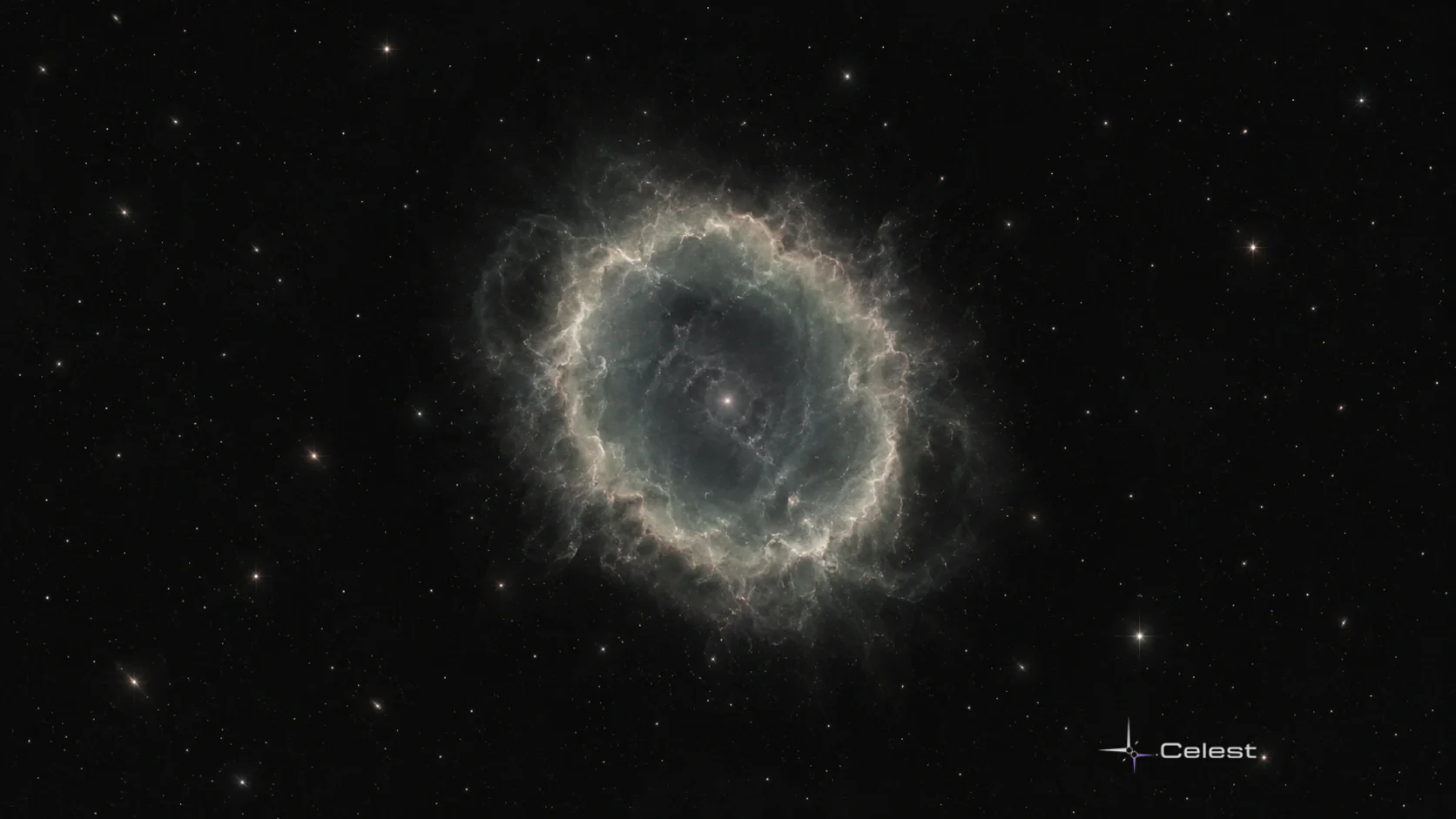
The Ring Nebula, also called Messier 57 or M57, is gas released by an aging star in Lyra. Its familiar oval surrounds a hot stellar remnant, at a distance of roughly 2,500 light-years. Use the constellation guide to place this small cloud within the sky around Vega.
The ring is a useful visual landmark, but the cloud has depth as well as width. Gas occupies its apparently open centre, and faint structures continue beyond the brightest outline. Observations at different wavelengths help researchers reconstruct the star’s history rather than treating its nebula as a simple circle.
M57 at a Glance
- Names: Ring Nebula, Messier 57 and NGC 6720.
- Type: a planetary nebula surrounding a hot stellar remnant.
- Constellation: Lyra.
- Distance: about 2,500 light-years in the Webb overview.
- Apparent magnitude: approximately 8.8.
- Historical observations: recorded in 1779.
Check the live sky for Lyra’s position on your chosen date. M57 lies approximately halfway between Sheliak and Sulafat, the stars at the lower edge of the lyre pattern. A telescope provides the view needed to distinguish the small cloud and investigate its ring-like appearance.
What Should You Look for First?
Begin with the compact hazy object, then examine whether its centre looks dimmer than its rim. Resolving the ring requires more from the telescope and conditions than identifying its location. A research photograph provides context, while the first observing task is recognising the basic outline.
Choose an evening when moonlight is less intrusive. The bright nebular rim, faint surrounding material and tiny central star present different observing challenges. Finding one feature does not imply that the whole structure will be visible with the same equipment.
What Created the Glowing Cloud?
An evolving star expelled material from its outer layers. Its exposed central remnant becomes a white dwarf: a compact, hot object that continues to affect the surrounding gas. Ultraviolet radiation from that remnant supplies energy that makes the cloud emit light.
The term planetary nebula comes from the small disk-like appearance of such objects through early telescopes. M57 instead belongs to the later evolution of a star. Its shape records interactions between released gas, radiation and the changing conditions around the central remnant.
Is the Middle of the Ring Empty?
The centre contains lower-density gas. A 2013 investigation using Hubble and ground-based observations interpreted the bright ring as surrounding an elongated volume of material. That inner structure extends both toward and away from the observer, beyond the two sides of the ring.
Imagine a long rounded shape placed through a thicker ring. Looking almost along its length can produce a bright oval rim with a fainter interior. The model connects a two-dimensional photograph with a three-dimensional distribution, rather than turning every dark-looking patch into an absence of matter.
Images alone supply only part of that interpretation. Researchers also use measurements of emitted light and gas motion. Hubble observations at different times revealed expansion, while the combined information helped constrain how the cloud is arranged.
What Did Webb Add in 2023?
Webb’s infrared observations resolved fine filaments and features outside the main ring. Near-infrared NIRCam and mid-infrared MIRI respond to different signals, so their views complement one another. Dense concentrations rich in molecular hydrogen coexist with much hotter gas in the interior.
The release described approximately ten arcs beyond the main ring. Researchers proposed that interaction with a low-mass companion could help explain their arrangement. That is an interpretation of the patterns, rather than a photograph securely identifying the proposed companion itself.
The infrared images also trace emissions associated with carbon-containing molecules. Their display colours help distinguish selected measurements. Comparing those signals with optical observations builds a more complete account of the material and conditions than either view alone.
What Was Found in the Cloud in 2026?
A January 2026 study reported a narrow strip of ionised iron across the nebula’s central region. The team used WEAVE, an instrument on the William Herschel Telescope, to obtain spectra at many positions across the bright cloud and part of its outer halo.
A spectrum separates light into wavelengths. Specific emission signals help identify which kinds of atoms produced the light and where those signals are strongest. Mapping iron emissions revealed a structure that familiar pictures had not isolated.
The strip is a cloud of ionised atoms. Its shape in the measurements gave rise to the description of an iron bar; that description refers to its distribution. Its position along the depth of the nebula and the process that produced it remain unresolved.
Could the Iron Have Come From a Planet?
The team discussed that as one possibility, alongside an explanation involving how the star expelled its gas. A rocky planet caught in the star’s earlier expansion could, in principle, provide material that later appears as stretched-out plasma. The observations do not establish that this happened.
Further information about accompanying elements and more detailed spectra could help distinguish explanations. An interesting origin hypothesis becomes useful when it suggests observations that can test it. The detection of an iron structure is firmer than any current account of its source.
Why Does a Familiar Ring Still Matter?
M57 shows how a recognisable object can reveal more when researchers change their observing method. Its outline led to investigations of three-dimensional structure; infrared data exposed finer arrangements; spatially resolved spectra separated a previously unrecognised iron signal.
The apparent ring is therefore an entry point into a physical history. When you recognise it, you are looking toward gas that a star released and continues to illuminate. The challenge is to connect its shape, motion and chemistry well enough to explain how that history unfolded.
Leave a comment
Comments appear after moderation.