Taurus Constellation: The Bull With Two Nearby Star Clusters
Aldebaran looks like a member of the Bull’s V-shaped face, but it is a foreground star. Two familiar clusters and their surrounding dust show why the sky’s apparent groupings need a closer look.

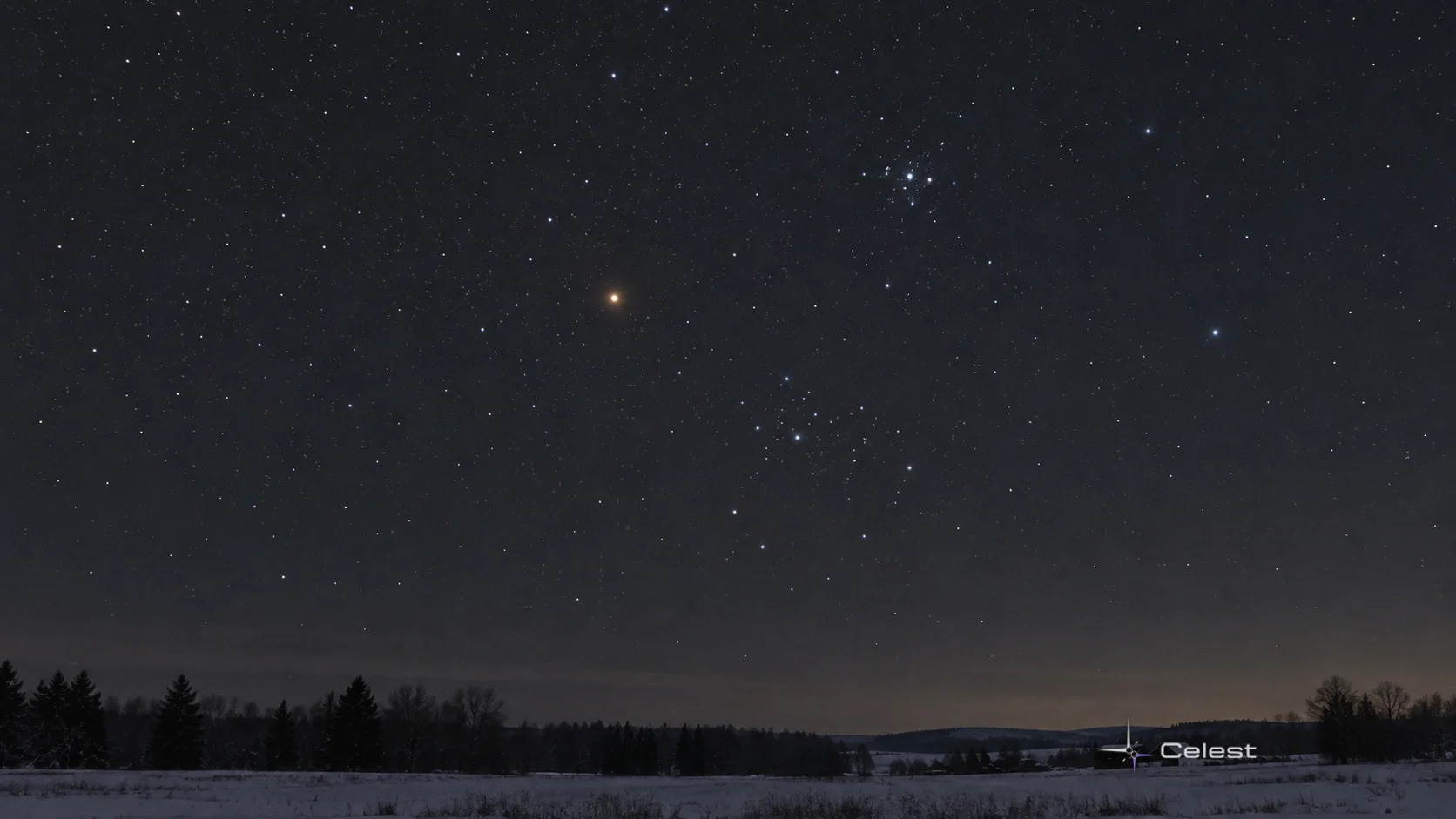
The Taurus constellation, the Bull, contains two familiar star clusters: the broad Hyades and the compact Pleiades. Orange Aldebaran marks the Bull’s face but is not actually part of the Hyades. Compare Taurus with neighbouring Orion in the constellation guide.
The contrast is visible before you learn any distances: one group is spread into a V, while the other forms a small, concentrated patch of stars. Set the live sky map to your time and location to locate both, rather than assuming the Bull always holds the same orientation.
Taurus at a Glance
The official region and the physical clusters are different kinds of grouping.
- Traditional figure: the Bull.
- Official abbreviation: Tau.
- Bright landmark: Aldebaran, an orange giant in front of the Hyades.
- Broad cluster: the Hyades, outlining the Bull’s V-shaped face.
- Compact cluster: the Pleiades, also called M45 or the Seven Sisters.
- Northern observing season: late autumn and winter, with local placement checked for the date.
Aldebaran Looks Like a Member but Is Closer
Aldebaran appears beside the Hyades stars in the V-shaped head. That apparent place does not make it a cluster member. It lies in the foreground, along the same direction from Earth, while the real Hyades grouping is farther away.
A useful rounded comparison puts Aldebaran about 65 light-years away and the Hyades around 150 light-years away. A light-year is the distance light travels in a year. The difference gives the drawing depth that a flat constellation chart cannot show by itself.
The Hyades are the closest open star cluster to the Sun. Its stars are hundreds of millions of years old and more spread out than the Pleiades. Unlike the larger Taurus drawing, a cluster identifies stars sharing a physical history, not merely nearby positions on a map.
Keep Aldebaran as a finder landmark. Its membership is unnecessary for navigation: you can use the bright point to locate the V while understanding that its apparent place is a perspective effect.
The Seven Sisters Have More Than Seven Stars
The Pleiades is an open cluster, a relatively loose stellar group held together by gravity. Its handful of brightest stars accounts for the familiar pattern. Binoculars show more members, so the name Seven Sisters should not be read as a census of the whole cluster.
Compare its tight appearance with the wider Hyades. The Pleiades is younger, though older than the newly forming stars inside the Orion Nebula. These nearby directions let astronomers compare stellar populations at different stages rather than treating all winter stars as one age group.
Blue wisps in photographs of the Pleiades introduce another distinction. They are a reflection nebula: light from the stars scatters from dust. The cloud is passing through the cluster independently, rather than simply being the material left from its birth.
The blue photographic dust is not a detail to demand from a first binocular view. Begin with the stars themselves. In a Hubble close-up, some apparent stellar rays are produced by the telescope’s optics, while the illuminated dust is a real separate structure.
A Recorded Explosion Left a Faint Cloud
Taurus also contains M1, the Crab Nebula, a supernova remnant. Chinese astronomers recorded its explosion as a guest star in 1054. The bright temporary event and the cloud visible today are different stages of the same physical history.
A neutron star, the exceptionally dense remaining core of the exploded star, sits within the nebula. It rotates and produces repeating radiation pulses, making it a pulsar. That central engine is a scientific feature, not a point to promise in a small beginner telescope.
M1 lies about 6,500 light-years away and has apparent magnitude 8.4. Magnitude describes observed brightness: larger numbers mean fainter objects. Finding the subdued cloud requires a different observing task from recognising bright Aldebaran or the Pleiades; Hubble’s processed filaments show much more than an ordinary visual view.
How to Compare the Clusters Yourself
For northern winter evenings, begin with Orion and its line of three Belt stars. Check the adjoining Taurus region on the map, then identify Aldebaran beside the V and the smaller Pleiades grouping. The current chart supplies the direction and angle for your actual observing time.
First trace the shapes with unaided eyes. Then use binoculars to compare how the stars are distributed. A wide view is especially useful for keeping the Hyades shape recognisable, while the Pleiades gives you a more compact field to examine.
Check the observing conditions before choosing between that cluster comparison and the fainter Crab Nebula. M1 needs a telescope and a more detailed finder chart. Being able to recognise Taurus does not require finding every faint object inside its boundaries.
Even a Real Cluster Gradually Loses Its Stars
Measurements from Gaia revealed former Hyades members stretching into two tidal tails, one ahead of the cluster and one behind. As members tug on each other, some motions change enough for the Milky Way’s gravitational pull to carry stars away.
The familiar V is therefore only the visible centre of a much larger, dispersing population. Stars can be genuinely born together and still leave the group later. Learning which stars belong to the Hyades reveals not a permanent family portrait, but one stage in the cluster’s gradual spread through the galaxy.
Leave a comment
Comments appear after moderation.